Stock Analysis · Arista Networks (ANET)
Overview
Arista Networks designs and sells high-performance networking equipment and software used in large data centers, cloud computing environments, enterprise campuses, and increasingly in artificial intelligence infrastructure. In simple terms, its products help move very large amounts of digital traffic quickly and reliably between servers, storage systems, users, and applications. The company is best known for Ethernet switches, but its business is broader than hardware alone: it also sells network operating software, cloud-based management tools, routing products, security capabilities, and related support services.
Its customer base has historically been strongest among very large cloud and internet platforms, and that remains the core of the business. Arista has also expanded deeper into enterprise customers, where companies need modern networks for offices, campuses, and branch locations. This matters because it reduces reliance on a single type of buyer and gives the company more ways to grow over time.
Based on company disclosures, Arista’s revenue mix can be summarized this way:
- Product revenue: about 78% to 82% of total revenue in recent years. This mainly includes data center switching, routing platforms, campus networking equipment, and attached software sold with these systems.
- Service revenue: about 18% to 22% of total revenue. This includes post-contract customer support, maintenance, repairs, and subscription-related software support.
- Customer concentration: Microsoft and Meta have each represented more than 10% of revenue in recent periods, showing that a meaningful share of sales still comes from a small number of very large customers.
- Geographic mix: the United States is the largest market by a wide margin, with international revenue providing the remainder through Europe, Asia, and other regions.
What stands out most is not just the top line growth, but the structure of the business. Arista converts a large share of revenue into gross profit and operating income, while continuing to invest heavily in research and development. Over the last several years, revenue, gross profit, operating income, and net income have all expanded strongly, which suggests that scale has been improving rather than weakening the economics of the company.
The long-term pattern shows a company that has been growing fast while keeping tight control over operating costs. Research and development has increased substantially, but profits have still grown faster, which is an important sign in a technology infrastructure business.
Key Figures
| Metric | Value | Sector ⓘ |
|---|---|---|
| Date | Sep 12, 2026 | |
| Context | ||
| Sector | Technology | |
| Industry | Computer Hardware | |
| Market Cap ⓘ | $238.36B | |
| Beta ⓘ | 1.62 | |
Value (Cheapness) | ||
| P/E Ratio ⓘ | 60.96 | 29.51 |
| FCF Yield ⓘ | 2.16% | 4.25% |
| EBIT / EV ⓘ | 2.17% | 2.85% |
| PEG ⓘ | 1.44 | |
Growth (Business expansion) | ||
| Revenue Growth ⓘ | 37.70% | 15.40% |
| RPS Growth (5Y CAGR) ⓘ | 32.24% | 8.56% |
| EPS Growth (5Y CAGR) ⓘ | 14.32% | -11.88% |
| Margin Growth (5Y Trend) ⓘ | 15.61% | 0.46% |
| FCF Growth (5Y CAGR) ⓘ | 45.41% | 9.80% |
Quality (Business durability) | ||
| ROIC (Latest) ⓘ | 30.78% | 9.44% |
| ROIC (5Y Median) ⓘ | 31.40% | 8.30% |
| Net Debt / EBIT (Latest) ⓘ | -0.46 | 0.54 |
| Net Debt / EBIT (5Y Median) ⓘ | -0.61 | 0.44 |
| Operating Margin (Latest) ⓘ | 47.34% | 9.58% |
| Operating Margin (5Y Median) ⓘ | 41.33% | 8.25% |
| Debt to Equity (Latest) ⓘ | N/A | 33.33% |
| Profit Margin (Latest) ⓘ | 38.37% | 7.14% |
| Free Cash Flow (Latest) ⓘ | $5.16B | |
Momentum (Price trend) | ||
| 3Y Return ⓘ | +322.35% | +45.48% |
| 12M Return (excl. last month) ⓘ | +49.03% | +23.48% |
| 6M Return ⓘ | +48.91% | +20.93% |
| Price vs. 200-Day MA ⓘ | +30.11% | +7.43% |
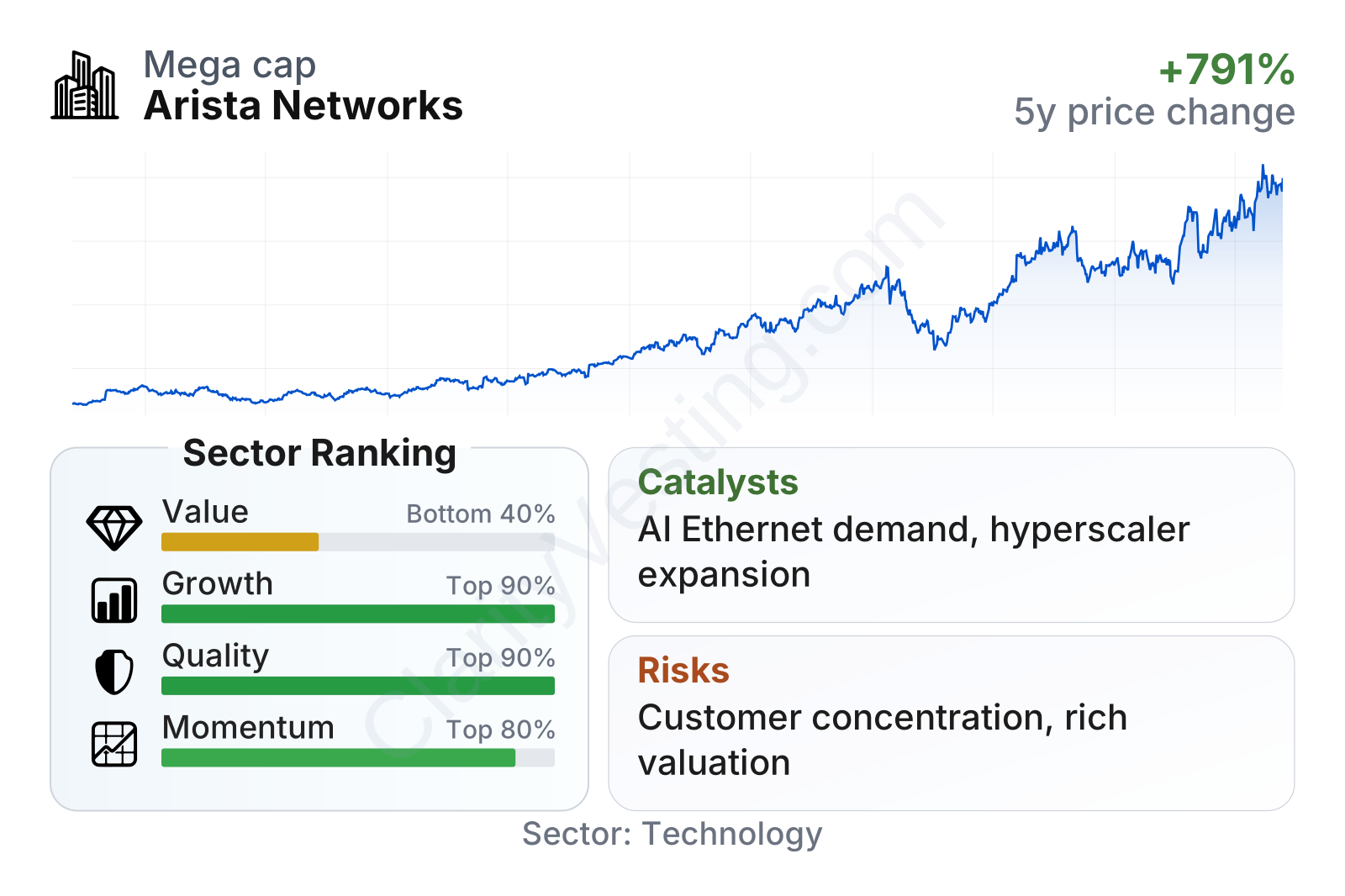
Arista is now a very large technology company, and the stock has delivered a strong multiyear climb with periods of volatility along the way. The overall metric profile is unusual in a good sense: growth ranks near the top of the sector, quality also ranks near the top, and momentum remains strong. The main area that looks less favorable is valuation, where Arista trades well above many sector peers. In other words, the business fundamentals look elite, but the market already recognizes much of that strength.
Growth
Arista operates in a part of the technology market that still has meaningful room to expand. Cloud computing keeps requiring larger and faster data centers, enterprise customers are upgrading older network architectures, and AI workloads are increasing the need for dense, high-bandwidth networking. AI training and inference systems depend on moving huge volumes of data with very low delay, which plays directly into Arista’s expertise in high-performance Ethernet networking.
The company’s strategy appears coherent for this next phase. Arista is not trying to win by being the cheapest networking provider. Instead, it focuses on performance, software integration, automation, and operational simplicity. Its Extensible Operating System, or EOS, is an important piece of that approach because it gives customers a common software layer across different hardware products. That can make networks easier to manage and expand, especially for large customers running thousands of devices.
Growth has remained far above the broader sector median. After the exceptional surge tied to large cloud spending and infrastructure upgrades, revenue expansion slowed from peak levels but then reaccelerated again into 2026, landing in the high-30% range year over year. That suggests demand has stayed strong rather than fading after one unusual cycle.
Cash generation has strengthened alongside revenue. Trailing free cash flow has risen from under $1 billion a few years ago to above $5 billion more recently. That is important because it shows the company is not relying on accounting profits alone; it is turning growth into real cash that can support product development, acquisitions, and resilience during weaker industry periods.
Recent company updates have also reinforced the growth case. Management has highlighted strong demand tied to cloud customers, AI back-end networking, and broader enterprise adoption. The company has continued to introduce faster platforms, including 400G and 800G-class networking products, while building out routing, campus, and security capabilities. These developments matter because they enlarge Arista’s addressable market beyond its original data center niche.
A significant catalyst is the broader industry shift toward AI clusters built on Ethernet-based networking. For years, specialized architectures dominated parts of high-performance computing, but large customers increasingly want open standards, scalability, and lower complexity. Arista is well positioned if Ethernet keeps gaining share in AI environments, especially with hyperscale customers that already know its software and hardware stack.
Risks
This article is for informational purposes only and does not constitute financial advice. Some content is AI-generated. See Disclaimer