Stock Analysis · Alimentation Couchen Tard Inc A (ANCTF)
Overview
Alimentation Couche-Tard is a large convenience-store operator with fuel retailing as a core activity. Through banners such as Circle K, Couche-Tard, and Ingo, the company runs a broad network of stores and forecourts across North America, Europe, and other selected markets. In simple terms, it makes money by selling road fuel, everyday convenience items, tobacco products, beverages, food, and a growing set of services linked to mobility.
Its revenue mix is still led by fuel, while a meaningful share of earnings comes from merchandise and prepared food sold inside the stores. Based on the company’s recent annual disclosures, the main sources of revenue can be summarized as follows:
- Road transportation fuel: about 70% to 75% of revenue. This includes gasoline and diesel sold at company-operated sites. Fuel usually dominates sales dollars because prices per gallon are high, even if margins are relatively thin.
- Merchandise and service revenue: about 20% to 25% of revenue. This covers cigarettes and other tobacco products, beverages, snacks, beer, wine where permitted, grocery items, quick-service food, car wash, lottery, and other in-store services.
- Other revenue: a small residual share. This can include franchise and licensing activities, rents, and other operating income depending on the market.
The important point for long-term analysis is that fuel brings traffic and scale, while the in-store business usually carries better margins. That combination is central to the company’s model. Recent financial flow trends also show a business where revenue has continued to expand over time, gross profit has risen, and operating income has improved, although interest expense has also climbed as debt costs moved higher.
Key Figures
| Metric | Value | Sector ⓘ |
|---|---|---|
| Date | Sep 12, 2026 | |
| Context | ||
| Sector | Consumer Cyclical | |
| Industry | Specialty Retail | |
| Market Cap ⓘ | $53.01B | |
| Beta ⓘ | 0.71 | |
Value (Cheapness) | ||
| P/E Ratio ⓘ | 16.74 | 17.10 |
| FCF Yield ⓘ | 6.94% | 8.53% |
| EBIT / EV ⓘ | 7.38% | 6.46% |
| PEG ⓘ | N/A | |
Growth (Business expansion) | ||
| Revenue Growth ⓘ | -22.10% | 5.75% |
| RPS Growth (5Y CAGR) ⓘ | 17.51% | 9.14% |
| EPS Growth (5Y CAGR) ⓘ | -31.53% | -18.21% |
| Margin Growth (5Y Trend) ⓘ | -1.64% | -0.23% |
| FCF Growth (5Y CAGR) ⓘ | 4.17% | 4.91% |
Quality (Business durability) | ||
| ROIC (Latest) ⓘ | 13.90% | 12.61% |
| ROIC (5Y Median) ⓘ | 14.98% | 10.72% |
| Net Debt / EBIT (Latest) ⓘ | 2.52 | 2.10 |
| Net Debt / EBIT (5Y Median) ⓘ | 2.78 | 2.32 |
| Operating Margin (Latest) ⓘ | 5.98% | 9.25% |
| Operating Margin (5Y Median) ⓘ | 5.99% | 9.64% |
| Debt to Equity (Latest) ⓘ | 92.19% | 75.78% |
| Profit Margin (Latest) ⓘ | 3.94% | 5.33% |
| Free Cash Flow (Latest) ⓘ | $3.68B | |
Momentum (Price trend) | ||
| 3Y Return ⓘ | +12.86% | +14.53% |
| 12M Return (excl. last month) ⓘ | +32.03% | +3.08% |
| 6M Return ⓘ | -2.24% | +0.55% |
| Price vs. 200-Day MA ⓘ | -0.35% | -0.54% |
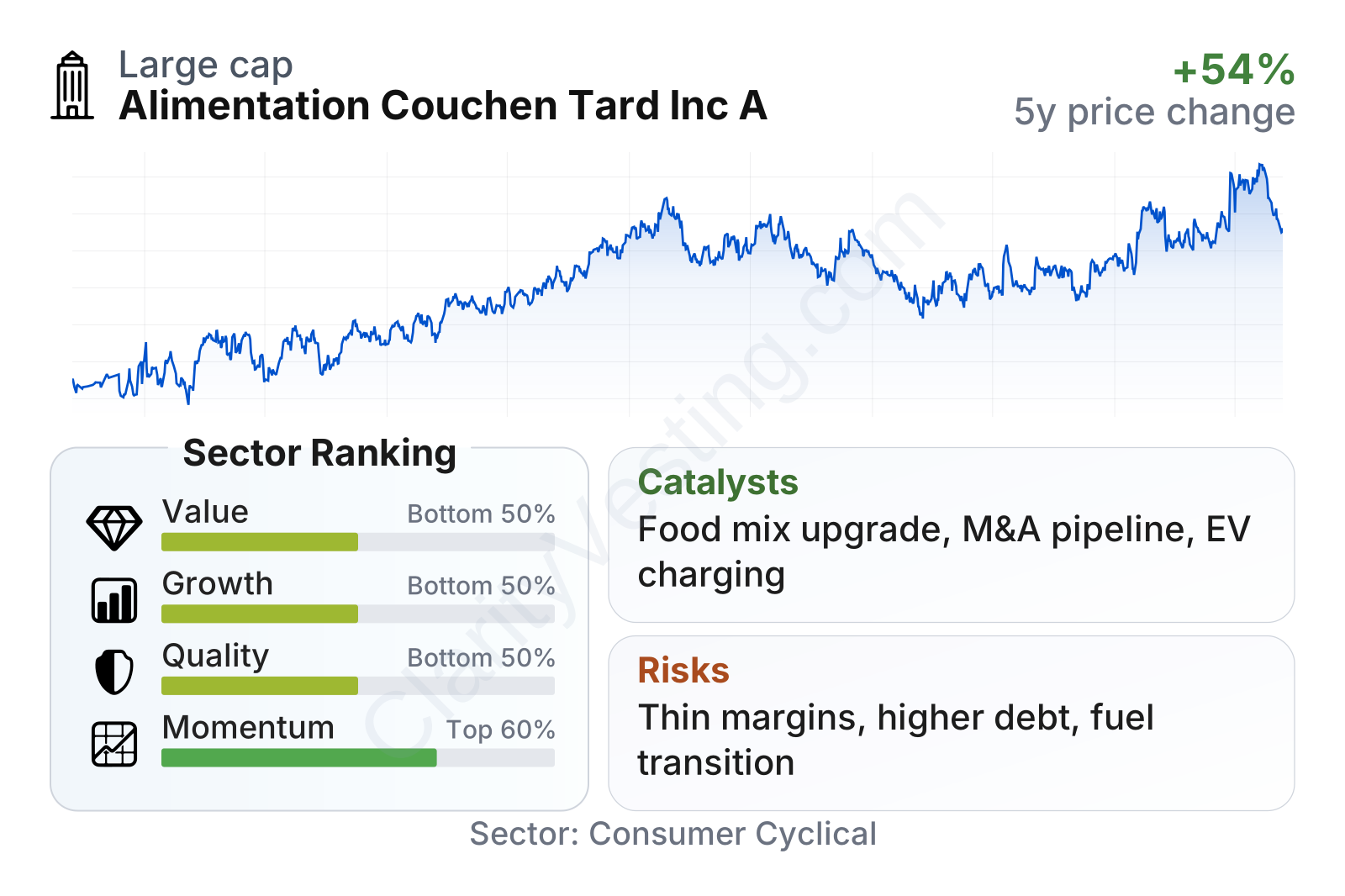
Couche-Tard is a large-cap retail operator with relatively low share-price volatility, reflected by a beta below 1. In the factor breakdown, the picture is mixed but understandable for this kind of business. Valuation sits close to the sector median on earnings, growth looks better than many peers over a multiyear period, and recent price performance has been stronger than much of the sector. Profitability ratios are not standout versus the broader consumer cyclical group, but returns on invested capital remain solid, which is important for an acquisition-driven retailer.
Growth
Convenience retail and fuel distribution is not a fast-moving technology market, but it is a durable sector tied to everyday spending and mobility. People keep buying fuel, drinks, snacks, and basic items in all kinds of economic environments. That makes the industry more about steady execution, store productivity, supply-chain discipline, and network expansion than about sudden disruption.
Couche-Tard’s strategy for future growth remains coherent. The company has historically grown through a combination of acquisitions, cost discipline, and improvements in store operations. It has the scale to negotiate with suppliers, spread technology spending over a large base, and bring acquired stores onto a common operating model. It is also pushing higher-margin categories such as fresh food, private-label products, loyalty, digital offers, and car wash, while building out electric vehicle charging in selected markets.
Revenue growth has been uneven on a year-over-year basis because fuel prices can strongly affect reported sales. That makes headline revenue less informative than it first appears. A temporary decline in sales does not necessarily mean weaker store economics if fuel prices fall. Over a longer horizon, revenue per share has grown at a strong pace, and earnings per share have also increased over five years, which suggests that expansion and execution have been productive overall.
Cash generation is another encouraging feature. Free cash flow has moved upward over the past several years and recently stepped up into a meaningfully higher range. That matters because a retailer like Couche-Tard needs real cash, not just accounting profit, to fund store upgrades, acquisitions, debt service, and shareholder returns. Stronger free cash flow also gives management more flexibility if deal opportunities appear.
A notable catalyst for the next phase is the company’s ability to keep lifting the contribution from food, convenience services, and digital engagement rather than relying only on fuel volumes. Another potential opportunity comes from continued network optimization and selective acquisitions, a playbook that has worked for the company for many years. In mobility, EV charging is still small today, but it can help keep sites relevant as vehicle fleets evolve over time.
Risks
This article is for informational purposes only and does not constitute financial advice. Some content is AI-generated. See Disclaimer