Stock Analysis · AutoNation Inc (AN)
Overview
AutoNation Inc. is one of the largest automotive retailers in the United States. The company sells new and used vehicles through a large dealership network, arranges financing and insurance products for customers, provides vehicle maintenance and repair services, and sells parts. It also operates collision centers, auctions, and a growing set of digital tools that support vehicle buying, service scheduling, and customer retention.
Its revenue is still mainly tied to vehicle retailing, but profit is more diversified than that headline suggests because service, parts, and finance-related activities often carry stronger margins than car sales alone. Based on recent annual reporting, the business mix can be approximated as follows:
- New vehicle sales: about 58% to 62% of revenue. This is the largest activity and includes sales of new cars, trucks, SUVs, and related manufacturer programs.
- Used vehicle sales: about 24% to 28% of revenue. This includes retail used vehicles and, depending on reporting line items, some wholesale activity linked to inventory management.
- Parts and service: about 10% to 12% of revenue. This covers maintenance, repair work, warranty work, and replacement parts. It is typically a more stable source of gross profit than vehicle sales.
- Finance and insurance: about 3% to 5% of revenue. This includes arranging loans, leases, vehicle protection products, and other aftermarket products sold at the dealership.
That structure makes AutoNation a broad auto retail platform rather than just a car seller. Revenue is large, but a very high share is absorbed by vehicle acquisition costs, which is normal for dealerships. The more important point for long-term analysis is how much profit the company can keep after inventory, operating expenses, and interest costs.
The business has kept annual revenue in the high-$20 billion range in recent years, but the flow from sales to net income has become tighter. Gross profit has softened from the unusually strong post-pandemic period, while interest expense has risen sharply, which helps explain why earnings have fallen faster than revenue.
Key Figures
| Metric | Value | Sector ⓘ |
|---|---|---|
| Date | Sep 12, 2026 | |
| Context | ||
| Sector | Consumer Cyclical | |
| Industry | Auto & Truck Dealerships | |
| Market Cap ⓘ | $6.85B | |
| Beta ⓘ | 0.72 | |
Value (Cheapness) | ||
| P/E Ratio ⓘ | 9.70 | 17.10 |
| FCF Yield ⓘ | 0.18% | 8.53% |
| EBIT / EV ⓘ | 7.58% | 6.46% |
| PEG ⓘ | 0.57 | |
Growth (Business expansion) | ||
| Revenue Growth ⓘ | -0.60% | 5.75% |
| RPS Growth (5Y CAGR) ⓘ | 20.45% | 9.14% |
| EPS Growth (5Y CAGR) ⓘ | -22.18% | -18.21% |
| Margin Growth (5Y Trend) ⓘ | -2.64% | -0.23% |
| FCF Growth (5Y CAGR) ⓘ | N/A | 4.91% |
Quality (Business durability) | ||
| ROIC (Latest) ⓘ | 8.17% | 12.61% |
| ROIC (5Y Median) ⓘ | 14.24% | 10.72% |
| Net Debt / EBIT (Latest) ⓘ | 8.13 | 2.10 |
| Net Debt / EBIT (5Y Median) ⓘ | 3.61 | 2.32 |
| Operating Margin (Latest) ⓘ | 5.02% | 9.25% |
| Operating Margin (5Y Median) ⓘ | 6.30% | 9.64% |
| Debt to Equity (Latest) ⓘ | 501.58% | 75.78% |
| Profit Margin (Latest) ⓘ | 2.82% | 5.33% |
| Free Cash Flow (Latest) ⓘ | $12.10M | |
Momentum (Price trend) | ||
| 3Y Return ⓘ | +34.56% | +14.53% |
| 12M Return (excl. last month) ⓘ | +1.58% | +3.08% |
| 6M Return ⓘ | +10.30% | +0.55% |
| Price vs. 200-Day MA ⓘ | +0.98% | -0.54% |
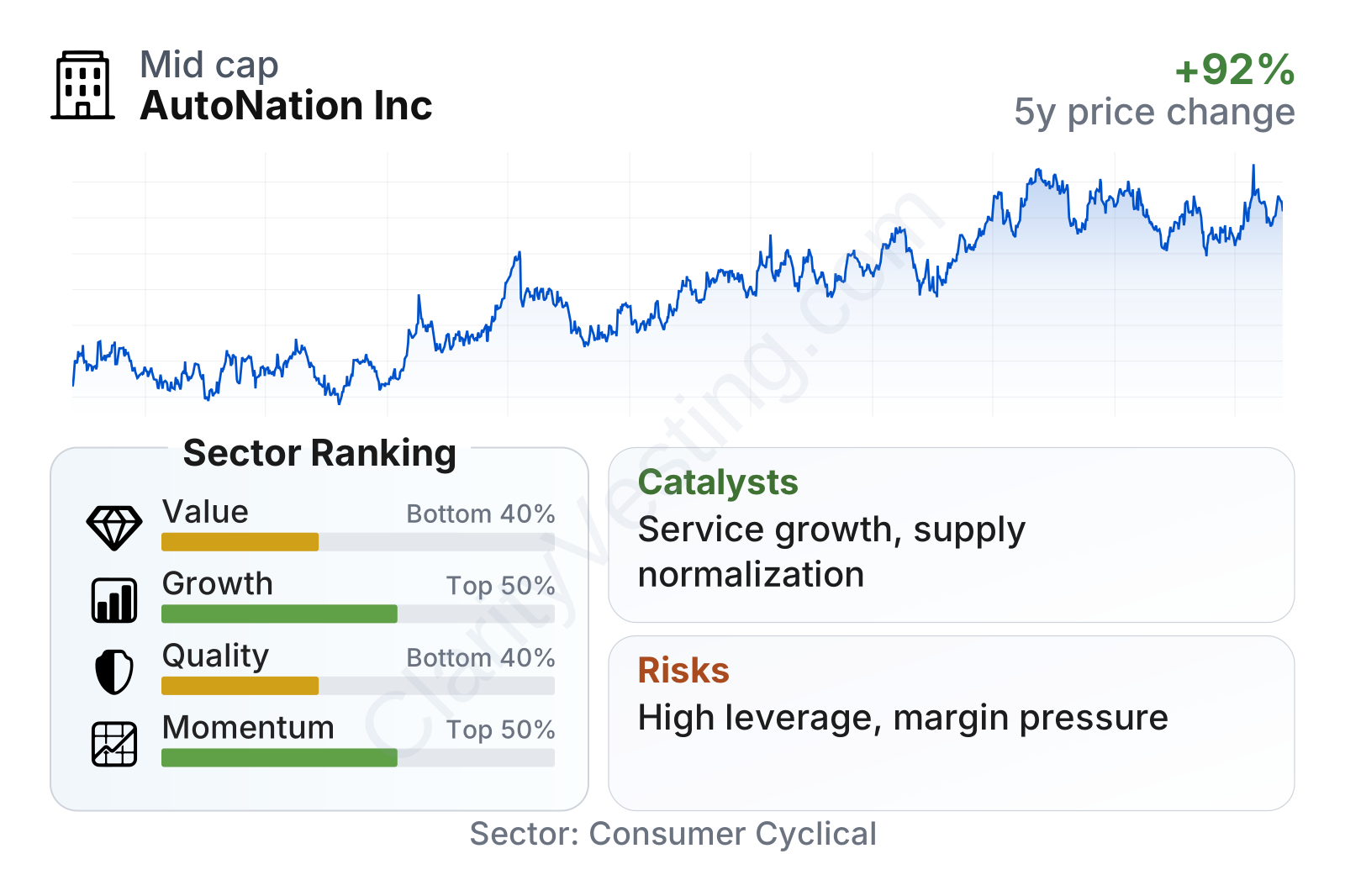
AutoNation is a large public company in its industry, with a market value in the multi-billion-dollar range and a stock that has historically been less volatile than the broader market. The metrics show a mixed profile. On valuation, the shares trade at an earnings multiple around 10, clearly below the sector median near 18, while EBIT relative to enterprise value looks solid. On growth, recent year-over-year revenue has been slightly negative, but the five-year revenue-per-share trend remains stronger than the sector median. Quality is where the numbers are weaker: operating margin and profit margin sit well below sector norms, free cash flow has recently turned negative, and leverage is elevated. Price momentum is also uneven, with stronger multi-year performance than peers but softer relative performance over the last year.
Growth
AutoNation operates in a sector with durable long-term demand, because vehicles need to be replaced, repaired, financed, and serviced regardless of economic cycles. That said, it is not a structurally high-growth industry. Growth tends to come from market share gains, dealership acquisitions, used-vehicle execution, service retention, and digital improvements rather than from rapid expansion in overall industry demand.
The company’s strategy still makes sense for future expansion. AutoNation has scale, established brand relationships, a nationwide footprint, and an installed base of customers returning for maintenance and repairs. Its parts-and-service business is especially important because it can provide steadier activity even when new vehicle demand weakens. The company has also invested in digital retail capabilities and customer-facing service tools, which can improve conversion, efficiency, and repeat business over time.
Revenue growth has been choppy since the exceptional pandemic-era environment faded. Recent quarters point to a business that is no longer benefiting from the unusual pricing power seen in 2021 and 2022. Even so, the longer view is more constructive than the short-term trend: over five years, revenue per share has compounded faster than the sector median, showing that AutoNation has not simply stood still despite a normalization in the vehicle market.
Free cash flow is the main area that weakens the growth picture. The shift from strongly positive free cash flow a few years ago to negative levels more recently suggests heavier working-capital demands, inventory needs, capital spending, or weaker earnings conversion. For a dealership group, this matters because growth funded by balance-sheet pressure is less attractive than growth funded by durable cash generation.
One meaningful catalyst is the continued normalization of new-vehicle supply after years of shortage. A healthier supply environment can support unit sales and improve dealership throughput, even if margins per vehicle remain below peak levels. Another opportunity is the expansion of higher-margin after-sales activities such as service, repair, collision, and finance-related products. These are less dependent on daily pricing conditions in the new-car market and can make earnings more resilient. Company-hosted updates in 2026 have also continued to emphasize capital allocation discipline and operational efficiency, which remain important if the market stays competitive.
Risks
This article is for informational purposes only and does not constitute financial advice. Some content is AI-generated. See Disclaimer


