Stock Analysis · Amazon.com Inc (AMZN)
Overview
Amazon.com Inc. is one of the world’s largest digital commerce and technology companies. It started as an online bookstore, but today it operates a much broader platform that includes online retail, third-party seller services, digital advertising, cloud computing, subscription services, consumer devices, entertainment, and a large logistics network. In practical terms, Amazon makes money both by selling products directly and by providing infrastructure and services to businesses, merchants, developers, advertisers, and households.
Its revenue base is diversified, but the business does not contribute evenly to profit. Retail brings in the largest share of sales, while cloud computing and advertising are widely viewed as the most important profit engines because they typically carry higher margins than first-party retail.
Based on Amazon’s latest annual reporting structure, the main sources of revenue are approximately:
- Online stores: about 40% — products sold directly by Amazon on its websites.
- Third-party seller services: about 25% — fees from merchants using Amazon’s marketplace, including commissions, fulfillment, shipping, and related services.
- Amazon Web Services (AWS): about 17% — cloud infrastructure, computing, storage, databases, and AI-related services for businesses and governments.
- Advertising services: about 9% — sponsored listings and other ads shown across Amazon’s shopping ecosystem and selected owned properties.
- Physical stores: about 3% — Whole Foods Market and other brick-and-mortar retail activity.
- Subscription services: about 4% — mainly Prime memberships, digital subscriptions, and audiobook-related services.
- Other: about 2% — smaller revenue lines not broken out above.
Geographically, Amazon is still centered on North America, but it also has a major international retail presence and a global cloud business. That mix matters because the company is no longer simply an e-commerce name; it is increasingly a combination of retail scale, software infrastructure, data-driven advertising, and fulfillment capacity.
The long-term financial pattern has also shifted in an important way. Revenue has kept rising, gross profit has expanded strongly, and operating income has improved much faster than sales since 2023. That suggests more of Amazon’s growth is now coming from higher-margin activities rather than only from shipping more boxes.
Over the last few years, Amazon’s revenue has climbed from roughly $470 billion to more than $700 billion, while net income and operating income have recovered sharply from the 2022 slowdown. The most notable improvement is that gross profit has grown faster than cost of revenue, showing the increasing weight of AWS, advertising, and seller services in the business mix.
Key Figures
| Metric | Value | Sector ⓘ |
|---|---|---|
| Date | Sep 12, 2026 | |
| Context | ||
| Sector | Consumer Cyclical | |
| Industry | Internet Retail | |
| Market Cap ⓘ | $2.77T | |
| Beta ⓘ | 1.44 | |
Value (Cheapness) | ||
| P/E Ratio ⓘ | 20.28 | 17.10 |
| FCF Yield ⓘ | -0.42% | 8.53% |
| EBIT / EV ⓘ | 6.35% | 6.46% |
| PEG ⓘ | 1.48 | |
Growth (Business expansion) | ||
| Revenue Growth ⓘ | 19.60% | 5.75% |
| RPS Growth (5Y CAGR) ⓘ | 9.77% | 9.14% |
| EPS Growth (5Y CAGR) ⓘ | N/A | -18.21% |
| Margin Growth (5Y Trend) ⓘ | 8.60% | -0.23% |
| FCF Growth (5Y CAGR) ⓘ | N/A | 4.91% |
Quality (Business durability) | ||
| ROIC (Latest) ⓘ | 20.25% | 12.61% |
| ROIC (5Y Median) ⓘ | 13.94% | 10.72% |
| Net Debt / EBIT (Latest) ⓘ | 0.81 | 2.10 |
| Net Debt / EBIT (5Y Median) ⓘ | 1.69 | 2.32 |
| Operating Margin (Latest) ⓘ | 23.05% | 9.25% |
| Operating Margin (5Y Median) ⓘ | 6.41% | 9.64% |
| Debt to Equity (Latest) ⓘ | 40.47% | 75.78% |
| Profit Margin (Latest) ⓘ | 17.44% | 5.33% |
| Free Cash Flow (Latest) ⓘ | -$11.62B | |
Momentum (Price trend) | ||
| 3Y Return ⓘ | +81.82% | +14.53% |
| 12M Return (excl. last month) ⓘ | +20.68% | +3.08% |
| 6M Return ⓘ | +22.55% | +0.55% |
| Price vs. 200-Day MA ⓘ | +7.08% | -0.54% |
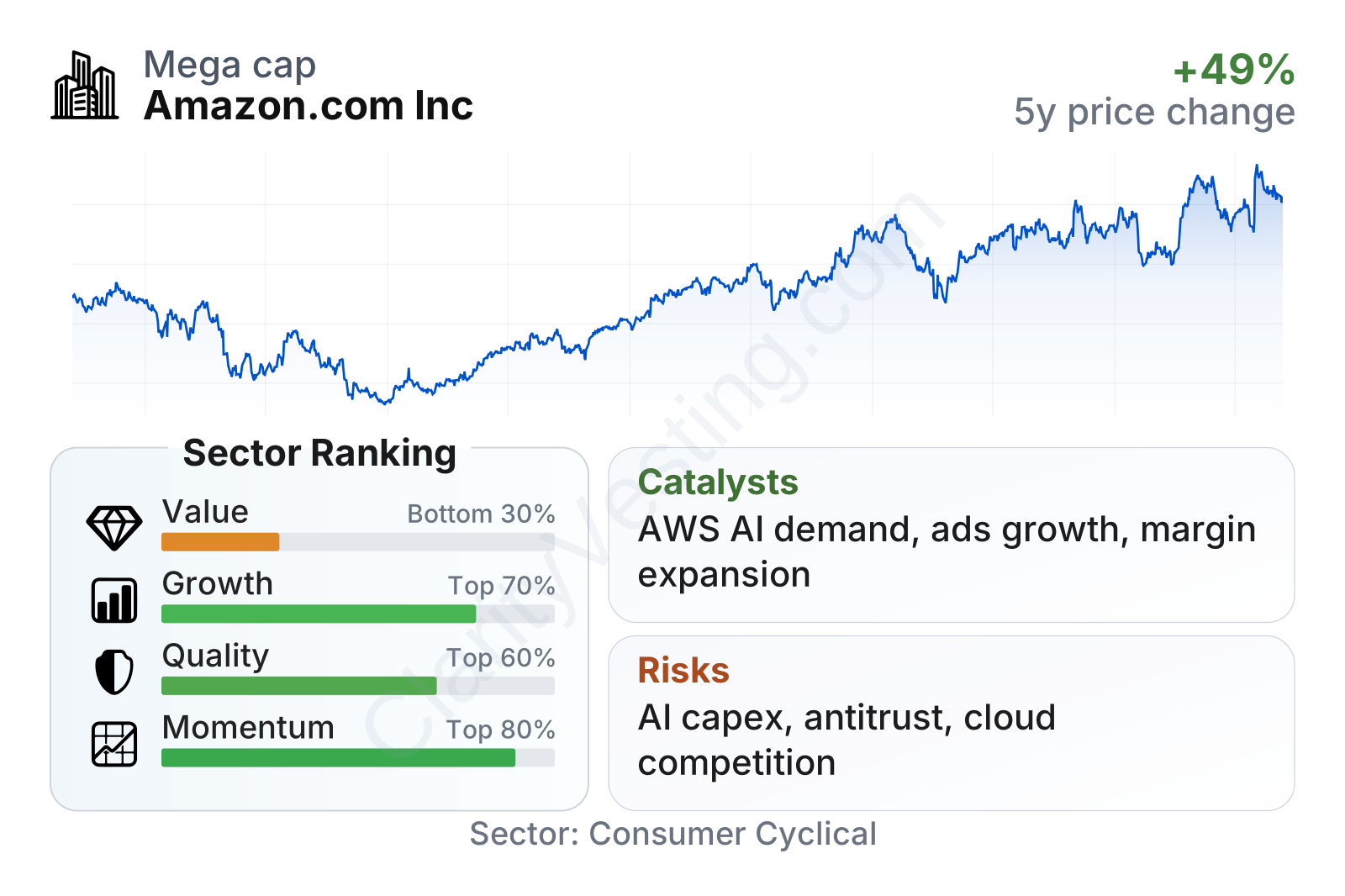
Amazon is one of the largest listed companies in the market, and its recent profile is stronger than a simple retail label would suggest. Growth and share-price momentum rank well against the broader consumer cyclical group, while quality metrics are also solid. Return on invested capital is above the sector median, margins are materially stronger than typical peers, and leverage is lower than most companies in the group. The weaker area is traditional valuation metrics, where the stock screens less attractively than much of the sector, and free cash flow has recently turned negative again because capital spending remains very high.
Growth
Amazon operates in several sectors that still offer meaningful room for expansion. E-commerce continues to gain share from offline retail over time, even if growth is no longer as explosive as it was earlier in the company’s life. Cloud computing remains a structurally growing market as companies move workloads out of their own data centers. On top of that, generative AI is creating another demand layer for computing capacity, software tools, storage, and specialized chips. Digital advertising also continues to grow as merchants and brands spend more to win visibility at the point of purchase.
Amazon’s strategy is coherent for this environment. The company uses its logistics network, Prime ecosystem, and marketplace scale to keep shoppers and sellers inside the platform. It then monetizes that traffic through fulfillment fees, advertising, subscriptions, and direct product sales. On the business side, AWS gives Amazon exposure to enterprise technology budgets, which are very different from household spending patterns. This combination makes the company less dependent on any single engine.
Recent revenue growth has accelerated into the mid-to-high teens and is running well above the sector median. That matters because Amazon is already operating at enormous scale, so maintaining this pace points to continued demand across multiple segments rather than one temporary rebound.
A major catalyst is artificial intelligence infrastructure. Amazon has been expanding data center capacity, custom silicon, and AI services inside AWS, including tools for model building, deployment, and enterprise use. The company is also investing heavily in Anthropic, which supports its ambition to be a core platform for AI workloads. If AI spending remains strong, AWS could benefit from both higher consumption and deeper customer relationships.
Another growth driver is advertising. Amazon’s ad business benefits from high-intent shopping traffic: advertisers can reach people close to the moment of purchase. That makes the platform particularly valuable to brands and marketplace sellers. As Amazon adds more ad inventory and measurement tools, this business can grow faster than core retail while supporting overall margin expansion.
Free cash flow has been volatile. It improved sharply after the heavy investment cycle that pressured results in 2022, then softened again as spending rose for infrastructure, including AI-related capacity. This is an important point for long-term analysis: lower free cash flow does not necessarily indicate weakening demand if the reason is deliberate expansion into high-return areas such as cloud and AI. The key question is whether those investments continue to convert into stronger operating income over time.
Recent company updates have continued to highlight AWS expansion, AI product development, and ongoing efficiency gains in fulfillment and regional logistics. Those developments support the view that Amazon is still in a phase where scale advantages and newer high-margin businesses can lift earnings faster than revenue.
Risks
This article is for informational purposes only and does not constitute financial advice. Some content is AI-generated. See Disclaimer