Stock Analysis · Amplitude Inc (AMPL)
Overview
Amplitude is a software company focused on digital analytics. In simple terms, it helps businesses understand how people use websites, mobile apps, and digital products. Its platform shows where users engage, where they drop off, which features are working, and how product changes affect growth, retention, and monetization. This is part of a broader shift in software spending toward product-led growth, where companies try to improve the customer experience using usage data instead of relying only on sales or marketing intuition.
The company sells its platform mainly through subscriptions. Based on company filings, revenue is overwhelmingly recurring and tied to software access and usage rather than one-time projects. Amplitude also offers professional services, but that is a small part of the business.
Main revenue sources are approximately:
- Subscription revenue: about 95% to 97% of total revenue. This includes access to Amplitude Analytics, experimentation tools, customer data capabilities, session replay, and related platform features sold under recurring contracts.
- Services and other revenue: about 3% to 5% of total revenue. This mainly includes implementation, training, and support-related work tied to customer onboarding and use of the platform.
From a business model perspective, Amplitude has an attractive software profile: high gross margins, recurring revenue, and a product that can expand inside customers over time. The trade-off is that it still has not converted that model into durable accounting profits.
The flow of revenue and costs shows a clear pattern: gross profit has increased steadily over the past several years, while research and development plus selling and administrative spending have remained heavy enough to keep operating income negative. That means the core product appears economically attractive, but scale has not yet fully translated into bottom-line efficiency.
Key Figures
| Metric | Value | Sector ⓘ |
|---|---|---|
| Date | Sep 12, 2026 | |
| Context | ||
| Sector | Technology | |
| Industry | Software - Application | |
| Market Cap ⓘ | $1.65B | |
| Beta ⓘ | 1.50 | |
Value (Cheapness) | ||
| P/E Ratio ⓘ | N/A | 29.51 |
| FCF Yield ⓘ | 1.71% | 4.25% |
| EBIT / EV ⓘ | -6.98% | 2.85% |
| PEG ⓘ | N/A | |
Growth (Business expansion) | ||
| Revenue Growth ⓘ | 21.20% | 15.40% |
| RPS Growth (5Y CAGR) ⓘ | 14.33% | 8.56% |
| EPS Growth (5Y CAGR) ⓘ | -48.96% | -11.88% |
| Margin Growth (5Y Trend) ⓘ | N/A | 0.46% |
| FCF Growth (5Y CAGR) ⓘ | N/A | 9.80% |
Quality (Business durability) | ||
| ROIC (Latest) ⓘ | -35.83% | 9.44% |
| ROIC (5Y Median) ⓘ | -24.41% | 8.30% |
| Net Debt / EBIT (Latest) ⓘ | N/A | 0.54 |
| Net Debt / EBIT (5Y Median) ⓘ | N/A | 0.44 |
| Operating Margin (Latest) ⓘ | -26.42% | 9.58% |
| Operating Margin (5Y Median) ⓘ | -32.25% | 8.25% |
| Debt to Equity (Latest) ⓘ | 4.06% | 33.33% |
| Profit Margin (Latest) ⓘ | -26.59% | 7.14% |
| Free Cash Flow (Latest) ⓘ | $28.30M | |
Momentum (Price trend) | ||
| 3Y Return ⓘ | +1.04% | +45.48% |
| 12M Return (excl. last month) ⓘ | +10.24% | +23.48% |
| 6M Return ⓘ | +70.14% | +20.93% |
| Price vs. 200-Day MA ⓘ | +41.12% | +7.43% |
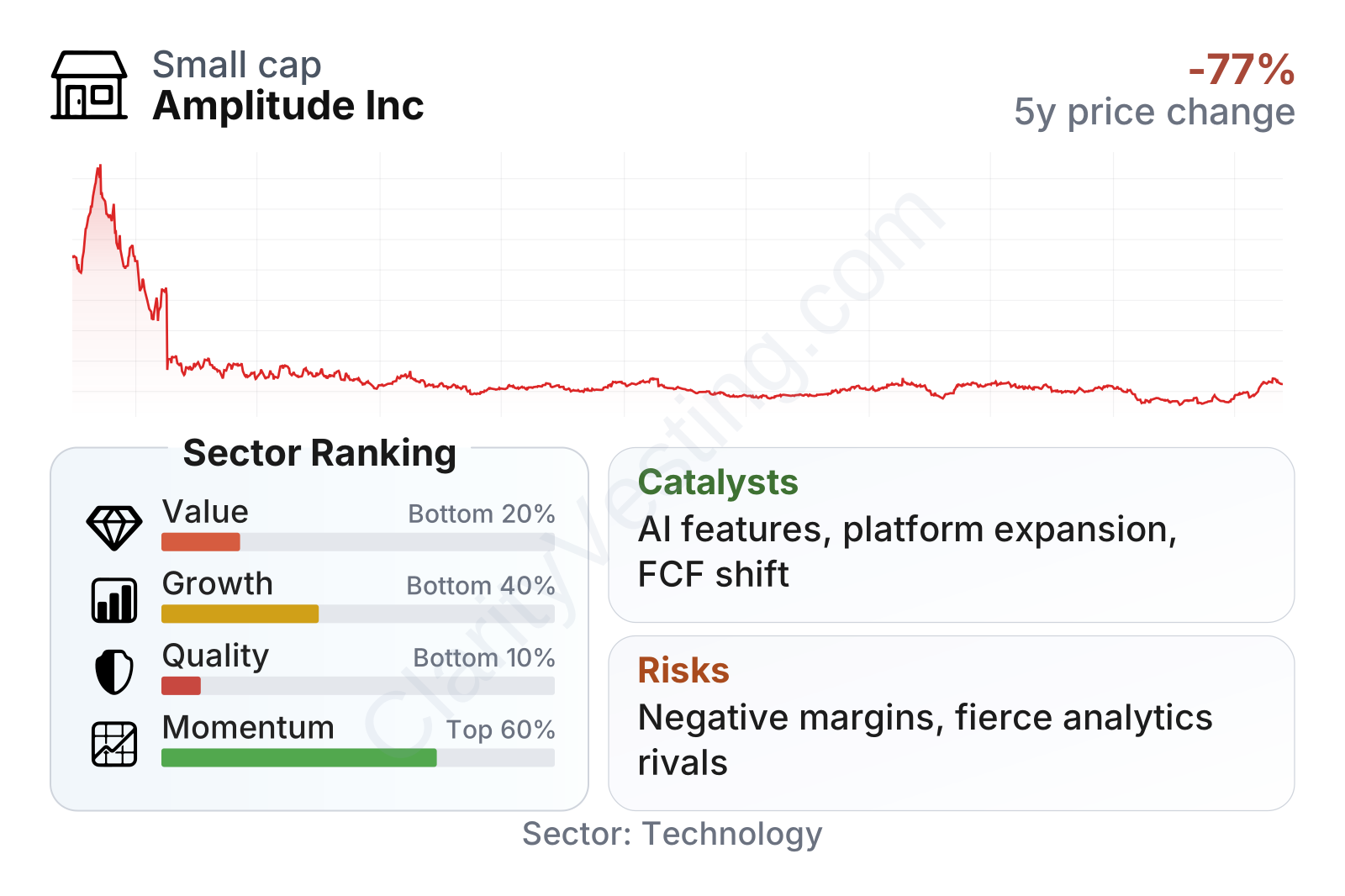
Amplitude is a small-cap software company with above-average share price volatility, reflected in a beta above 1.4. The factor breakdown is mixed. Growth is still better than the sector median on revenue expansion, but quality and value metrics remain weak because profitability is still negative. Momentum has improved recently, with a strong six-month recovery, but the longer stock history still reflects a company that lost a large portion of its post-IPO valuation and has not yet rebuilt a consistently stronger market profile.
Growth
Amplitude operates in a sector with long-term tailwinds. More business activity happens through apps, websites, and digital workflows every year, and companies increasingly want clearer measurement of user behavior, retention, and feature adoption. That creates lasting demand for analytics, experimentation, and customer data tools. Amplitude sits directly in that trend.
Its strategy also makes sense. Rather than offering only basic reporting, the company is building a broader digital optimization platform. The logic is straightforward: once a customer trusts Amplitude to measure user behavior, it becomes easier to add adjacent tools such as experimentation, session replay, and activation capabilities. That can raise customer spending over time and make the platform more deeply embedded in day-to-day product decisions.
Growth has gone through two phases. After very fast expansion earlier in its public-company life, revenue growth slowed materially in 2023 and 2024 as software budgets tightened. More recently, growth has reaccelerated into the low-20% range year over year, which is stronger than the sector median. That rebound matters because it suggests demand has not disappeared; instead, the business may be regaining traction after a reset period.
Cash generation has also improved compared with earlier years. Free cash flow moved from clearly negative territory to positive territory, although the level has not been smooth from period to period. For a company in this stage, that is important: it suggests Amplitude can grow without relying heavily on external financing, even if reported earnings remain negative.
Recent company updates have also pointed to a sharper focus on enterprise accounts, platform consolidation, and AI-related features. In practical terms, AI can increase the usefulness of analytics software by making data easier to query, interpret, and act on for non-technical users. If Amplitude succeeds in turning that into higher adoption across product, marketing, and business teams, it could expand beyond its original core audience of product managers and analysts.
A meaningful catalyst is the company’s position at the intersection of analytics, experimentation, and customer understanding. Many businesses want fewer disconnected software tools, not more. If Amplitude can keep broadening its platform while maintaining ease of use, it has a reasonable path to larger contract sizes and stronger retention.
Risks
This article is for informational purposes only and does not constitute financial advice. Some content is AI-generated. See Disclaimer


