Stock Analysis · Amkor Technology Inc (AMKR)
Overview
Amkor Technology is a semiconductor packaging and test company. In simple terms, it helps turn finished silicon chips into components that can be installed into phones, cars, servers, industrial equipment, and many other electronic products. Chip designers and semiconductor manufacturers send wafers or finished chips to Amkor, and Amkor provides services such as packaging, electrical testing, and other back-end manufacturing steps that are required before the chips can be used in real devices.
The company operates in an important part of the semiconductor supply chain. It does not usually design chips itself. Instead, it serves many chip companies that outsource assembly and test work. This makes Amkor a manufacturing partner to large semiconductor customers, especially in markets where package complexity is rising and chips need better performance, smaller size, lower power use, or higher reliability.
Revenue is primarily generated from outsourced semiconductor assembly and test services. Based on the company’s recent annual disclosures, the business is commonly discussed through end markets rather than through sharply separated product lines. Approximate revenue exposure is as follows:
- Communications: about 40% to 45% of revenue. This mainly includes chips used in smartphones, wireless connectivity, networking, and related consumer communications devices.
- Computing: about 15% to 20%. This includes processors and related chips used in PCs, data centers, AI-related computing, and other digital systems.
- Consumer: about 15% to 20%. This covers a wide range of everyday electronics beyond smartphones.
- Automotive and industrial: about 20% to 25%. This includes chips for vehicles, power systems, factory automation, and industrial electronics, areas that typically require strong reliability and long product life cycles.
Another useful way to think about the company is by service mix. Most revenue comes from advanced packaging and mainstream packaging services, with testing representing a smaller but still essential part of the offering. The exact split can vary by year and customer program, but packaging remains the core of the business model.
The overall cost structure is typical of a high-volume manufacturing company: most revenue is consumed by production costs, leaving more moderate operating margins. The business produced strong earnings in 2021 and 2022, saw a softer period in 2023 and 2024, and then began showing signs of recovery as revenue improved again.
Over the last several years, revenue moved from a little above $6 billion to just above $7 billion at the cycle peak, then eased back before recovering. Profitability has been more volatile than sales, which shows how sensitive the business can be to semiconductor demand, factory utilization, and product mix.
Key Figures
| Metric | Value | Sector ⓘ |
|---|---|---|
| Date | Sep 12, 2026 | |
| Context | ||
| Sector | Technology | |
| Industry | Semiconductor Equipment & Materials | |
| Market Cap ⓘ | $12.85B | |
| Beta ⓘ | 2.23 | |
Value (Cheapness) | ||
| P/E Ratio ⓘ | 23.20 | 29.51 |
| FCF Yield ⓘ | 4.02% | 4.25% |
| EBIT / EV ⓘ | 5.55% | 2.85% |
| PEG ⓘ | 0.76 | |
Growth (Business expansion) | ||
| Revenue Growth ⓘ | 25.60% | 15.40% |
| RPS Growth (5Y CAGR) ⓘ | 1.97% | 8.56% |
| EPS Growth (5Y CAGR) ⓘ | -27.10% | -11.88% |
| Margin Growth (5Y Trend) ⓘ | -4.74% | 0.46% |
| FCF Growth (5Y CAGR) ⓘ | -13.52% | 9.80% |
Quality (Business durability) | ||
| ROIC (Latest) ⓘ | 9.95% | 9.44% |
| ROIC (5Y Median) ⓘ | 7.84% | 8.30% |
| Net Debt / EBIT (Latest) ⓘ | 1.40 | 0.54 |
| Net Debt / EBIT (5Y Median) ⓘ | 0.70 | 0.44 |
| Operating Margin (Latest) ⓘ | 9.54% | 9.58% |
| Operating Margin (5Y Median) ⓘ | 7.85% | 8.25% |
| Debt to Equity (Latest) ⓘ | 54.78% | 33.33% |
| Profit Margin (Latest) ⓘ | 7.45% | 7.14% |
| Free Cash Flow (Latest) ⓘ | $516.04M | |
Momentum (Price trend) | ||
| 3Y Return ⓘ | +143.25% | +45.48% |
| 12M Return (excl. last month) ⓘ | +130.17% | +23.48% |
| 6M Return ⓘ | +25.72% | +20.93% |
| Price vs. 200-Day MA ⓘ | -8.16% | +7.43% |
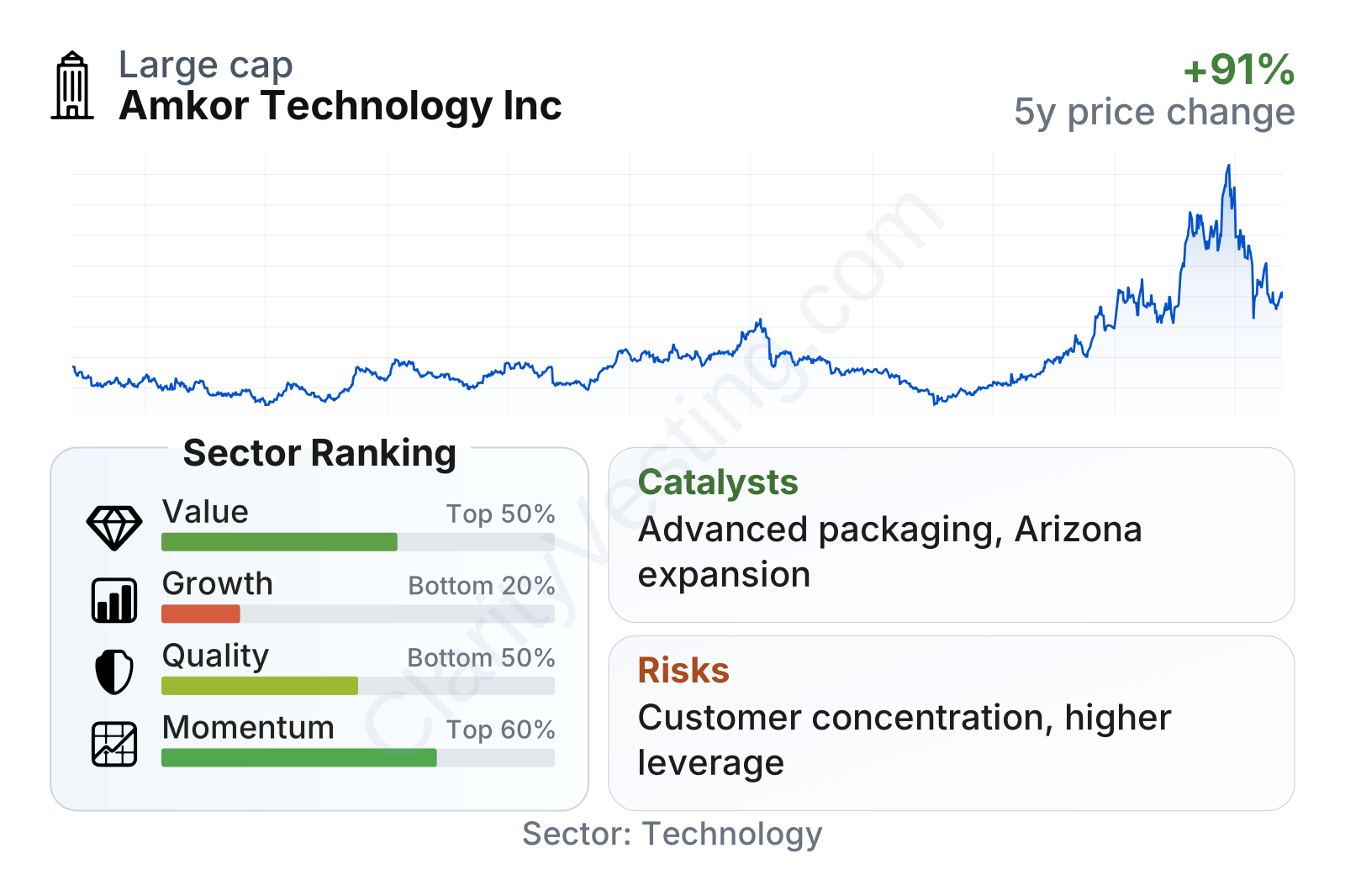
Amkor is a mid-sized semiconductor services company with above-average share price volatility, which is consistent with its position in a cyclical industry. The latest snapshot looks mixed but understandable: valuation measures remain relatively moderate versus much of the technology sector, profitability is acceptable, and recent revenue growth has improved sharply. At the same time, longer-term growth and balance-sheet indicators are less favorable, which suggests the recent upturn still needs to prove it can translate into a stronger multi-year trend.
Growth
Amkor operates in a sector with solid long-term demand drivers. Semiconductor content continues to expand in smartphones, cloud infrastructure, AI hardware, electric vehicles, advanced driver assistance systems, and industrial automation. That does not mean growth is smooth every year, but the underlying direction for chip packaging and test remains favorable because more complex chips often require more sophisticated packaging solutions.
The company’s strategy broadly fits that trend. Amkor has been investing in advanced packaging technologies and in capacity that supports high-performance computing, mobile devices, and automotive applications. This matters because packaging is no longer just a low-value finishing step. In many leading-edge products, the package helps determine performance, heat management, power efficiency, and how multiple chips can be integrated together.
Recent revenue momentum has improved noticeably after a weaker stretch in 2023 and parts of 2024. Year-over-year growth turned negative during the semiconductor downturn, then recovered and recently moved back into the mid-20% range. That kind of rebound suggests Amkor is participating in a broader recovery in customer demand and product ramps, even though its five-year growth profile still looks modest compared with many technology peers.
Free cash flow has been positive, but it has not followed a steady upward path. That is important because Amkor’s business requires regular capital spending on factories, equipment, and technology upgrades. Positive cash generation gives the company room to keep investing, but the uneven trend also shows that growth comes with heavy reinvestment needs and is exposed to industry cycles.
A meaningful catalyst is the increasing complexity of advanced packaging. As AI accelerators, high-bandwidth memory integration, and chiplet-based designs become more common, outsourced packaging specialists can become more important to the semiconductor ecosystem. Automotive is another notable opportunity. Vehicles are using more chips for power management, safety systems, infotainment, and driver assistance, and those programs often run for years once designed in.
Recent company updates have also highlighted expansion initiatives in the United States, including the planned advanced packaging and test facility in Arizona. That project could strengthen Amkor’s role in the push to build a more geographically diversified semiconductor supply chain and may improve its position with customers that want more packaging capacity closer to U.S. chip manufacturing.
Risks
This article is for informational purposes only and does not constitute financial advice. Some content is AI-generated. See Disclaimer


