Stock Analysis · Advanced Micro Devices Inc (AMD)
Overview
Advanced Micro Devices, better known as AMD, designs high-performance chips used in data centers, personal computers, gaming consoles, and embedded systems. In simple terms, it makes the processors and accelerators that power servers, laptops, desktops, artificial intelligence workloads, and a wide range of connected machines. AMD does not run most of its own chip factories; instead, it focuses on chip design and relies on external manufacturing partners. That model can support strong margins when products are successful, while also reducing the huge capital burden of owning leading-edge fabrication plants.
AMD’s business is organized into four main operating segments. Based on the latest annual filing for 2025, revenue was distributed approximately as follows:
- Data Center: about 50% — server CPUs, GPU accelerators for AI and high-performance computing, networking and related platform products used by cloud providers, enterprises, and large-scale computing customers.
- Client: about 21% — processors and chipsets for consumer and commercial PCs, including notebooks and desktops.
- Gaming: about 16% — graphics products and semi-custom chips, notably the processors used in major game consoles.
- Embedded: about 13% — chips and adaptive computing products used in communications, industrial, automotive, aerospace, and other specialized applications, largely expanded by the Xilinx acquisition.
That mix matters because it shows AMD is no longer mainly a PC chip company. The largest revenue driver is now data center, which is generally a more strategic and faster-growing market, especially as AI spending continues to reshape the semiconductor industry.
The broader financial flow also shows a business that has become much larger over the past several years, with revenue more than doubling from 2021 to 2025. At the same time, research and development spending has climbed sharply, highlighting how much AMD is reinvesting to stay competitive in servers, AI accelerators, and custom silicon.
Key Figures
| Metric | Value | Sector ⓘ |
|---|---|---|
| Date | Sep 12, 2026 | |
| Context | ||
| Sector | Technology | |
| Industry | Semiconductors | |
| Market Cap ⓘ | $822.11B | |
| Beta ⓘ | 2.48 | |
Value (Cheapness) | ||
| P/E Ratio ⓘ | 133.23 | 29.51 |
| FCF Yield ⓘ | 1.02% | 4.25% |
| EBIT / EV ⓘ | 0.91% | 2.85% |
| PEG ⓘ | 0.53 | |
Growth (Business expansion) | ||
| Revenue Growth ⓘ | 50.10% | 15.40% |
| RPS Growth (5Y CAGR) ⓘ | 11.67% | 8.56% |
| EPS Growth (5Y CAGR) ⓘ | -4.35% | -11.88% |
| Margin Growth (5Y Trend) ⓘ | -9.83% | 0.46% |
| FCF Growth (5Y CAGR) ⓘ | 20.26% | 9.80% |
Quality (Business durability) | ||
| ROIC (Latest) ⓘ | 9.81% | 9.44% |
| ROIC (5Y Median) ⓘ | 2.87% | 8.30% |
| Net Debt / EBIT (Latest) ⓘ | -0.11 | 0.54 |
| Net Debt / EBIT (5Y Median) ⓘ | -0.76 | 0.44 |
| Operating Margin (Latest) ⓘ | 18.62% | 9.58% |
| Operating Margin (5Y Median) ⓘ | 8.07% | 8.25% |
| Debt to Equity (Latest) ⓘ | 6.36% | 33.33% |
| Profit Margin (Latest) ⓘ | 15.58% | 7.14% |
| Free Cash Flow (Latest) ⓘ | $8.40B | |
Momentum (Price trend) | ||
| 3Y Return ⓘ | +390.11% | +45.48% |
| 12M Return (excl. last month) ⓘ | +176.04% | +23.48% |
| 6M Return ⓘ | +161.01% | +20.93% |
| Price vs. 200-Day MA ⓘ | +48.78% | +7.43% |
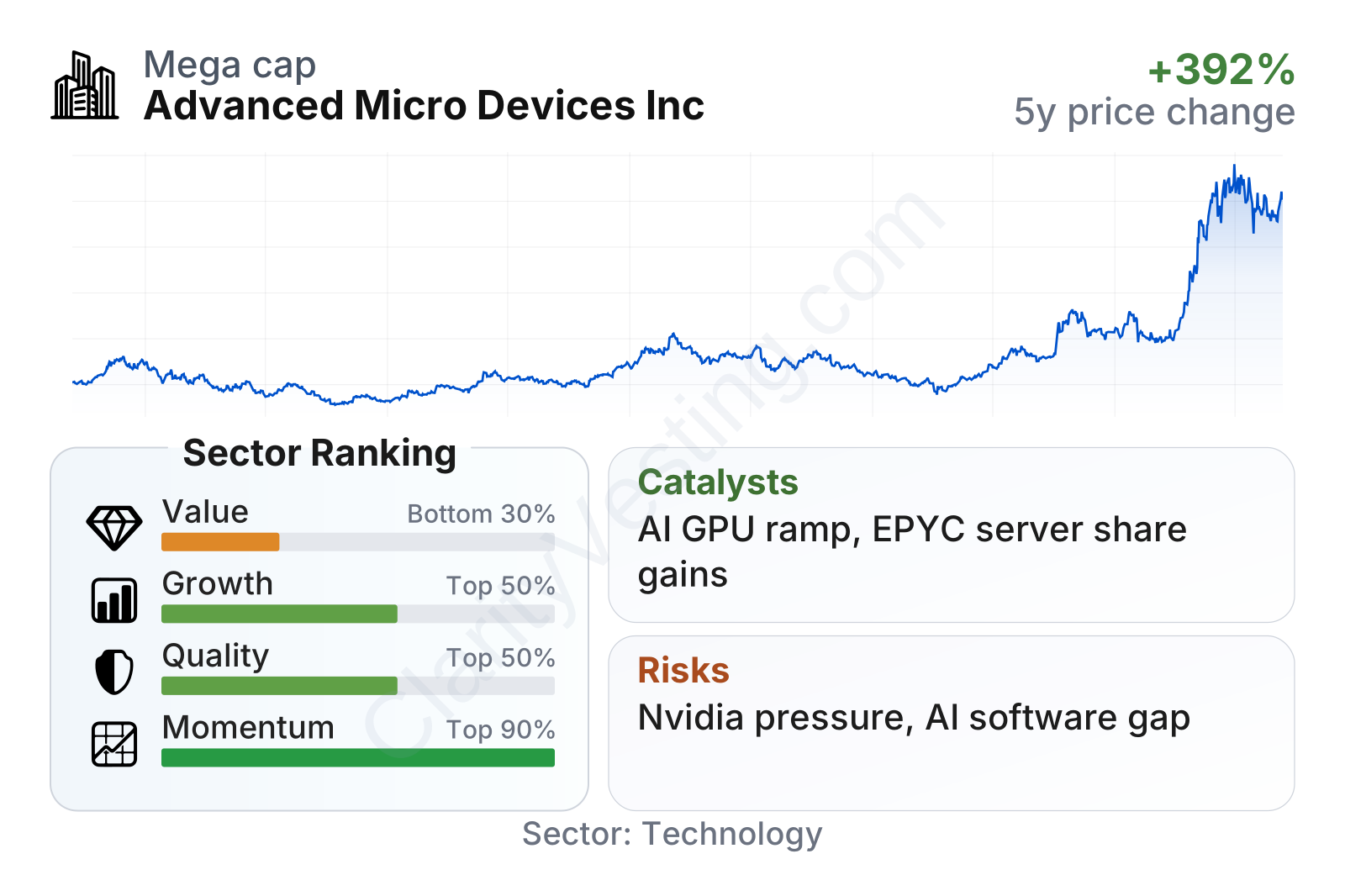
AMD is now one of the largest companies in semiconductors by market value, but the stock remains notably volatile, with a beta well above 2. The factor profile is unusual: growth, quality, and momentum all rank well versus much of the sector, while value ranks weakly. In practical terms, the market is assigning a high price to the company because it expects strong future expansion, especially in data center and AI. The balance sheet is a clear positive, with very low leverage and net cash relative to earnings, while profitability and cash generation have improved materially from the lows seen during the 2023 slowdown.
Growth
AMD operates in one of the most attractive parts of technology: advanced semiconductors for cloud computing, AI, and high-performance processing. These are long-duration growth markets because data centers need more computing power, AI models require specialized accelerators, and enterprises continue upgrading infrastructure. The PC market is more cyclical, but AMD’s exposure is now more balanced than it used to be, with a much larger contribution from higher-value enterprise products.
Its strategy is coherent. AMD has spent years building a broader product stack: EPYC server CPUs, Instinct AI accelerators, Ryzen PC processors, adaptive computing from Xilinx, and custom chips for large customers. This gives the company multiple ways to participate in demand growth instead of relying on a single category. A key part of the strategy is selling complete platforms rather than isolated chips, which can deepen customer relationships and make switching less attractive.
Revenue growth has been volatile, which is normal in semiconductors, but the recent direction has been strong. After the 2023 dip, growth reaccelerated through 2024, 2025, and into 2026, with year-over-year expansion rising to around 50% in the latest reading. That is far above the sector median and suggests AMD is capturing meaningful demand, not merely moving in line with the industry.
Cash generation has also improved sharply. Free cash flow had weakened during the industry downturn, then recovered strongly to more than $8 billion on a trailing basis. That is important because it shows growth is increasingly translating into actual financial strength, not just into higher reported sales. It also provides AMD with resources to keep funding product development, software, and go-to-market efforts in AI infrastructure.
A major catalyst is the ongoing buildout of AI infrastructure. AMD has been pushing its Instinct GPU family and ROCm software ecosystem as an alternative to Nvidia in large-scale AI systems. The opportunity is significant because even modest share gains in AI accelerators can move revenue meaningfully given the size of the market. Another catalyst is the continuing expansion of EPYC server processors, where AMD has already built a strong reputation for performance and efficiency. Large cloud customers increasingly want multiple suppliers, which can help AMD deepen its footprint.
Recent company updates have also pointed to continued ramp-up in data center AI products and stronger enterprise demand. While the exact pace can vary quarter to quarter, the overall signal is that AMD is benefiting from structural spending on compute capacity rather than a short-lived product cycle.
Risks
This article is for informational purposes only and does not constitute financial advice. Some content is AI-generated. See Disclaimer