Stock Analysis · Amcor PLC (AMCR)
Overview
Amcor PLC is a global packaging company that makes flexible and rigid packaging used to protect, ship, display, and preserve everyday products. Its customers are mainly large consumer goods, food, beverage, healthcare, and personal care companies. In simple terms, Amcor sells the packaging around products rather than the products themselves: pouches, films, cartons, bottles, containers, closures, and medical packaging.
This is generally a steady business because packaging is tied to recurring consumer demand. People continue to buy food, beverages, household goods, and healthcare products in both strong and weak economies, which gives Amcor a more defensive profile than many other companies in the broader consumer sector.
Based on Amcor’s recent annual reporting structure, revenue is mainly generated from two large segments.
- Flexibles: about 74% of revenue. This includes flexible packaging for food, beverages, healthcare, home care, and personal care products, such as pouches, films, wraps, sachets, and specialty packaging.
- Rigid Packaging: about 26% of revenue. This includes rigid containers, bottles, caps, and closures used in beverages, spirits, food, dairy, personal care, and household products.
By end market, food and beverage packaging represents the largest share of activity, with healthcare and personal care also important contributors. Geographically, Amcor operates across North America, Europe, Latin America, and Asia-Pacific, which reduces dependence on any single country.
The business model is straightforward: Amcor buys raw materials such as resin, aluminum, paper, and other substrates, converts them into packaging, and sells customized solutions at very large scale. That scale matters because major consumer brands want reliable supply, global manufacturing, product safety, and regulatory compliance.
One notable recent development is the combination with Berry Global, announced as an all-stock merger intended to create a larger global packaging platform. If completed and integrated well, that transaction would significantly increase Amcor’s scale, especially in consumer and healthcare packaging.
The long-term pattern shows a business with high material costs, modest operating margins, and meaningful sensitivity to financing costs. At the same time, the latest year points to a much larger revenue base and improved net income compared with the prior year, which suggests the company is entering a new scale phase.
Key Figures
| Metric | Value | Sector ⓘ |
|---|---|---|
| Date | Sep 05, 2026 | |
| Context | ||
| Sector | Consumer Cyclical | |
| Industry | Packaging & Containers | |
| Market Cap ⓘ | $20.87B | |
| Beta ⓘ | 0.59 | |
Value (Cheapness) | ||
| P/E Ratio ⓘ | 19.29 | 17.51 |
| FCF Yield ⓘ | 6.17% | 8.30% |
| EBIT / EV ⓘ | N/A | 6.34% |
| PEG ⓘ | 1.04 | |
Growth (Business expansion) | ||
| Revenue Growth ⓘ | 25.90% | 5.90% |
| RPS Growth (5Y CAGR) ⓘ | 2.05% | 9.14% |
| EPS Growth (5Y CAGR) ⓘ | -5.13% | -17.43% |
| Margin Growth (5Y Trend) ⓘ | -0.71% | -0.30% |
| FCF Growth (5Y CAGR) ⓘ | 5.32% | 4.91% |
Quality (Business durability) | ||
| ROIC (Latest) ⓘ | N/A | 12.33% |
| ROIC (5Y Median) ⓘ | 11.05% | 10.68% |
| Net Debt / EBIT (Latest) ⓘ | N/A | 2.11 |
| Net Debt / EBIT (5Y Median) ⓘ | 5.26 | 2.32 |
| Operating Margin (Latest) ⓘ | N/A | 9.12% |
| Operating Margin (5Y Median) ⓘ | 8.76% | 9.56% |
| Debt to Equity (Latest) ⓘ | 127.91% | 75.78% |
| Profit Margin (Latest) ⓘ | 4.71% | 5.31% |
| Free Cash Flow (Latest) ⓘ | $1.29B | |
Momentum (Price trend) | ||
| 3Y Return ⓘ | +13.74% | +15.88% |
| 12M Return (excl. last month) ⓘ | +8.12% | +5.17% |
| 6M Return ⓘ | +6.57% | 0.00% |
| Price vs. 200-Day MA ⓘ | +8.79% | +0.59% |
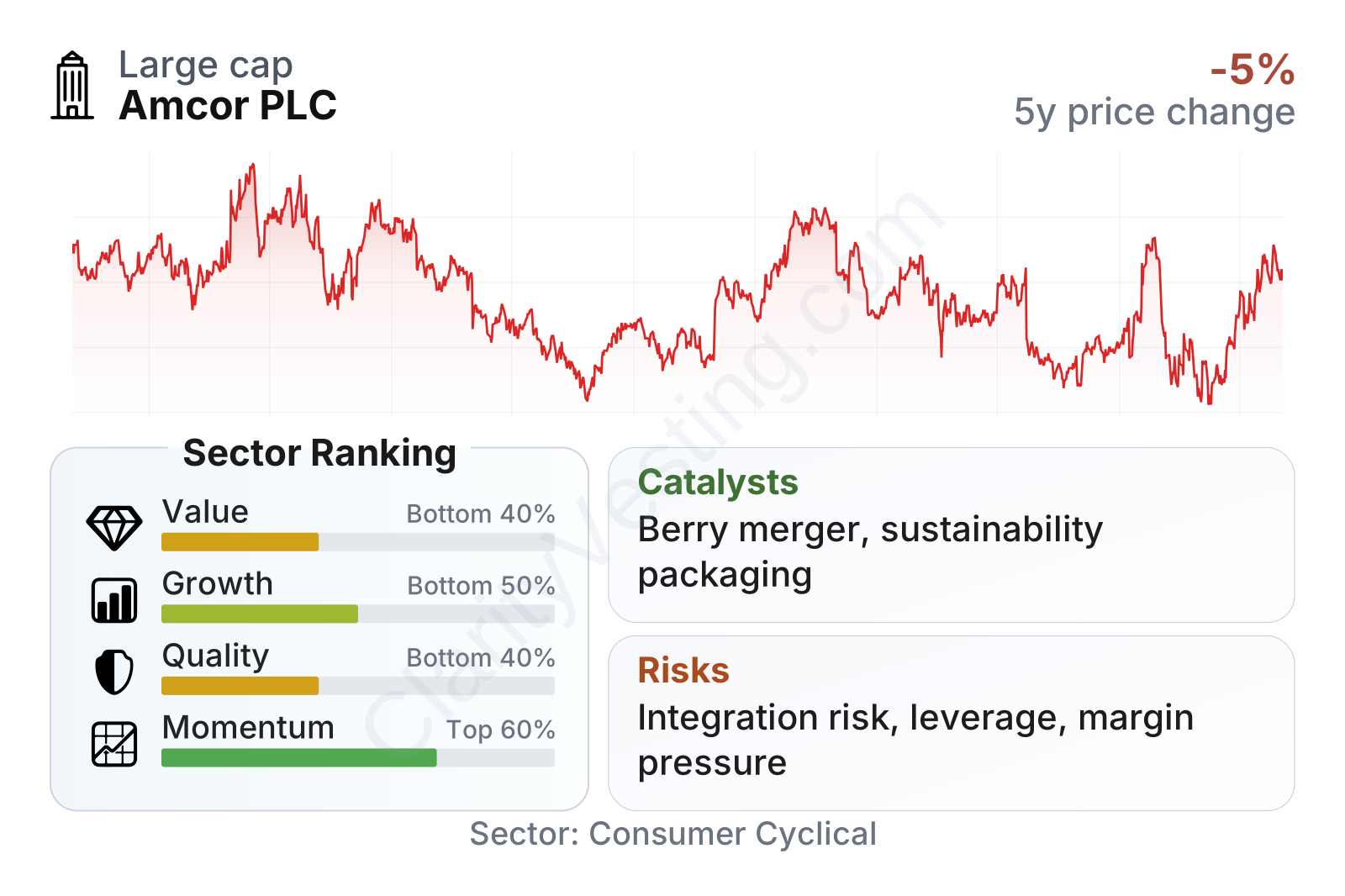
Amcor is a large-cap company with relatively low share-price volatility, as shown by a beta well below 1. That fits the nature of the business: packaging demand is usually steadier than demand for more discretionary products. The factor summary is more mixed. Growth has recently improved sharply on a year-over-year basis, but the longer-term growth record remains modest. Profitability and balance-sheet quality are not standout areas versus the sector, mainly because leverage is elevated and margins are somewhat below the median. Valuation also does not look clearly discounted relative to those fundamentals.
The share-price history shows a stock that has spent several years moving in a fairly wide range rather than establishing a strong long-term uptrend. That behavior is consistent with a company viewed more as a stable cash generator than as a fast-growing compounder.
Growth
The packaging industry is not a high-growth sector in the way software or semiconductors can be, but it does benefit from durable demand. Food, beverage, healthcare, and personal care all require packaging regardless of the economic cycle. Over time, growth tends to come from population increases, product premiumization, more convenience-oriented packaging, healthcare demand, and new sustainability requirements.
Amcor’s strategy broadly makes sense for this environment. The company focuses on categories where packaging performance matters, such as shelf life, product safety, lightweighting, and recyclability. Its research and development spending is not huge relative to sales, but innovation is still important because brand owners increasingly want packaging that uses less material, contains recycled content, and meets new regulatory standards.
The recent revenue trend is unusually strong, with year-over-year growth far above the sector median. That deserves context. Amcor had a period of declining sales through much of 2023 and 2024 before returning to strong reported growth. That kind of rebound can come from acquisitions, portfolio changes, currency effects, or a recovery in volumes and pricing, so it is encouraging but should not automatically be treated as a new normal growth rate.
Free cash flow has been positive across the period shown, which is one of the more reassuring features of the business. Even though the level has been uneven, the company has generally remained capable of producing hundreds of millions to more than $1 billion in annualized free cash flow. For a packaging company, that matters because cash generation supports capital spending, dividends, debt service, and integration costs tied to large transactions.
The biggest catalyst is the planned Berry Global combination. The industrial logic is clear: larger scale, broader product reach, more purchasing power, and potential cost synergies. The healthcare and consumer packaging portfolio would become more comprehensive, and the merged company could have stronger bargaining power with both suppliers and customers. If management executes well, that deal could improve earnings resilience and cash generation over time.
A second growth driver is sustainability. Consumer brands and regulators are pushing toward recyclable, reusable, compostable, and lower-waste packaging. Amcor has spent years positioning itself in this area, and that could help protect customer relationships and open opportunities as packaging specifications change. In healthcare, demand for safe and compliant packaging also offers a structurally attractive niche.
Risks
This article is for informational purposes only and does not constitute financial advice. Some content is AI-generated. See Disclaimer