Stock Analysis · Amcor plc (AMCCF)
Overview
Amcor plc is a global packaging company that makes flexible packaging, rigid containers, cartons, closures, and specialty packaging used in everyday products. Its customers are mainly large consumer goods, food, beverage, healthcare, and personal care companies that need packaging to protect products, extend shelf life, support branding, and meet regulatory requirements. In simple terms, Amcor sells the packaging around many of the items people buy regularly rather than the products inside.
The business is broad and geographically diversified, which helps reduce dependence on any single end market. Based on the company’s recent annual reporting structure and the added scale from the announced Berry Global combination, revenue is mainly generated from the following areas:
- Flexible Packaging: approximately 70% to 75% of revenue. This includes pouches, films, foils, and sachets used in food, beverage, home care, personal care, and healthcare applications.
- Rigid Packaging: approximately 25% to 30% of revenue. This includes bottles, containers, caps, and closures for beverages, spirits, food, dairy, and household products.
- By end market, food and beverage together: roughly 55% to 65% of sales, with healthcare, personal care, home care, and other consumer categories making up the balance.
That revenue mix matters for long-term analysis because packaging demand is usually tied to daily consumption rather than discretionary big-ticket spending. This tends to make Amcor more defensive than many businesses in the broader consumer sector, although it also means growth is often steadier rather than spectacular.
The latest financial flow also shows a meaningful step-up in sales and operating income in fiscal 2026 compared with fiscal 2025, suggesting that scale increased materially. At the same time, cost of revenue remains very large relative to sales, which is normal for packaging manufacturing but keeps margins sensitive to raw material costs, plant efficiency, and pricing discipline.
Key Figures
| Metric | Value | Sector ⓘ |
|---|---|---|
| Date | Sep 14, 2026 | |
| Context | ||
| Sector | Consumer Cyclical | |
| Industry | Packaging & Containers | |
| Market Cap ⓘ | $20.43B | |
| Beta ⓘ | 0.59 | |
Value (Cheapness) | ||
| P/E Ratio ⓘ | 18.56 | 17.10 |
| FCF Yield ⓘ | 6.18% | 8.53% |
| EBIT / EV ⓘ | N/A | 6.46% |
| PEG ⓘ | 1.00 | |
Growth (Business expansion) | ||
| Revenue Growth ⓘ | 25.90% | 5.75% |
| RPS Growth (5Y CAGR) ⓘ | 3106.07% | 9.14% |
| EPS Growth (5Y CAGR) ⓘ | 4.49% | -18.19% |
| Margin Growth (5Y Trend) ⓘ | 0.06% | -0.23% |
| FCF Growth (5Y CAGR) ⓘ | 5.86% | 4.91% |
Quality (Business durability) | ||
| ROIC (Latest) ⓘ | N/A | 12.61% |
| ROIC (5Y Median) ⓘ | 11.05% | 10.72% |
| Net Debt / EBIT (Latest) ⓘ | N/A | 2.11 |
| Net Debt / EBIT (5Y Median) ⓘ | 5.26 | 2.32 |
| Operating Margin (Latest) ⓘ | N/A | 9.25% |
| Operating Margin (5Y Median) ⓘ | 8.82% | 9.64% |
| Debt to Equity (Latest) ⓘ | 128.41% | 75.99% |
| Profit Margin (Latest) ⓘ | 4.71% | 5.34% |
| Free Cash Flow (Latest) ⓘ | $1.26B | |
Momentum (Price trend) | ||
| 3Y Return ⓘ | +14.27% | +14.39% |
| 12M Return (excl. last month) ⓘ | -2.13% | +3.08% |
| 6M Return ⓘ | +7.25% | +0.55% |
| Price vs. 200-Day MA ⓘ | +7.71% | -0.54% |
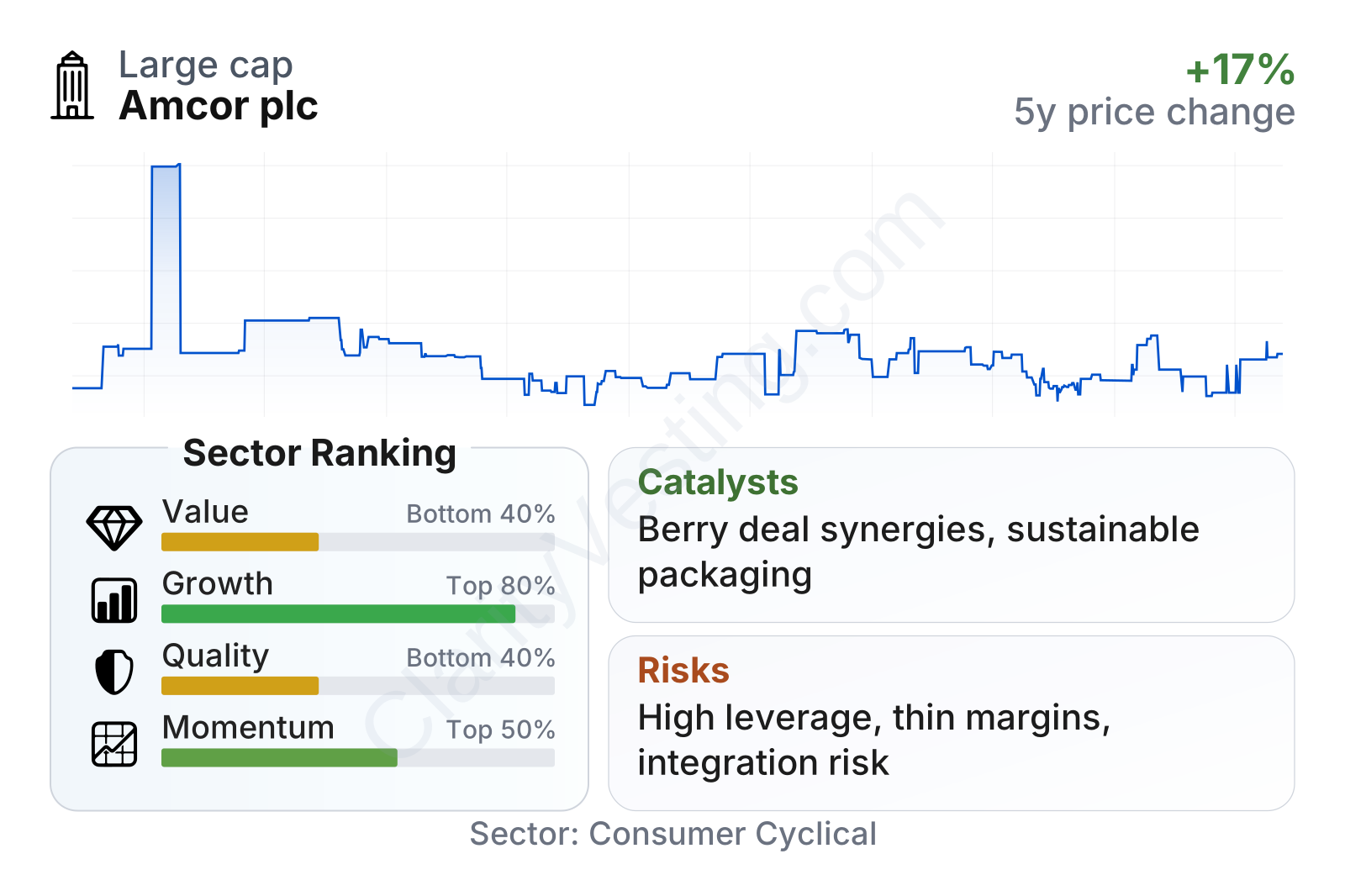
Amcor is a large packaging company with a market value around the low-$20 billion range and a relatively low beta, which points to lower share-price volatility than many stocks. The overall profile is mixed: growth metrics rank well above much of the sector, while quality and value measures look less impressive. Revenue growth has recently accelerated strongly versus the sector median, but profitability and balance-sheet leverage remain weaker than many peers. The table also suggests that recent share-price momentum has improved, even though longer-term returns have been more in line with the industry than clearly ahead of it.
Growth
Packaging is not a fast-changing technology market, but it is a large and durable sector supported by population growth, food distribution, healthcare demand, convenience packaging, and product safety requirements. Within that landscape, the more attractive pockets are flexible packaging, healthcare packaging, premium beverage containers, and recyclable or reusable formats. Amcor is active in all of those areas, which gives its strategy a logical long-term foundation.
A central part of the growth case is scale. Packaging customers are often multinational consumer brands that value global supply networks, reliable production, and technical support. Amcor already operates at that level, and its strategy has consistently focused on combining global reach with product innovation in lighter, more sustainable materials. That matters because brand owners are under pressure to reduce plastic use, increase recycled content, and improve recyclability without raising total packaging costs too much.
One of the most important recent developments is the company’s combination with Berry Global, which materially expands Amcor’s size, product range, and exposure to attractive categories such as healthcare and consumer packaging. Management has presented the deal as a way to unlock cost synergies, strengthen innovation capabilities, and create a broader platform for more sustainable packaging solutions. If execution goes well, this is the clearest near-to-medium-term catalyst because it can lift earnings through both revenue opportunities and cost savings.
Recent growth has been noticeably stronger than the sector median, which stands out for a business that is normally seen as mature. Some of that likely reflects transaction effects and portfolio changes rather than pure underlying demand, so it is important to separate headline expansion from organic volume growth. Even so, the direction is positive: Amcor is not relying only on a stagnant base business and has recently been able to expand at a pace well above many sector peers.
Cash generation is another important point for long-term analysis. Amcor has continued to produce substantial free cash flow, recently around the low-$1 billion range on a trailing basis. That supports debt service, dividends, reinvestment, and integration spending. In a packaging business, solid cash conversion often matters more than eye-catching revenue growth because the sector depends on operational discipline and efficient use of capital.
Risks
This article is for informational purposes only and does not constitute financial advice. Some content is AI-generated. See Disclaimer


