Stock Analysis · Ambarella Inc (AMBA)
Overview
Ambarella is a semiconductor designer focused on low-power, high-performance chips used for video processing and artificial intelligence at the edge, meaning devices that analyze data locally instead of sending everything to the cloud. Its products are mainly system-on-chip designs and related software that help cameras and other machines capture, compress, process, and interpret visual data.
The company is best known for computer vision chips used in security cameras, automotive systems, and other intelligent imaging devices. Over time, Ambarella has been shifting from its older video-processing heritage toward AI-enabled vision processors, where management sees a larger long-term opportunity. This matters because customers increasingly want cameras and edge devices that can not only record video, but also understand what they are seeing in real time.
Based on recent company reporting, revenue is primarily organized across the following end markets:
- IoT / Edge AI vision: the largest revenue source, estimated at roughly 55% to 65% of revenue in the latest fiscal year. This includes security cameras, enterprise and industrial vision, robotics-related applications, and other connected vision devices.
- Automotive: estimated at roughly 25% to 35% of revenue. This includes advanced driver-assistance systems, electronic mirrors, driver and cabin monitoring, and other vision processors for vehicles.
- Other / legacy video and smaller categories: estimated at roughly 5% to 15% of revenue. This includes remaining older markets and smaller product lines.
That mix is important for long-term analysis. Automotive and AI vision are the areas with the clearest structural growth potential, while legacy video processing is a less powerful driver than it once was. The business model is also relatively asset-light compared with manufacturers that own fabrication plants, since Ambarella designs chips and relies on outside foundries for production.
The financial flow also shows a clear pattern: gross profit remains meaningful, but very high research and development spending absorbs most of it. That reflects a company still investing heavily to secure future design wins rather than optimizing for current earnings.
Key Figures
| Metric | Value | Sector ⓘ |
|---|---|---|
| Date | Sep 12, 2026 | |
| Context | ||
| Sector | Technology | |
| Industry | Semiconductor Equipment & Materials | |
| Market Cap ⓘ | $3.00B | |
| Beta ⓘ | 2.09 | |
Value (Cheapness) | ||
| P/E Ratio ⓘ | N/A | 29.51 |
| FCF Yield ⓘ | 0.30% | 4.25% |
| EBIT / EV ⓘ | -2.36% | 2.85% |
| PEG ⓘ | 4.97 | |
Growth (Business expansion) | ||
| Revenue Growth ⓘ | 13.20% | 15.40% |
| RPS Growth (5Y CAGR) ⓘ | 0.21% | 8.56% |
| EPS Growth (5Y CAGR) ⓘ | N/A | -11.88% |
| Margin Growth (5Y Trend) ⓘ | N/A | 0.46% |
| FCF Growth (5Y CAGR) ⓘ | 18.80% | 9.80% |
Quality (Business durability) | ||
| ROIC (Latest) ⓘ | -8.88% | 9.44% |
| ROIC (5Y Median) ⓘ | -10.04% | 8.30% |
| Net Debt / EBIT (Latest) ⓘ | N/A | 0.54 |
| Net Debt / EBIT (5Y Median) ⓘ | N/A | 0.44 |
| Operating Margin (Latest) ⓘ | -16.62% | 9.58% |
| Operating Margin (5Y Median) ⓘ | -21.99% | 8.25% |
| Debt to Equity (Latest) ⓘ | 2.04% | 33.33% |
| Profit Margin (Latest) ⓘ | -13.48% | 7.14% |
| Free Cash Flow (Latest) ⓘ | $9.08M | |
Momentum (Price trend) | ||
| 3Y Return ⓘ | +16.70% | +45.48% |
| 12M Return (excl. last month) ⓘ | +20.76% | +23.48% |
| 6M Return ⓘ | +29.45% | +20.93% |
| Price vs. 200-Day MA ⓘ | -1.33% | +7.43% |
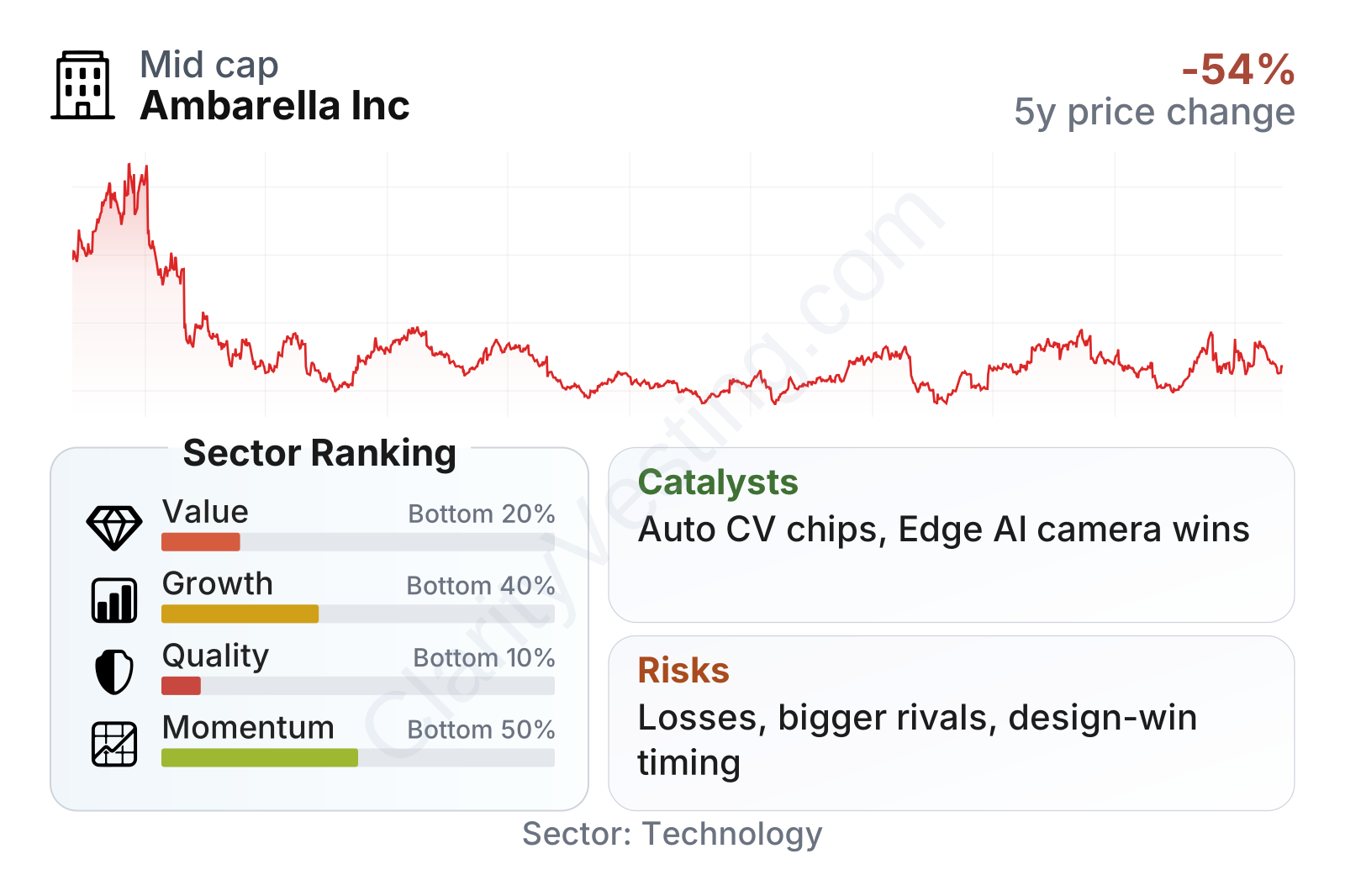
Ambarella sits in the smaller end of the listed technology universe, with a market value in the low single-digit billions, and the stock has been notably volatile, as shown by a beta above 2. The factor profile is mixed: balance-sheet leverage is very conservative and free cash flow has turned positive, but profitability and returns on capital still rank well below the sector. Growth is also uneven rather than clearly leading the group, while recent share-price performance has improved from weaker longer-term trends.
Growth
Ambarella operates in markets that are structurally attractive over the long run. Automotive electronics content continues to rise, especially in camera-based safety systems and assisted driving features. At the same time, more security, industrial, and enterprise devices are moving toward on-device AI, where low-power computer vision chips can become essential components. Those are favorable end markets even if near-term demand remains cyclical.
The company’s strategy is coherent. Instead of competing broadly across all semiconductors, Ambarella is concentrating on edge AI vision, where it combines image processing, video compression, and neural-network acceleration. That specialization gives it a clearer identity in niches where power efficiency, heat limits, and real-time processing matter. In automotive, the strategy is especially important because vehicle programs tend to last for years once a chip is designed in.
Revenue performance has been highly cyclical. After a sharp downturn in 2023 and early 2024, growth rebounded strongly and then moderated again into 2026, with the latest year-over-year increase around the low teens. That is still positive, but it shows that Ambarella is not in a straight-line expansion phase. The recent pattern looks more like a recovery from a weak base than a fully matured high-growth run.
Cash generation has improved more clearly than accounting profits. Free cash flow moved from a much weaker level in 2024 to a meaningfully stronger level by 2026. This suggests the business is regaining operating traction even before it returns to net profitability. For a company in a heavy investment phase, that is an encouraging sign because it reduces pressure on the balance sheet.
A key catalyst remains the expansion of AI-enabled vision in both automotive and intelligent camera systems. Recent company communications have emphasized continued customer adoption of its CVflow architecture and a growing pipeline tied to advanced driver assistance and edge AI applications. If those design wins convert into production at scale, revenue can become more durable and less dependent on older product categories.
Risks
This article is for informational purposes only and does not constitute financial advice. Some content is AI-generated. See Disclaimer


