Stock Analysis · Applied Materials Inc (AMAT)
Overview
Applied Materials is one of the largest suppliers of equipment, software, and services used to manufacture semiconductors and advanced displays. In simple terms, it sells the highly specialized tools that chipmakers need to build and improve the tiny circuits inside processors, memory chips, and many other electronic components. The company also provides support services that help customers keep those tools running efficiently over many years.
Its business is closely tied to long-term technology trends: more computing power, artificial intelligence infrastructure, advanced packaging, data centers, electric vehicles, and increasingly sophisticated electronics. Because Applied Materials sits upstream in the semiconductor supply chain, it benefits when major chip manufacturers expand capacity, upgrade production lines, or move to more advanced manufacturing methods.
Based on the company’s recent annual reporting, revenue is mainly generated from the following activities:
- Semiconductor Systems: about 72% of revenue. This is the core business and includes wafer fabrication equipment used for deposition, etching-related steps, ion implantation, process control, and other manufacturing stages needed to build logic, memory, and foundry chips.
- Applied Global Services: about 24% of revenue. This segment includes spare parts, maintenance, upgrades, optimization software, and long-term service agreements for the large installed base of equipment already operating at customer sites.
- Display and Adjacent Markets: about 4% of revenue. This area includes equipment for display manufacturing and selected adjacent technologies.
The company’s financial structure also shows a useful pattern for long-term analysis: revenue has continued to rise over the past several years, while gross profit and operating income have expanded faster than many peers. Research and development spending has also increased steadily, which is important in a business where technical leadership matters.
Over the last five reported fiscal years, Applied Materials has grown revenue from roughly $23 billion to more than $28 billion while also lifting operating income materially. At the same time, research and development spending has moved higher, showing that profitability has not come from cutting innovation.
Key Figures
| Metric | Value | Sector ⓘ |
|---|---|---|
| Date | Sep 12, 2026 | |
| Context | ||
| Sector | Technology | |
| Industry | Semiconductor Equipment & Materials | |
| Market Cap ⓘ | $362.27B | |
| Beta ⓘ | 1.60 | |
Value (Cheapness) | ||
| P/E Ratio ⓘ | 39.42 | 29.51 |
| FCF Yield ⓘ | 1.55% | 4.25% |
| EBIT / EV ⓘ | 2.65% | 2.85% |
| PEG ⓘ | 0.90 | |
Growth (Business expansion) | ||
| Revenue Growth ⓘ | 24.80% | 15.40% |
| RPS Growth (5Y CAGR) ⓘ | 8.76% | 8.56% |
| EPS Growth (5Y CAGR) ⓘ | 3.40% | -11.88% |
| Margin Growth (5Y Trend) ⓘ | 3.30% | 0.46% |
| FCF Growth (5Y CAGR) ⓘ | 4.52% | 9.80% |
Quality (Business durability) | ||
| ROIC (Latest) ⓘ | 31.37% | 9.44% |
| ROIC (5Y Median) ⓘ | 56.63% | 8.30% |
| Net Debt / EBIT (Latest) ⓘ | 0.01 | 0.54 |
| Net Debt / EBIT (5Y Median) ⓘ | -0.02 | 0.44 |
| Operating Margin (Latest) ⓘ | 36.72% | 9.58% |
| Operating Margin (5Y Median) ⓘ | 30.33% | 8.25% |
| Debt to Equity (Latest) ⓘ | 28.67% | 33.33% |
| Profit Margin (Latest) ⓘ | 30.05% | 7.14% |
| Free Cash Flow (Latest) ⓘ | $5.62B | |
Momentum (Price trend) | ||
| 3Y Return ⓘ | +224.59% | +45.48% |
| 12M Return (excl. last month) ⓘ | +193.01% | +23.48% |
| 6M Return ⓘ | +35.66% | +20.93% |
| Price vs. 200-Day MA ⓘ | +11.06% | +7.43% |
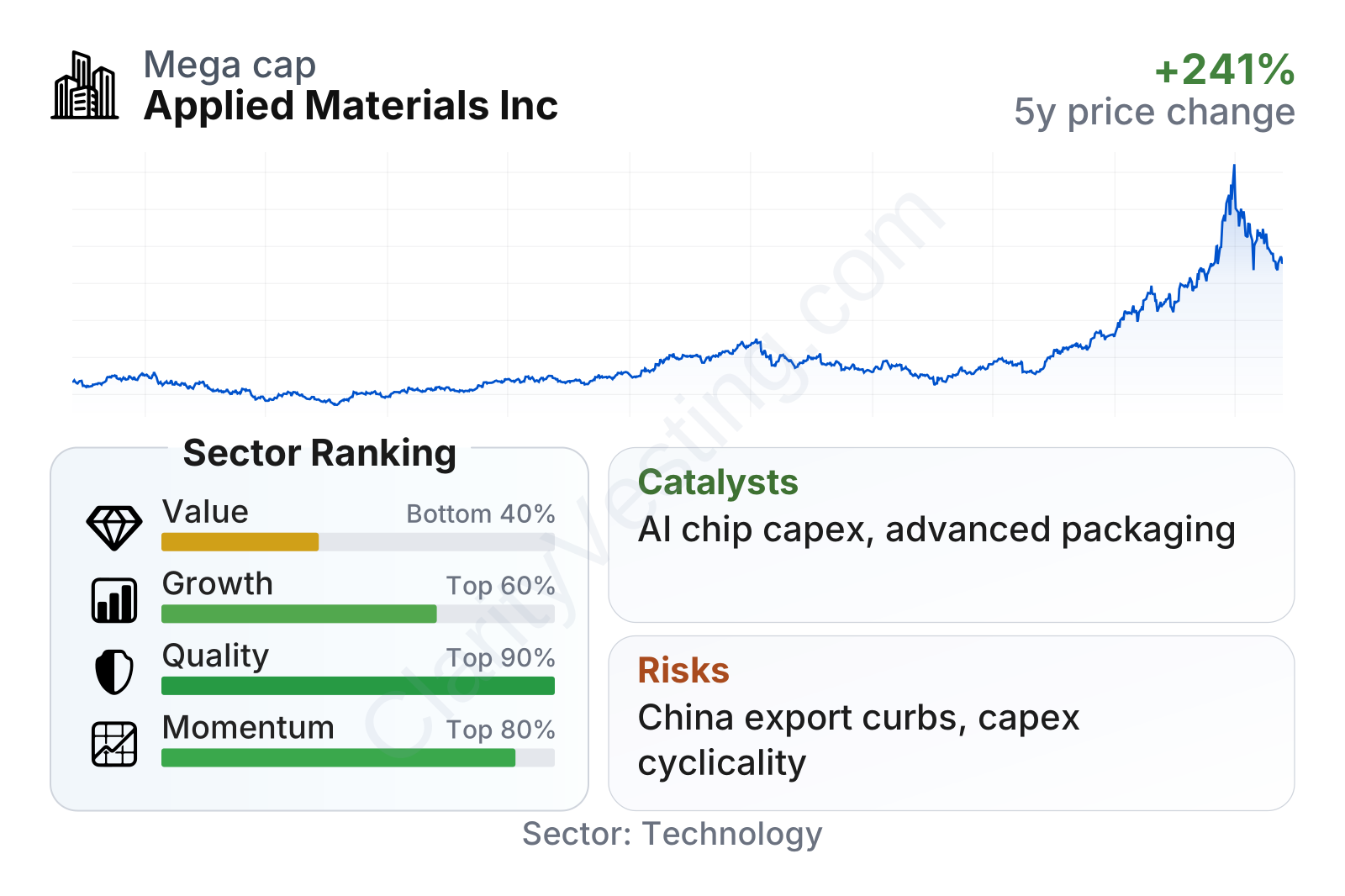
Applied Materials stands out most clearly on business quality. Profitability, return on invested capital, and balance-sheet strength are all well above typical sector levels. Growth metrics are also favorable overall, especially recent revenue growth and margin progression. The weaker area is valuation: the shares trade on a noticeably higher earnings multiple than the sector median, while free-cash-flow yield is lower, which implies the market is already pricing in a good amount of future progress.
The stock’s long-term price trend has been powerful, but also volatile. That is not unusual for a semiconductor equipment company, where sentiment can shift quickly as investors react to chip spending cycles, export restrictions, or changes in AI demand expectations.
Growth
Applied Materials operates in a sector with strong long-term expansion drivers. Semiconductor demand is being pushed by AI servers, cloud infrastructure, industrial automation, connected devices, and automotive electronics. Even when the industry goes through periodic slowdowns, the long-term direction has generally been toward more chips, more complex chips, and more capital spending to produce them.
Applied Materials’ strategy fits that environment well. The company is focused on enabling customers to improve performance, power efficiency, and manufacturing yields. That matters because progress in semiconductors is no longer only about making transistors smaller. Manufacturers now also rely more heavily on materials engineering, advanced packaging, heterogeneous integration, and process intensity. Those trends can increase the number of manufacturing steps per wafer, which can expand demand for the kind of tools Applied Materials sells.
Recent revenue growth shows the business moving from a softer patch back into a stronger expansion phase. After a period of flatter performance around 2023 and early 2024, growth reaccelerated meaningfully into 2026, and the latest year-over-year increase is comfortably ahead of the sector median. That suggests the company is participating in a stronger part of the current semiconductor spending cycle rather than merely keeping pace with it.
Cash generation has remained solid through the cycle. Free cash flow has moved up and down from year to year, which is normal in capital equipment, but it has stayed at a multi-billion-dollar level. That is important because it gives the company flexibility to fund research, manufacturing capacity, acquisitions, and shareholder returns without relying heavily on debt.
A meaningful catalyst is the rise of AI-related chip investment. Advanced logic and memory manufacturing typically requires more process complexity, and that can favor leading equipment suppliers. Applied Materials has also highlighted demand tied to gate-all-around transistors, backside power delivery, advanced packaging, and equipment upgrades for existing fabs. These are not one-time themes; they are part of the industry’s next generation of manufacturing transitions.
Another support factor is the services business. As the installed base of equipment grows, service revenue can become more recurring and less cyclical than new tool sales. That does not remove cyclicality, but it can soften the swings.
Recent company communications in 2026 have continued to emphasize resilient customer spending in advanced foundry-logic and AI-driven infrastructure, along with the importance of materials engineering in next-generation chip design. For long-term analysis, that is notable because it points to structural demand rather than a purely short-lived rebound.
Risks
This article is for informational purposes only and does not constitute financial advice. Some content is AI-generated. See Disclaimer


