Stock Analysis · Alarm.com Holdings Inc (ALRM)
Overview
Alarm.com Holdings is a software-centered security and automation company best known for the cloud platform that powers connected homes and small businesses. Its technology lets users monitor intrusion alarms, video cameras, locks, lights, thermostats, water sensors, and other devices through mobile apps and professional monitoring services. Rather than selling directly to most end users, the company mainly works through service providers such as security dealers, telecom operators, and managed service partners.
The business is built around a recurring-revenue model. Alarm.com develops the software platform, analytics, apps, and connected-service tools, while partners install systems and manage customer relationships. That structure matters for long-term analysis because recurring software and service revenue is usually steadier than one-time hardware sales.
Based on company filings, Alarm.com reports revenue in two main buckets.
- SaaS and license revenue: about 64% of 2025 revenue. This is the core of the business and includes subscription services sold through service provider partners, cloud platform access, video and analytics services, interactive security, automation, and certain software licensing activities.
- Hardware and other revenue: about 36% of 2025 revenue. This includes devices such as cameras, sensors, control panels, communication modules, and other connected equipment used with the platform, plus smaller non-recurring items.
That mix shows a company whose economics are primarily driven by software subscriptions, with hardware playing an important supporting role by helping place more systems onto its platform. Over time, this can create a useful cycle: more devices in the field can feed more recurring service revenue.
The broader financial flow also points to a software business with improving scale. Revenue has moved past $1.0 billion, gross profit has steadily expanded, and operating income has grown faster than sales over the last several years. Research and development remains a large expense line, which is normal for a company that needs to keep upgrading its platform and devices to stay relevant.
The business has become more efficient as it has grown. Revenue, gross profit, operating income, and net income have all trended upward over the last five annual periods, while operating expenses have risen more slowly than gross profit. That is a favorable sign for the underlying business model.
Key Figures
| Metric | Value | Sector ⓘ |
|---|---|---|
| Date | Sep 12, 2026 | |
| Context | ||
| Sector | Technology | |
| Industry | Software - Application | |
| Market Cap ⓘ | $2.71B | |
| Beta ⓘ | 0.76 | |
Value (Cheapness) | ||
| P/E Ratio ⓘ | 24.41 | 29.51 |
| FCF Yield ⓘ | 8.76% | 4.25% |
| EBIT / EV ⓘ | 6.13% | 2.85% |
| PEG ⓘ | 1.41 | |
Growth (Business expansion) | ||
| Revenue Growth ⓘ | 9.20% | 15.40% |
| RPS Growth (5Y CAGR) ⓘ | 4.44% | 8.56% |
| EPS Growth (5Y CAGR) ⓘ | -10.89% | -11.88% |
| Margin Growth (5Y Trend) ⓘ | 9.91% | 0.46% |
| FCF Growth (5Y CAGR) ⓘ | 11.80% | 9.80% |
Quality (Business durability) | ||
| ROIC (Latest) ⓘ | 8.14% | 9.44% |
| ROIC (5Y Median) ⓘ | 8.06% | 8.30% |
| Net Debt / EBIT (Latest) ⓘ | 0.52 | 0.54 |
| Net Debt / EBIT (5Y Median) ⓘ | -1.54 | 0.44 |
| Operating Margin (Latest) ⓘ | 16.09% | 9.58% |
| Operating Margin (5Y Median) ⓘ | 11.48% | 8.25% |
| Debt to Equity (Latest) ⓘ | 65.64% | 33.33% |
| Profit Margin (Latest) ⓘ | 11.11% | 7.14% |
| Free Cash Flow (Latest) ⓘ | $237.16M | |
Momentum (Price trend) | ||
| 3Y Return ⓘ | -5.75% | +45.48% |
| 12M Return (excl. last month) ⓘ | +0.84% | +23.48% |
| 6M Return ⓘ | +18.04% | +20.93% |
| Price vs. 200-Day MA ⓘ | +12.66% | +7.43% |
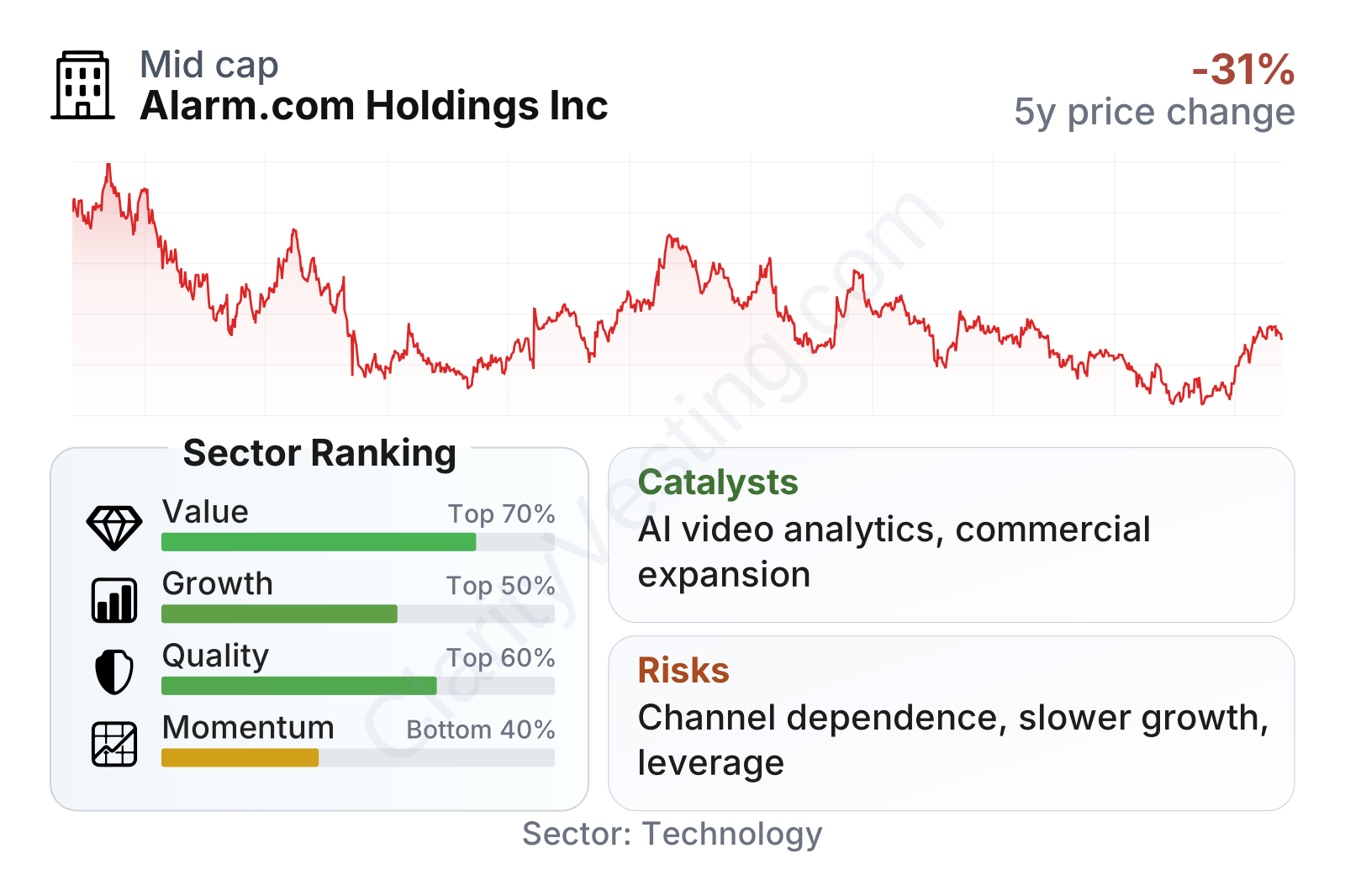
Alarm.com is a mid-sized software company with a relatively low beta of about 0.76, which means its share price has historically moved less sharply than the overall market. On valuation and cash generation, the picture looks stronger than the sector median: its P/E is below many software peers, while free cash flow yield and EBIT relative to enterprise value are notably better. Growth is more mixed. Recent revenue growth is around 9%, which is positive but slower than the typical software company in its sector. Profitability, however, is clearly solid, with operating and net margins above sector medians. Market momentum has been less impressive over longer periods even though the more recent six-month trend has improved.
Growth
Alarm.com operates in an attractive part of the market: connected security, smart home services, commercial video, and remote property management. These are supported by long-term trends that are easier to understand than many other technology themes. Homes and businesses are adding more connected devices, more video, more remote control features, and more automation. Insurance, energy savings, safety, and convenience all support demand, which makes the category more resilient than areas driven only by consumer gadget upgrades.
The company’s strategy is also coherent. It is not trying to win mainly by selling a single device. Instead, it is building a platform that connects many functions: security monitoring, access control, video, energy management, water detection, and analytics. That platform approach can make the service more valuable over time because each added feature can deepen customer usage and raise switching costs for service providers and end users.
Revenue growth has cooled from the much faster pace seen in 2021 and early 2022, but it has remained positive and recently improved back toward high-single-digit to low-double-digit levels. That suggests a business that is still expanding, although no longer in a rapid-growth phase. For a long-term view, the more important point is that growth has not disappeared while profitability has improved.
Cash generation supports that point. Free cash flow rose sharply from earlier levels and has stayed at a healthy level, even with some fluctuations. Over a five-year span, free cash flow growth has outpaced the sector median, which is a meaningful signal because cash is harder to manufacture than reported earnings. A business that can keep converting recurring revenue into cash has more flexibility for product development, acquisitions, and balance sheet management.
Recent company developments also reinforce the growth case. Alarm.com has continued expanding commercial offerings such as access control, video analytics, gunshot detection, and energy management, while also pushing further into adjacent property technology categories through earlier acquisitions and platform extensions. These moves matter because commercial and multifamily customers can carry larger contract values than a basic residential system and may create broader cross-selling opportunities.
Another visible catalyst is the rise of AI-enabled video and automation features. Alarm.com has been adding analytics that can improve detection, filtering, and operational insights for users. If these tools continue to become more useful in real-world deployments, they can help the company raise the value of subscriptions without needing the business to rely only on new customer additions.
Risks
This article is for informational purposes only and does not constitute financial advice. Some content is AI-generated. See Disclaimer


