Stock Analysis · Allient Inc (ALNT)
Overview
Allient Inc is a motion, controls, and power technology company. In simple terms, it makes the components and systems that help machines move, control speed and position, and manage electrical power. Its products are used in areas such as industrial automation, medical equipment, robotics, aerospace and defense, transportation, and other specialized machinery. The company was previously known as Allied Motion Technologies and changed its name to Allient to reflect a broader solutions focus.
Its business is built around selling engineered components and integrated systems rather than one mass-market product. That gives it exposure to several long-term themes, especially factory automation, electrification, and higher-precision equipment.
Based on company disclosures, revenue is mainly generated from product families tied to motion control and power systems. Precise percentages can vary by year, but the business is broadly centered on the following sources:
- Motion control products and systems — the largest revenue source, including motors, servo systems, drives, encoders, and related controls used to create and manage movement in equipment.
- Power quality and conversion solutions — a meaningful secondary source, including power electronics and systems that condition, convert, or manage electrical power in industrial and transportation applications.
- Integrated solutions and engineered assemblies — customized combinations of motion, control, and power products built for customer-specific applications.
- Aftermarket and other sales — a smaller source, including replacement demand and related support tied to installed equipment.
The company reports through a global operating structure rather than a simple consumer-facing brand model, so the clearest way to understand it is as a niche industrial technology supplier serving business customers that need reliable, application-specific components.
The financial flow over the last several years shows a business that expanded revenue strongly through 2023, faced a softer 2024, and then recovered in 2025. Gross profit has remained substantial, while operating income improved notably in 2025, though interest expense also rose and limited the translation of operating gains into net income.
Key Figures
| Metric | Value | Sector ⓘ |
|---|---|---|
| Date | Sep 12, 2026 | |
| Context | ||
| Sector | Technology | |
| Industry | Electronic Components | |
| Market Cap ⓘ | $1.68B | |
| Beta ⓘ | 1.62 | |
Value (Cheapness) | ||
| P/E Ratio ⓘ | 55.12 | 29.51 |
| FCF Yield ⓘ | 1.64% | 4.25% |
| EBIT / EV ⓘ | 3.11% | 2.85% |
| PEG ⓘ | N/A | |
Growth (Business expansion) | ||
| Revenue Growth ⓘ | 10.20% | 15.40% |
| RPS Growth (5Y CAGR) ⓘ | 4.49% | 8.56% |
| EPS Growth (5Y CAGR) ⓘ | -6.27% | -11.88% |
| Margin Growth (5Y Trend) ⓘ | 3.67% | 0.46% |
| FCF Growth (5Y CAGR) ⓘ | 43.60% | 9.80% |
Quality (Business durability) | ||
| ROIC (Latest) ⓘ | 8.90% | 9.44% |
| ROIC (5Y Median) ⓘ | 7.56% | 8.30% |
| Net Debt / EBIT (Latest) ⓘ | 2.84 | 0.54 |
| Net Debt / EBIT (5Y Median) ⓘ | 5.84 | 0.44 |
| Operating Margin (Latest) ⓘ | 9.51% | 9.58% |
| Operating Margin (5Y Median) ⓘ | 6.53% | 8.25% |
| Debt to Equity (Latest) ⓘ | 63.13% | 33.33% |
| Profit Margin (Latest) ⓘ | 4.98% | 7.14% |
| Free Cash Flow (Latest) ⓘ | $27.50M | |
Momentum (Price trend) | ||
| 3Y Return ⓘ | +215.47% | +45.48% |
| 12M Return (excl. last month) ⓘ | +147.80% | +23.48% |
| 6M Return ⓘ | +54.65% | +20.93% |
| Price vs. 200-Day MA ⓘ | +32.89% | +7.43% |
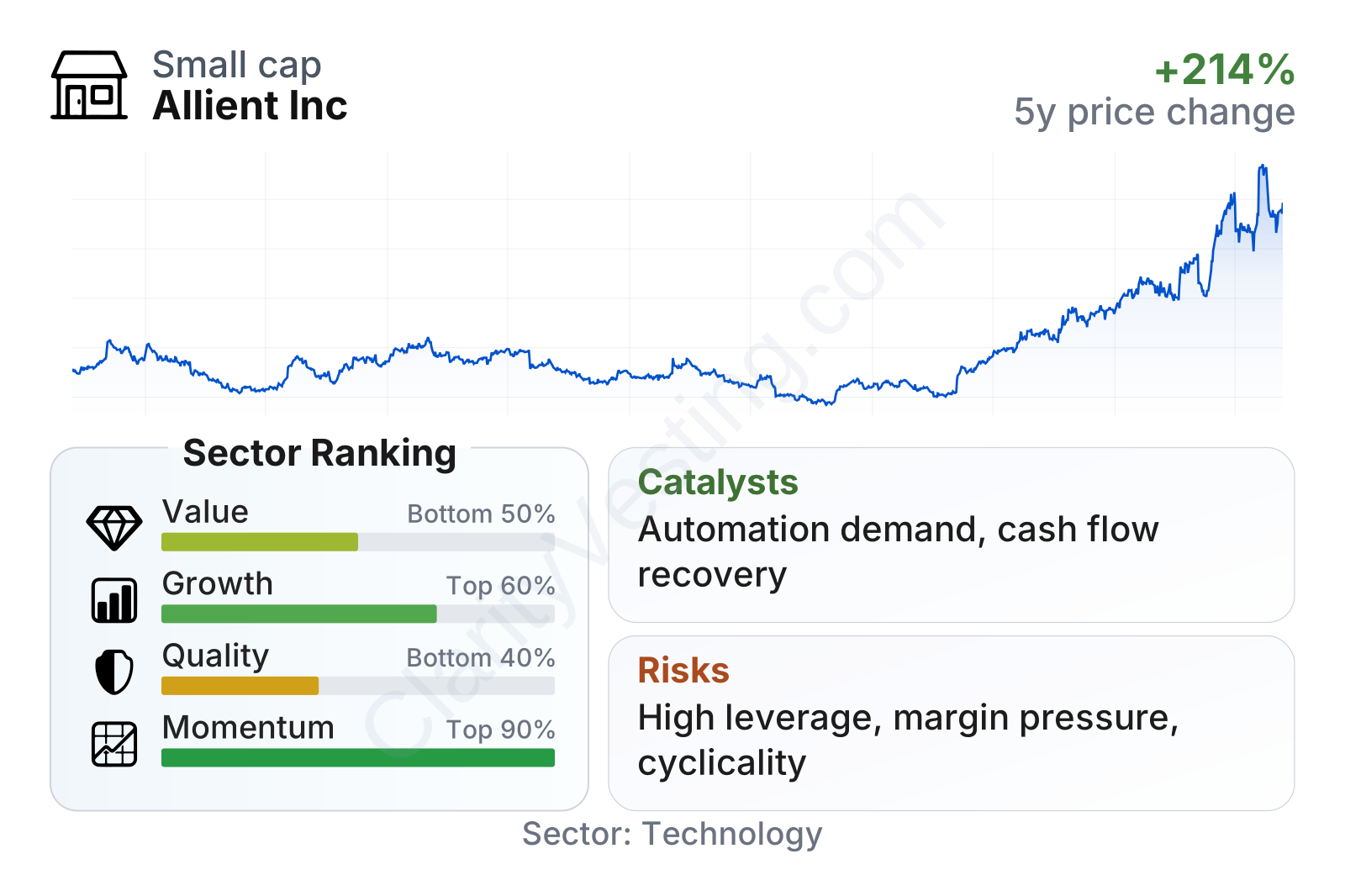
Allient is a mid-sized company in its sector, with a stock that has been much more volatile than the broader market, as suggested by a beta above 1.5. The stock’s recent momentum has been exceptionally strong relative to most technology peers, but the underlying factor picture is more mixed. Growth and momentum rank better than value and quality, which suggests the market has rewarded improving business conditions faster than fundamentals have fully caught up.
Valuation metrics are on the rich side compared with the sector median, while free cash flow yield looks relatively modest. At the same time, operating margin is around the sector median and long-term free cash flow growth has been much stronger than typical peers. That combination points to a company with improving operating discipline, but also a stock price that already reflects a meaningful amount of optimism.
Growth
Allient operates in markets with credible long-term growth drivers. Industrial automation continues to expand as manufacturers seek labor efficiency, precision, and uptime. Electrification is also a durable theme, especially where motion systems and power conversion are needed in transport, medical devices, and advanced equipment. These are not short-lived trends; they are part of a broader shift toward smarter, more efficient machines.
The company’s strategy also makes practical sense for future growth. Instead of competing only on commodity components, it aims to provide more complete motion and power solutions. That can deepen customer relationships, raise switching costs, and make Allient more relevant on complex projects where engineering support matters as much as unit price.
Revenue growth has clearly been uneven. The company moved from very strong expansion in 2022 and 2023 into contraction during much of 2024, then returned to positive year-over-year growth through 2025 and into 2026. The latest pace, roughly around 10%, is respectable, but still below the sector median. In other words, growth has resumed, yet the company is not currently outgrowing its broader peer group by a wide margin.
Free cash flow is one of the more encouraging areas. It improved from negative territory in 2022 to consistently positive levels in the following years, and has stayed around the low tens of millions of dollars on a trailing basis. For a company of this size, that matters because it supports debt reduction, investment in engineering, and resilience during slower demand periods.
A meaningful catalyst is the company’s exposure to defense, aerospace, medical, and industrial automation programs where product qualification cycles can be long and supply relationships can last for years. Another potential growth driver is continued demand for higher-performance motion systems in robotics and automated manufacturing. Recent company communications have also emphasized operational execution and a focus on higher-value applications, which is important because stronger mix can help margins even when revenue growth is not spectacular.
Risks
This article is for informational purposes only and does not constitute financial advice. Some content is AI-generated. See Disclaimer