Stock Analysis · Alkami Technology Inc (ALKT)
Overview
Alkami Technology is a software company focused on digital banking. Its platform helps banks and credit unions offer online and mobile banking services to retail and business customers. In practical terms, Alkami provides the technology behind functions such as account access, payments, transfers, alerts, card controls, onboarding, financial wellness tools, business banking features, and marketing or data-driven engagement tools. The company mainly serves U.S. financial institutions, especially community, regional, and super-regional banks as well as credit unions.
Its business model is largely subscription-based, which means customers typically sign multi-year contracts and pay recurring fees to use the platform. That makes revenue more predictable than in one-time software sales models. Based on recent company filings, Alkami’s revenue is primarily split between subscription and services revenue, with subscription revenue clearly dominant.
- Subscription revenue: about 93% to 95% of total revenue. This includes recurring fees for access to Alkami’s cloud-based digital banking platform and related products, often priced based on registered users, transaction activity, or product modules adopted.
- Services and other revenue: about 5% to 7% of total revenue. This includes implementation, professional services, and other support tied to customer launches, migrations, and product deployments.
The broader financial picture shows a business that has scaled quickly. Revenue has expanded strongly over the last several years, and gross profit has risen with it. Operating losses are still present, but they have narrowed compared with earlier periods, while free cash flow has moved from negative territory to positive. That combination is typical of a software company moving from heavy expansion toward greater operating discipline.
One notable pattern is that revenue and gross profit have both grown substantially over time, while spending on research and development and selling expenses has also remained high. This suggests Alkami is still investing heavily to expand its product set and customer base, even as cash generation has improved.
Key Figures
| Metric | Value | Sector ⓘ |
|---|---|---|
| Date | Sep 12, 2026 | |
| Context | ||
| Sector | Technology | |
| Industry | Software - Application | |
| Market Cap ⓘ | $2.04B | |
| Beta ⓘ | 0.61 | |
Value (Cheapness) | ||
| P/E Ratio ⓘ | N/A | 29.51 |
| FCF Yield ⓘ | 3.19% | 4.25% |
| EBIT / EV ⓘ | -1.81% | 2.85% |
| PEG ⓘ | N/A | |
Growth (Business expansion) | ||
| Revenue Growth ⓘ | 15.90% | 15.40% |
| RPS Growth (5Y CAGR) ⓘ | 26.05% | 8.56% |
| EPS Growth (5Y CAGR) ⓘ | N/A | -11.88% |
| Margin Growth (5Y Trend) ⓘ | N/A | 0.46% |
| FCF Growth (5Y CAGR) ⓘ | N/A | 9.80% |
Quality (Business durability) | ||
| ROIC (Latest) ⓘ | -4.54% | 9.44% |
| ROIC (5Y Median) ⓘ | -10.93% | 8.30% |
| Net Debt / EBIT (Latest) ⓘ | N/A | 0.54 |
| Net Debt / EBIT (5Y Median) ⓘ | N/A | 0.44 |
| Operating Margin (Latest) ⓘ | -8.40% | 9.58% |
| Operating Margin (5Y Median) ⓘ | -20.95% | 8.25% |
| Debt to Equity (Latest) ⓘ | 98.75% | 33.33% |
| Profit Margin (Latest) ⓘ | -9.21% | 7.14% |
| Free Cash Flow (Latest) ⓘ | $65.10M | |
Momentum (Price trend) | ||
| 3Y Return ⓘ | +16.53% | +45.48% |
| 12M Return (excl. last month) ⓘ | -7.04% | +23.48% |
| 6M Return ⓘ | +13.50% | +20.93% |
| Price vs. 200-Day MA ⓘ | +11.20% | +7.43% |
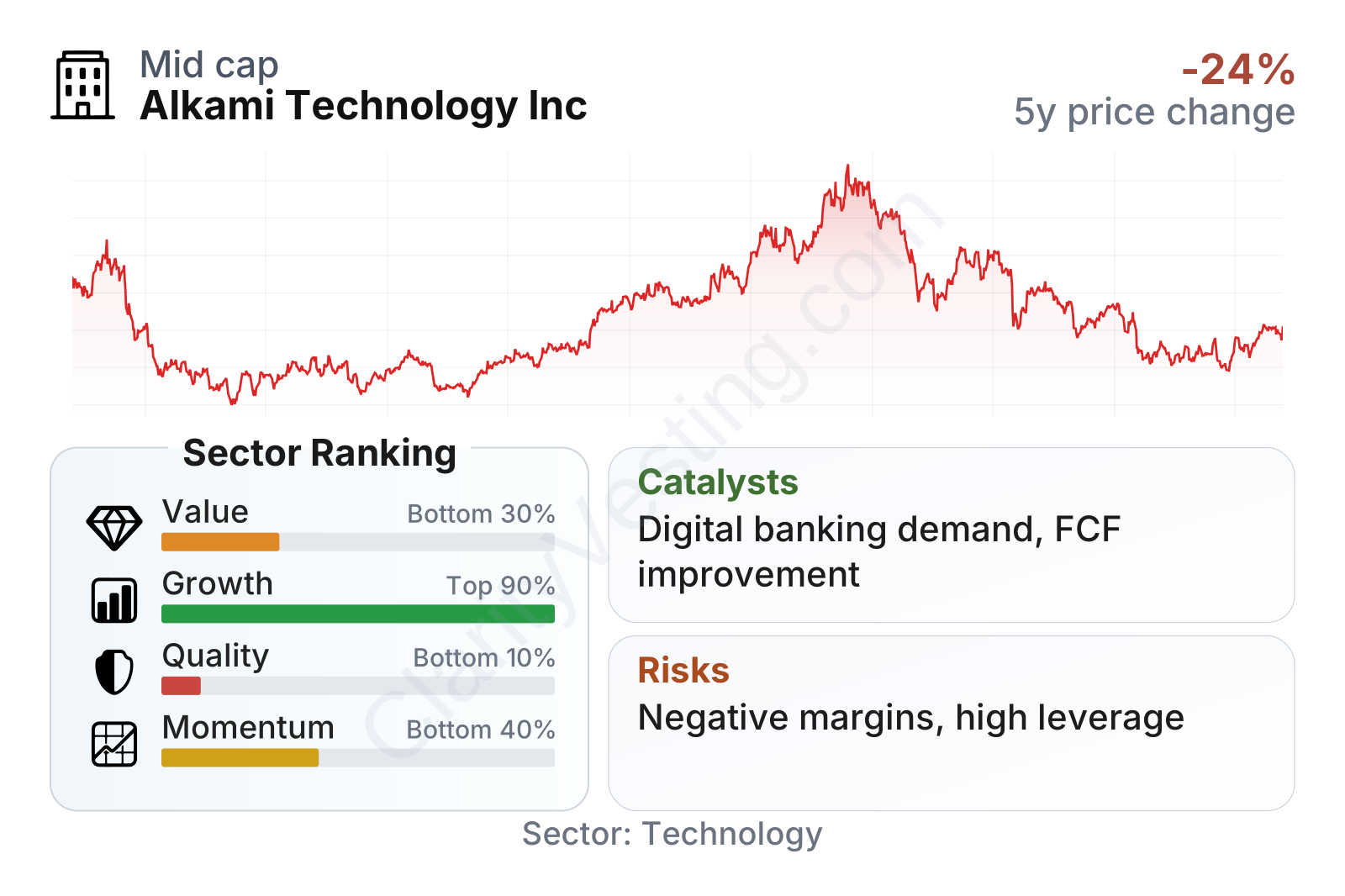
Alkami is a mid-sized software company with relatively low share-price volatility compared with many technology stocks, as reflected by a beta well below 1. In the factor breakdown, growth stands out as the strongest area, ranking near the top of the sector, while quality and value are weaker. That mix fits a company that is growing faster than many peers but has not yet reached the profitability levels usually associated with mature software businesses.
The stock’s history also shows that market sentiment has changed sharply over time. After a strong rebound through 2024, the shares lost momentum through 2025 and into 2026. That decline appears connected less to a collapse in the business itself and more to the market reassessing how much it is willing to pay for growth that has not fully translated into accounting profits yet.
Growth
Alkami operates in a sector with long-term structural support. Banks and credit unions are still shifting more customer activity toward digital channels, and many smaller institutions need modern platforms to keep up with large national banks and fintech apps. That gives specialist vendors like Alkami a clear addressable market: financial institutions that want better digital capabilities but do not want to build everything in-house.
The company’s strategy is logical for this environment. It is not just offering a basic online banking interface; it is trying to become a broader operating layer for digital engagement, product cross-sell, account opening, data analytics, and business banking. That matters because a broader platform can deepen customer relationships, raise switching costs, and create more cross-selling opportunities inside the existing client base.
Revenue growth has been strong for several years, often well above the software sector median, although the most recent pace has cooled compared with earlier peaks. Even with that slowdown, Alkami still appears to be growing faster than many peers. Its five-year revenue-per-share growth is especially strong, which supports the view that the company has built real scale rather than relying only on short-lived demand.
A particularly important improvement is cash generation. Free cash flow was negative for years, then turned positive and has improved meaningfully. For a long-term business analysis, that is one of the clearest signals that the model may be maturing: the company is still expanding, but it is no longer consuming cash at the same rate. If Alkami can keep growing while sustaining positive free cash flow, that would strengthen the case that its economics are improving in a durable way.
Another growth driver is customer expansion within existing accounts. Digital banking platforms can add more value over time as institutions adopt more modules, increase user activity, and roll out more services to business customers. Public company materials have also highlighted acquisitions and product additions aimed at strengthening data, marketing, and account-opening capabilities, which can support broader wallet share per customer if integration is executed well.
Recent company updates have also pointed to ongoing product innovation around user experience, data-driven personalization, and deeper capabilities for banks and credit unions serving both consumers and businesses. These are meaningful opportunities because financial institutions increasingly want one platform that can unify engagement, service, and growth tools rather than a patchwork of vendors.
Risks
This article is for informational purposes only and does not constitute financial advice. Some content is AI-generated. See Disclaimer


