Stock Analysis · Alight Inc (ALIT)
Overview
Alight Inc is a software and services company focused on human resources, payroll, benefits administration, and employee well-being programs. In simple terms, it helps large employers manage important workforce tasks such as paying employees, handling retirement and health benefits, supporting leave programs, and giving workers digital tools to make benefits choices. Its customers are mainly large organizations that want to outsource complex HR administration and use a single platform for several employee-related functions.
The company’s business is built around recurring contracts with employers, often supported by cloud-based technology and long implementation cycles. That model can create sticky customer relationships because changing payroll and benefits systems is difficult, time-consuming, and risky for clients.
Based on company reporting, Alight’s revenue is mainly generated from employer-focused recurring service and software arrangements, with the largest contributions coming from HR and payroll administration, followed by benefits administration and broader professional or implementation-related services. Public filings do not always give a simple consumer-style breakdown with exact percentages for every line item, but the business mix is broadly concentrated in the following areas:
- Recurring employer solutions: the largest source of revenue, generally the clear majority of the business. This includes ongoing contracts for payroll, HR, and benefits administration delivered through Alight’s platform.
- Benefits administration and enrollment services: a major component within recurring revenue, covering health, wealth, retirement, and leave-related administration.
- Professional and implementation services: a smaller revenue source tied to onboarding clients, configuring systems, consulting, and project-based work.
At a high level, the business has shown an important mismatch between cash generation and accounting earnings. Alight has been able to produce meaningful free cash flow, but reported profit has remained weak and volatile, with sizeable charges pushing net income deep into negative territory in recent periods. That gap is central to understanding the company.
The long-term pattern shows that revenue and gross profit have been large enough to support a substantial business, but operating costs, restructuring effects, and other charges have repeatedly prevented those sales from turning into stable net profit.
Key Figures
| Metric | Value | Sector ⓘ |
|---|---|---|
| Date | Sep 12, 2026 | |
| Context | ||
| Sector | Technology | |
| Industry | Software - Application | |
| Market Cap ⓘ | $694.46M | |
| Beta ⓘ | 1.59 | |
Value (Cheapness) | ||
| P/E Ratio ⓘ | N/A | 29.51 |
| FCF Yield ⓘ | 35.86% | 4.25% |
| EBIT / EV ⓘ | -69.95% | 2.85% |
| PEG ⓘ | N/A | |
Growth (Business expansion) | ||
| Revenue Growth ⓘ | -3.20% | 15.40% |
| RPS Growth (5Y CAGR) ⓘ | -10.32% | 8.56% |
| EPS Growth (5Y CAGR) ⓘ | -47.26% | -11.88% |
| Margin Growth (5Y Trend) ⓘ | N/A | 0.46% |
| FCF Growth (5Y CAGR) ⓘ | 297.64% | 9.80% |
Quality (Business durability) | ||
| ROIC (Latest) ⓘ | -38.30% | 9.44% |
| ROIC (5Y Median) ⓘ | -0.52% | 8.30% |
| Net Debt / EBIT (Latest) ⓘ | N/A | 0.54 |
| Net Debt / EBIT (5Y Median) ⓘ | N/A | 0.44 |
| Operating Margin (Latest) ⓘ | -72.12% | 9.58% |
| Operating Margin (5Y Median) ⓘ | -1.93% | 8.25% |
| Debt to Equity (Latest) ⓘ | 201.46% | 33.33% |
| Profit Margin (Latest) ⓘ | -90.90% | 7.14% |
| Free Cash Flow (Latest) ⓘ | $249.00M | |
Momentum (Price trend) | ||
| 3Y Return ⓘ | -90.98% | +45.48% |
| 12M Return (excl. last month) ⓘ | -82.24% | +23.48% |
| 6M Return ⓘ | -54.25% | +20.93% |
| Price vs. 200-Day MA ⓘ | -42.36% | +7.43% |
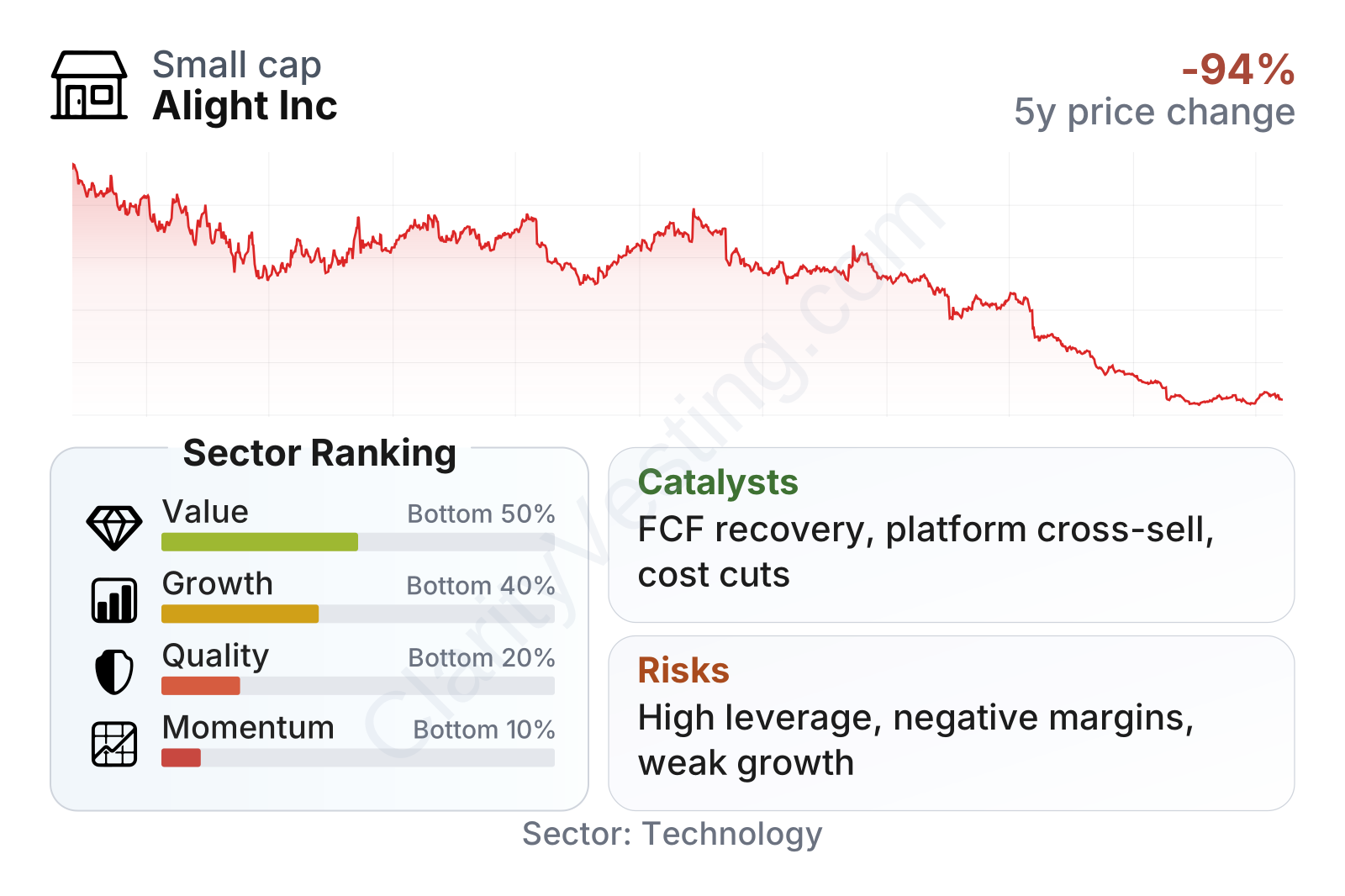
Alight is now a relatively small public company by market value, and the stock’s volatility is high, with a beta well above 1. The factor summary points to a mixed picture: cash flow-based value metrics look unusually strong, but growth, profitability, balance-sheet strength, and market performance all rank in the weaker part of the software sector. In other words, the stock looks statistically cheap on some cash flow measures, but that discount is happening alongside weak margins, negative returns on capital, and significant price deterioration.
The share-price history reflects that tension clearly. The stock has fallen sharply from its earlier post-listing levels, suggesting that the market has steadily reduced expectations around growth, profitability, or both.
Growth
Alight operates in a sector with favorable long-term demand drivers. Large employers continue to digitize HR processes, automate payroll, reduce administrative complexity, and outsource benefits management to specialized providers. Regulatory complexity in health, retirement, tax, and leave administration also supports demand for scaled platforms that can handle compliance and employee support at the same time.
Its strategy is logical for that environment. Alight has tried to combine software, analytics, and outsourced administration into one platform, which can make it more useful to large employers than a narrow single-function tool. Cross-selling is an important part of the model: a client that starts with benefits administration can potentially add payroll, leave management, and other workforce services over time.
That said, the recent growth record has been underwhelming. Revenue growth has moved from positive levels earlier in the period to repeated declines, including low-single-digit contraction more recently. Compared with the broader software sector, this places Alight well behind the median growth rate. For a company in a technology-enabled services niche, that is a meaningful weakness because scale is often needed to absorb operating costs and improve margins.
The more constructive element is cash generation. Free cash flow has improved substantially from negative territory a few years ago to a clearly positive level in the latest trailing period, despite swings along the way. That matters because it suggests the underlying client base and contract structure still produce real cash even while accounting profit remains poor. If management can stabilize revenue and reduce exceptional charges, that cash profile could become a more important part of the investment case.
A notable potential catalyst is any evidence that Alight can convert its installed base into more recurring platform revenue while simplifying the business and cutting costs. Public company communications in recent periods have emphasized transformation efforts, productivity improvements, and a focus on operating execution. If those efforts translate into steadier sales retention and cleaner margins, the market could start valuing the company more on normalized cash earnings than on headline losses.
Risks
This article is for informational purposes only and does not constitute financial advice. Some content is AI-generated. See Disclaimer


