Stock Analysis · Allegro Microsystems Inc (ALGM)
Overview
Allegro Microsystems is a semiconductor company focused on sensing and power chips. In simple terms, it makes the components that help electronic systems detect movement, position, speed, current, and magnetic fields, while also managing and converting electrical power efficiently. Its products are widely used in vehicles, industrial equipment, and some consumer and enterprise applications. The company is especially known for magnetic sensing and power integrated circuits, two categories that fit well with long-term trends such as vehicle electrification, advanced driver assistance systems, factory automation, and energy-efficient electronics.
The business is still heavily centered on automotive and industrial customers. Based on the company’s recent annual filing for fiscal 2026, automotive is the largest end market by a wide margin, with industrial the second pillar and all other markets much smaller.
- Automotive: about 79% of revenue. This includes chips used in electric powertrains, onboard chargers, battery systems, motor control, steering, braking, thermal management, and safety-related sensing.
- Industrial: about 12% of revenue. This covers factory automation, robotics, data center power infrastructure, clean energy applications, and motion or current sensing in industrial systems.
- Other markets: about 9% of revenue. This mainly includes consumer, enterprise, and miscellaneous applications.
Geographically, Allegro sells globally, but its demand is tied more to where customers manufacture electronics and vehicles than to the location of final consumers. The company operates as a fabless designer for much of its portfolio, while also using internal manufacturing capabilities and external foundry and assembly partners. That mixed model can support product control and customer relationships, but it also adds execution complexity.
The multi-year financial picture shows a clear cycle: revenue climbed strongly through fiscal 2024, then dropped sharply in fiscal 2025 as customers reduced inventory and industrial demand weakened, before recovering in fiscal 2026. Gross profit remains meaningful, but operating income and net income were pressured by higher costs and interest expense.
Over the last several years, the company expanded revenue materially before hitting a downcycle. The latest year shows a rebound in sales, but profitability has not yet fully recovered, partly because operating expenses and interest costs remain elevated.
Key Figures
| Metric | Value | Sector ⓘ |
|---|---|---|
| Date | Sep 12, 2026 | |
| Context | ||
| Sector | Technology | |
| Industry | Semiconductors | |
| Market Cap ⓘ | $6.57B | |
| Beta ⓘ | 1.91 | |
Value (Cheapness) | ||
| P/E Ratio ⓘ | N/A | 29.51 |
| FCF Yield ⓘ | 1.34% | 4.25% |
| EBIT / EV ⓘ | 0.52% | 2.85% |
| PEG ⓘ | N/A | |
Growth (Business expansion) | ||
| Revenue Growth ⓘ | 27.50% | 15.40% |
| RPS Growth (5Y CAGR) ⓘ | 4.63% | 8.56% |
| EPS Growth (5Y CAGR) ⓘ | -48.18% | -11.88% |
| Margin Growth (5Y Trend) ⓘ | -16.56% | 0.46% |
| FCF Growth (5Y CAGR) ⓘ | 9.72% | 9.80% |
Quality (Business durability) | ||
| ROIC (Latest) ⓘ | 9.48% | 9.44% |
| ROIC (5Y Median) ⓘ | 13.59% | 8.30% |
| Net Debt / EBIT (Latest) ⓘ | 3.51 | 0.54 |
| Net Debt / EBIT (5Y Median) ⓘ | -0.59 | 0.44 |
| Operating Margin (Latest) ⓘ | 3.77% | 9.58% |
| Operating Margin (5Y Median) ⓘ | 18.64% | 8.25% |
| Debt to Equity (Latest) ⓘ | 29.78% | 33.33% |
| Profit Margin (Latest) ⓘ | 1.50% | 7.14% |
| Free Cash Flow (Latest) ⓘ | $88.32M | |
Momentum (Price trend) | ||
| 3Y Return ⓘ | +6.79% | +45.48% |
| 12M Return (excl. last month) ⓘ | +33.18% | +23.48% |
| 6M Return ⓘ | +16.53% | +20.93% |
| Price vs. 200-Day MA ⓘ | -8.48% | +7.43% |
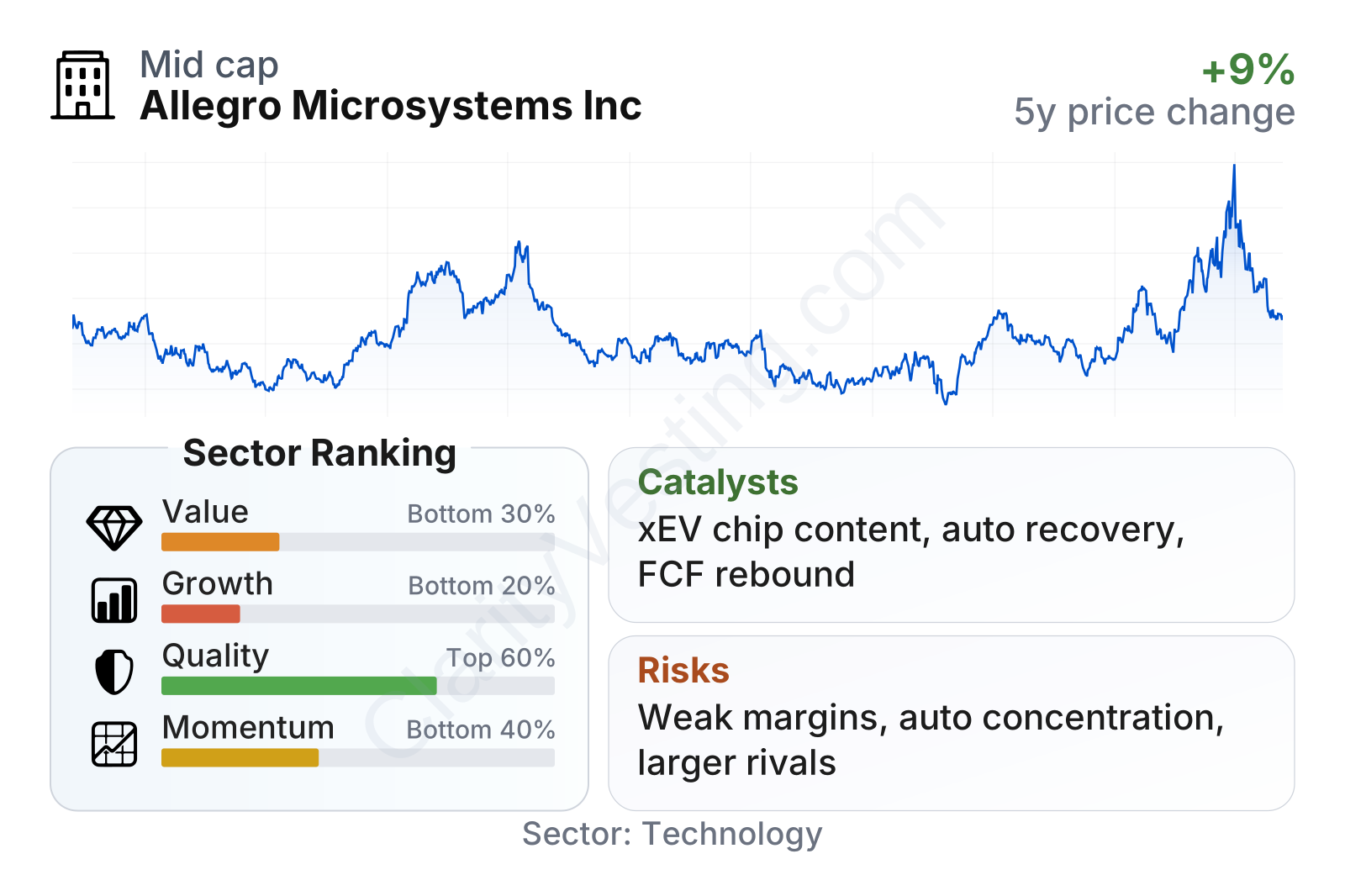
Allegro sits in the mid-cap range and its stock has been volatile, with a beta close to 1.9. The share price recovery over the last year has been much stronger than the sector median, but the longer three-year record is still weaker than many semiconductor peers. On the fundamentals table, the strongest area is quality over a five-year view, especially historical returns on invested capital and past margin strength. The weaker areas are current valuation and near-term growth quality, mainly because margins and earnings remain depressed even as revenue growth has improved again.
Growth
Allegro operates in a part of the semiconductor market that still has favorable structural demand. Vehicles are becoming more electronic, more connected, and more power-intensive. Electric vehicles need more current sensing, position sensing, and power management than many traditional internal combustion vehicles. Advanced driver assistance features also increase semiconductor content. In industrial markets, automation, robotics, and efficient power conversion create similar demand for analog and sensor chips.
The company’s strategy broadly makes sense for these trends. It is concentrating on higher-value niches rather than trying to compete across the entire chip industry. Magnetic sensors and power semiconductors are specialized categories where design know-how, reliability qualifications, and customer integration matter. In automotive, product qualification cycles can be long, which may help protect future revenue once a component is designed into a vehicle platform.
Recent revenue growth suggests that Allegro is coming out of a difficult inventory correction. Growth turned negative during 2024 and early 2025, then moved back into positive territory and recently reached the high-20% range year over year, well above the sector median. That matters because it indicates that demand recovery is not just theoretical; it is already visible in the company’s sales trend.
Cash generation also improved. Free cash flow had weakened significantly during the downturn, but the latest trailing twelve-month level rebounded to well above prior trough levels. That does not erase earnings pressure, but it does show the business still has an ability to convert recovery into cash.
A notable strategic catalyst is the company’s positioning in e-mobility and xEV applications. Management has continued to highlight design wins in traction inverters, battery management-related sensing, and thermal and motion applications. Another important opportunity is industrial power, including data center and automation-related uses where efficient power conversion is becoming more valuable. Recent company communications also point to product expansion in higher-performance sensing and power technologies, which could lift content per vehicle and per industrial system if adoption continues.
Risks
This article is for informational purposes only and does not constitute financial advice. Some content is AI-generated. See Disclaimer


