Stock Analysis · Alpha Bank SA (ALBKY)
Overview
Alpha Bank SA is one of the largest banks in Greece. It provides everyday banking services to households, small businesses, larger companies, and institutional clients. Its activities include taking deposits, making loans, payment services, cards, wealth products, insurance-related distribution, and financing for corporate and project customers. The bank also has operations outside Greece, mainly in Cyprus and selected markets in Southeastern Europe, but Greece remains the core of the business.
For a bank, revenue is not as simple as selling products. The biggest source usually comes from the spread between what the bank earns on loans and what it pays on deposits and funding. Alpha Bank’s recent results fit that pattern, with interest income clearly dominating the business, while fees provide a smaller but still important contribution.
Main revenue sources can be summarized as follows:
- Net interest income: approximately 75% to 85% of operating income in recent periods. This is the core banking engine and comes mainly from mortgages, business loans, consumer lending, and liquidity placement, minus interest paid on deposits and other funding.
- Fee and commission income: approximately 15% to 25%. This includes payment services, cards, asset management, bancassurance distribution, transaction banking, and lending-related fees.
- Trading and other income: usually a smaller and more variable share. This can include gains or losses from securities, treasury activity, and other non-recurring items.
Geographically, the business is heavily concentrated in Greece, which means Alpha Bank is closely tied to the direction of the Greek economy, credit demand, property activity, and interest-rate conditions in the euro area.
Over the last few years, the bank’s income profile has improved sharply. Revenue moved from a weak base in 2021 to a much stronger level in 2023-2025, while net income also turned from a large loss to solid profitability. Operating costs have been relatively more contained than revenue growth, which points to a healthier banking franchise than the one Alpha Bank had a few years ago.
The broad trend is encouraging: revenue and profit have recovered strongly since 2021, and the cost base has grown much more slowly than income. That suggests the bank has benefited from both better operating conditions and internal restructuring.
Key Figures
| Metric | Value | Sector ⓘ |
|---|---|---|
| Date | Nov 21, 2026 | |
| Context | ||
| Sector | Financial Services | |
| Industry | Banks - Regional | |
| Market Cap ⓘ | $11.05B | |
| Beta ⓘ | 0.83 | |
Value (Cheapness) | ||
| P/E Ratio ⓘ | 10.25 | 12.01 |
| P/B Ratio ⓘ | N/A | 1.48 |
| FCF Yield ⓘ | -10.40% | 8.77% |
| Dividend Yield ⓘ | 2.63% | 3.01% |
| EBIT / EV ⓘ | 7.34% | 8.31% |
| PEG ⓘ | 1.00 | |
Growth (Business expansion) | ||
| Revenue Growth ⓘ | 22.80% | 6.70% |
| RPS Growth (5Y CAGR) ⓘ | 98.52% | 12.35% |
| EPS Growth (5Y CAGR) ⓘ | N/A | -0.27% |
| BVPS Growth (5Y CAGR) ⓘ | 2.76% | 4.83% |
| Margin Growth (5Y Trend) ⓘ | 1195.34% | -4.16% |
| FCF Growth (5Y CAGR) ⓘ | -20.61% | 4.69% |
| DPS Growth (5Y CAGR) ⓘ | N/A | 8.82% |
Quality (Business durability) | ||
| ROIC (Latest) ⓘ | 7.34% | 9.49% |
| ROE (Latest) ⓘ | 11.67% | 14.02% |
| ROA (Latest) ⓘ | 1.26% | 1.53% |
| ROIC (5Y Median) ⓘ | 5.34% | 7.80% |
| ROE (5Y Median) ⓘ | 8.47% | 12.09% |
| ROA (5Y Median) ⓘ | 0.82% | 1.28% |
| Net Debt / EBIT (Latest) ⓘ | 4.00 | 0.88 |
| Net Debt / EBIT (5Y Median) ⓘ | -0.62 | 0.73 |
| Net Debt / EBITDA (Latest) ⓘ | 3.56 | 0.71 |
| Operating Margin (Latest) ⓘ | 27.98% | 23.37% |
| Operating Margin (5Y Median) ⓘ | 19.35% | 24.29% |
| Debt to Equity (Latest) ⓘ | 55.36% | 59.34% |
| Profit Margin (Latest) ⓘ | 47.03% | 26.65% |
| Free Cash Flow (Latest) ⓘ | -$1.15B | |
Momentum (Price trend) | ||
| 3Y Return ⓘ | +216.93% | +73.29% |
| 12M Return (excl. last month) ⓘ | +26.83% | +18.35% |
| 6M Return ⓘ | +21.41% | +3.24% |
| Price vs. 200-Day MA ⓘ | +8.33% | +2.17% |
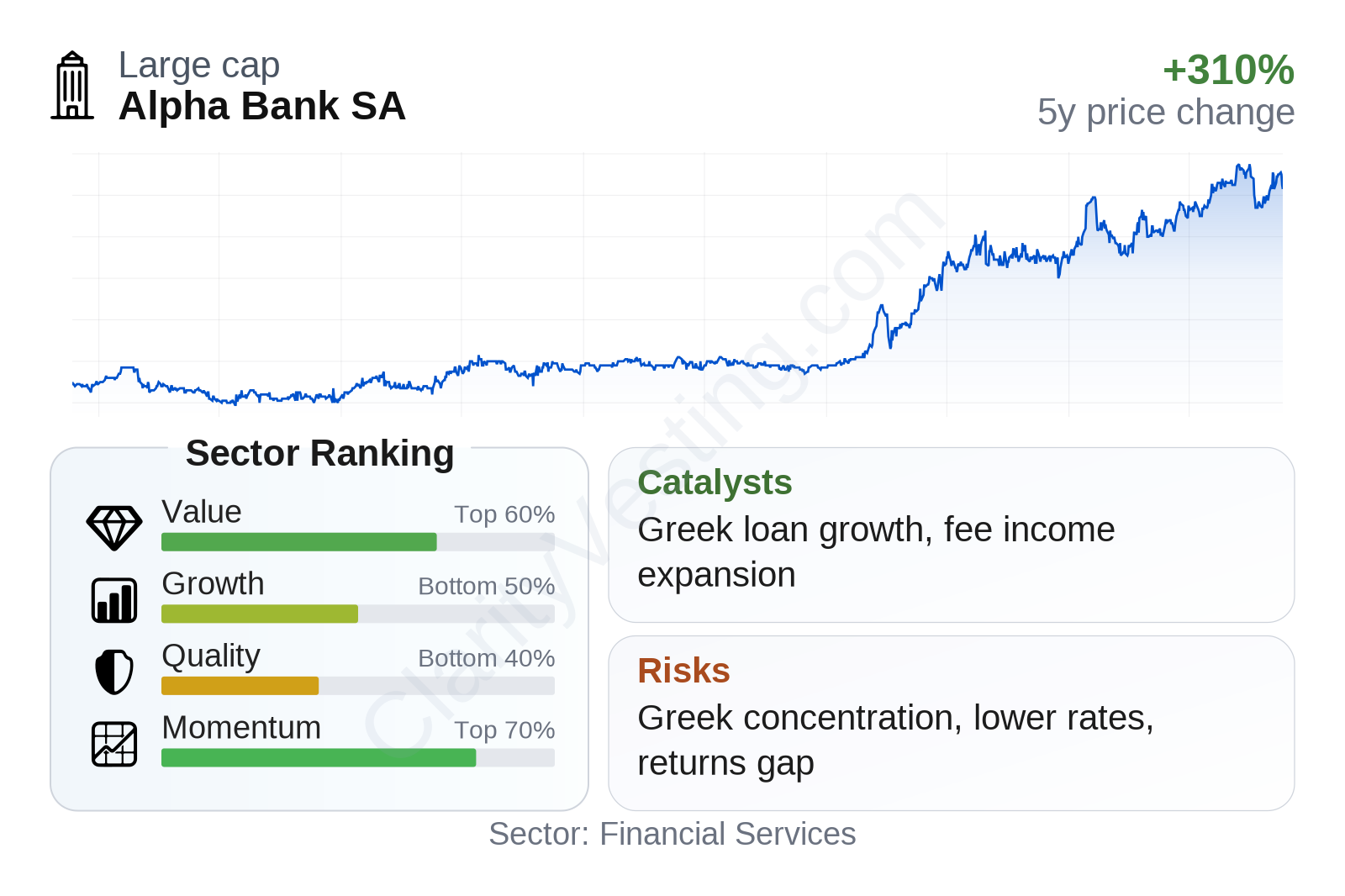
Alpha Bank is a mid-sized listed bank by global standards, but it is a major domestic player in Greece. The market’s recent view has been clearly more favorable than the sector average, as shown by very strong multi-year share-price performance and above-average momentum over the last 6 to 12 months. On valuation, the stock trades on an earnings multiple below the sector median, which does not look stretched. The picture is less favorable on balance-sheet-based and cash-flow-based measures, and the dividend yield is slightly below the sector median. Overall, the market seems to be recognizing the earnings turnaround, but it is not assigning a premium that would imply perfection.
Growth
Alpha Bank operates in a sector that is mature rather than structurally high-growth, but that does not mean growth is absent. In banking, expansion often comes from better loan demand, wider lending spreads, fee generation, lower credit losses, and improved efficiency. Greece has been in a much stronger position than during the sovereign debt crisis years, with better macro stability, investment inflows supported by European funds, and continued normalization of the banking system. That backdrop matters because domestic banks like Alpha Bank tend to rise and fall with the local economy.
The company’s strategy is centered on improving profitability, expanding performing loans, growing fee income, and using digital tools to lower service costs and deepen customer activity. For a long-term view, this makes sense: banks with stronger digital channels and more cross-selling capacity can defend margins better, especially when interest rates become less favorable.
Recent operating momentum has been solid. Revenue growth over the last year is well above the sector median, and operating margin has improved substantially over a five-year view. The strongest sign of progress is the earnings turnaround since 2021, with per-share profit moving from a loss to a clearly positive level by 2025.
The earnings path shows a clear recovery pattern rather than a flat trajectory. That is important because it suggests the business is no longer relying only on balance-sheet repair; it is generating materially stronger profit than it did a few years ago.
Book value per share has also recovered from earlier pressure, although growth has been modest and has recently flattened. For banks, book value matters because it reflects the capital base supporting future lending and absorbable losses.
The book value trend points to a franchise that has become more stable, but not yet one that is compounding capital at a top-tier rate. That fits the broader picture: Alpha Bank has made meaningful progress, though it still looks more like a recovering bank than a fully optimized one.
Potential catalysts are fairly visible. A supportive Greek economy can translate into more loan growth, especially in corporate lending, infrastructure, tourism, energy, and small business financing. Another catalyst is further improvement in fee income as card usage, asset management, and transaction banking expand. Continued balance-sheet cleanup and disciplined cost control could also help narrow the gap with more profitable European peers.
Recent company communications have also emphasized strategic partnerships and capital actions aimed at strengthening distribution and capital efficiency. In practical terms, that supports the view that Alpha Bank is trying to move from post-crisis repair into a more normal phase of shareholder returns and operating growth.
Risks
This article is for informational purposes only and does not constitute financial advice. Some content is AI-generated. See Disclaimer