Stock Analysis · Astera Labs Inc (ALAB)
Overview
Astera Labs is a semiconductor connectivity company focused on the infrastructure behind artificial intelligence and cloud computing. Its products help move data quickly and reliably between chips, servers, accelerators, memory, and networking equipment inside modern data centers. In simple terms, the company builds the “traffic management” layer that helps expensive AI hardware work together at full speed.
The business is centered on cloud and AI servers, especially systems using high-performance GPUs, CPUs, custom accelerators, and fast memory. Astera Labs combines hardware, software, and system-level design tools so customers can solve bottlenecks in bandwidth, signal integrity, and scaling. That positioning matters because AI clusters are becoming larger, denser, and more complex, making connectivity a more critical part of overall system performance.
Based on company disclosures, revenue is primarily generated from product sales tied to intelligent connectivity semiconductor solutions for cloud and AI infrastructure. Astera Labs does not report many separate end-market lines in the same way some larger chip companies do, but its revenue can still be understood through its main product families.
- PCIe connectivity solutions — likely the largest revenue source. This includes retimers, switches, and related products that help connect processors, accelerators, and peripherals at high speed.
- CXL memory connectivity and fabric solutions — a growing category tied to next-generation server architecture, including memory expansion and pooling.
- Ethernet and fabric connectivity products — products supporting scale-out AI and cloud infrastructure where fast networking between compute nodes is essential.
- Software and platform enablement — a smaller contributor, but strategically important because it helps customers deploy and manage Astera Labs components in complex systems.
Customer concentration is an important part of the revenue picture. Public filings have shown that a small number of very large cloud and platform customers account for a meaningful share of sales, which is common in specialized data-center semiconductors. That helps explain both the company’s rapid expansion and its sensitivity to large customer programs.
The broader financial flow has changed sharply over the last few years: revenue scaled from under $100 million in 2022 to more than $850 million in 2025, while the business moved from losses to sizable operating profit. Gross profit has remained strong, and the latest structure suggests Astera Labs is beginning to convert earlier heavy R&D spending into earnings and cash generation.
The long-term pattern is notable: the company spent aggressively on research before the current AI infrastructure boom, then saw revenue accelerate much faster than operating costs. That is the kind of operating leverage investors usually look for in fast-growing semiconductor platforms.
Key Figures
| Metric | Value | Sector ⓘ |
|---|---|---|
| Date | Sep 12, 2026 | |
| Context | ||
| Sector | Technology | |
| Industry | Semiconductors | |
| Market Cap ⓘ | $50.52B | |
| Beta ⓘ | 3.78 | |
Value (Cheapness) | ||
| P/E Ratio ⓘ | 140.69 | 29.51 |
| FCF Yield ⓘ | 0.55% | 4.25% |
| EBIT / EV ⓘ | 0.67% | 2.85% |
| PEG ⓘ | N/A | |
Growth (Business expansion) | ||
| Revenue Growth ⓘ | 104.50% | 15.40% |
| RPS Growth (5Y CAGR) ⓘ | 97.91% | 8.56% |
| EPS Growth (5Y CAGR) ⓘ | 142.86% | -11.88% |
| Margin Growth (5Y Trend) ⓘ | N/A | 0.46% |
| FCF Growth (5Y CAGR) ⓘ | N/A | 9.80% |
Quality (Business durability) | ||
| ROIC (Latest) ⓘ | 25.24% | 9.44% |
| ROIC (5Y Median) ⓘ | N/A | 8.30% |
| Net Debt / EBIT (Latest) ⓘ | -0.35 | 0.54 |
| Net Debt / EBIT (5Y Median) ⓘ | N/A | 0.44 |
| Operating Margin (Latest) ⓘ | 26.79% | 9.58% |
| Operating Margin (5Y Median) ⓘ | -20.23% | 8.25% |
| Debt to Equity (Latest) ⓘ | 2.80% | 33.33% |
| Profit Margin (Latest) ⓘ | 30.74% | 7.14% |
| Free Cash Flow (Latest) ⓘ | $276.68M | |
Momentum (Price trend) | ||
| 3Y Return ⓘ | N/A | +45.48% |
| 12M Return (excl. last month) ⓘ | +66.04% | +23.48% |
| 6M Return ⓘ | +142.89% | +20.93% |
| Price vs. 200-Day MA ⓘ | +27.64% | +7.43% |
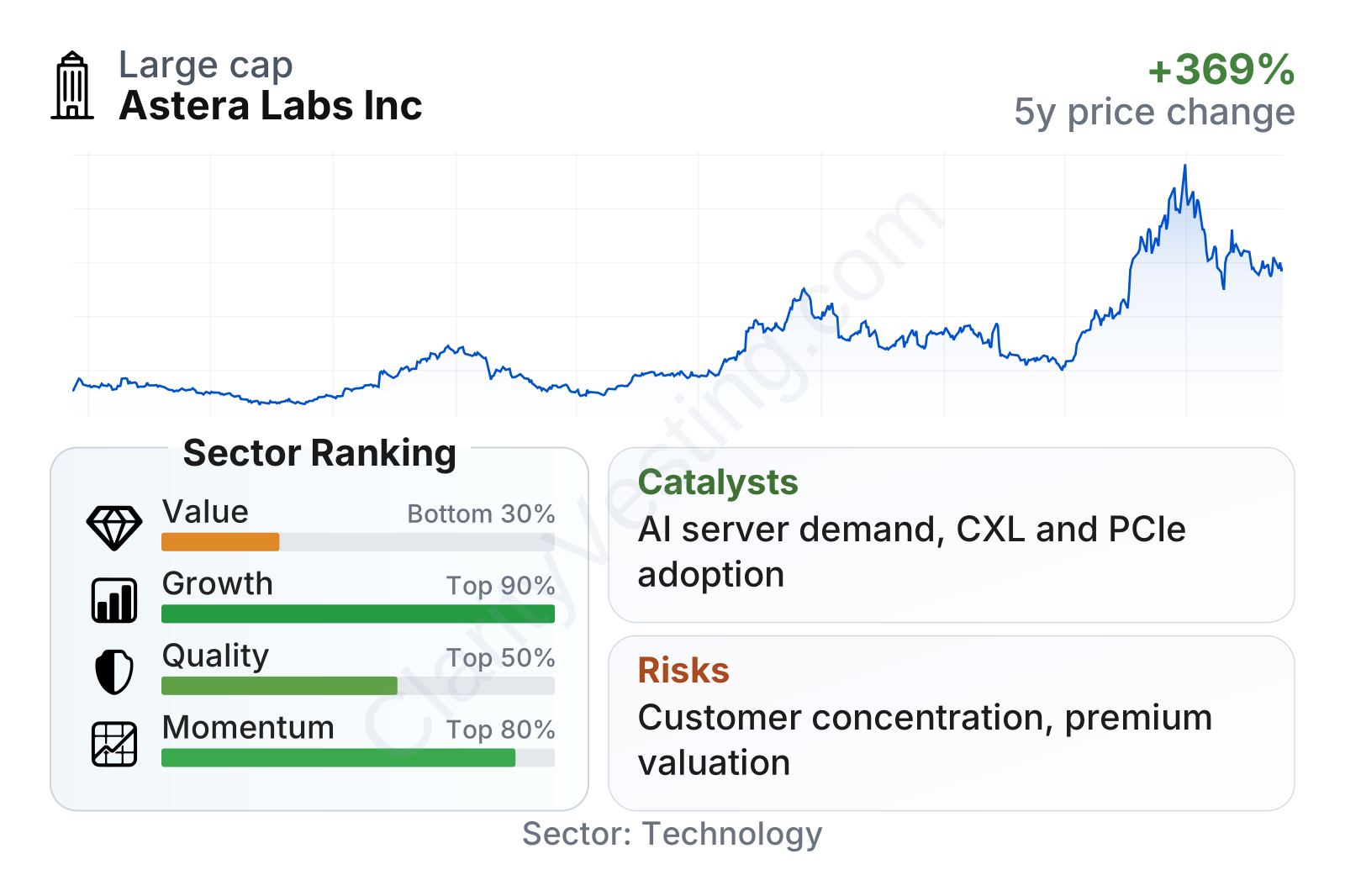
Astera Labs currently combines very strong growth, solid profitability, and an unusually clean balance sheet, but those strengths come with a rich valuation and high share-price volatility. Relative to the semiconductor sector, growth and momentum rank near the top, quality metrics are above average, while traditional valuation measures rank near the bottom because the market is pricing in continued rapid expansion.
The stock has also been exceptionally volatile. Its beta is very high, and the share-price history shows that the market’s view can shift dramatically as expectations for AI infrastructure demand rise or fall.
Growth
Astera Labs operates in one of the fastest-growing areas of semiconductors: AI and cloud data-center infrastructure. The key industry driver is not just more computing power, but more complex computing systems. As AI servers add more accelerators, memory, and networking layers, the need for high-speed interconnect, signal conditioning, and memory fabric technology rises with them. That is directly aligned with Astera Labs’ product focus.
The company’s strategy also makes sense for future growth because it is aimed at a difficult problem rather than a commodity chip category. AI racks and servers need reliable communication across many components, and poor connectivity can reduce the value of the entire system. This gives Astera Labs a way to sell products that are important to platform performance even though they represent only a fraction of total server cost.
Recent revenue growth has remained extremely high even after lapping tough comparisons. Year-over-year growth has stayed around or above 90% for multiple quarters and has recently moved back above 100%, which is far ahead of the typical semiconductor company. That suggests demand is not only strong, but broad enough to support continued scaling across major AI infrastructure programs.
Cash generation has improved alongside revenue. Free cash flow has risen from a modest level in 2024 to well above $300 million on a trailing basis by early 2026. This matters because it shows the company is no longer just growing on paper; it is increasingly turning that growth into cash that can support expansion, product development, and balance-sheet flexibility.
Several catalysts support the growth outlook. First, hyperscale and cloud customers continue investing heavily in AI clusters. Second, industry adoption of PCIe Gen 6, CXL-based memory architectures, and more disaggregated system designs should increase the amount of connectivity silicon required per server platform. Third, Astera Labs has been expanding its platform beyond point products toward broader system-level offerings, which could increase content per customer deployment.
Recent company updates and public communications have continued to emphasize design wins, platform expansion, and demand tied to AI server deployments. The most important opportunity is that Astera Labs sits in a part of the value chain that can grow with both the number of AI systems shipped and the complexity of each system.
Risks
This article is for informational purposes only and does not constitute financial advice. Some content is AI-generated. See Disclaimer


