Stock Analysis · Akamai Technologies Inc (AKAM)
Overview
Akamai Technologies is an internet infrastructure company that helps websites, apps, video platforms, and enterprises run faster, stay available, and remain secure. The business was originally known for content delivery, meaning it placed digital content closer to users so pages and videos loaded quickly. Over time, it expanded into cybersecurity and cloud computing, turning from a pure delivery network into a broader platform for performance, protection, and edge-based computing.
Today, Akamai’s revenue is mainly split across three business lines disclosed by the company:
- Security Technology Group: about 49% of 2025 revenue. This includes web application and API protection, bot management, micro-segmentation, zero-trust style security controls, account protection, and other products aimed at defending applications, networks, and enterprise systems.
- Delivery: about 29% of 2025 revenue. This is the company’s classic content delivery activity, covering web acceleration, media delivery, software downloads, and similar traffic-heavy services.
- Compute: about 22% of 2025 revenue. This segment includes cloud computing and edge services, largely built around Akamai’s infrastructure expansion and the Linode acquisition, serving developers and enterprises that want workloads closer to end users.
This revenue mix matters because it shows where the company is trying to go. Delivery remains important, but the larger long-term emphasis is clearly on security and compute, which generally carry stronger strategic value than the mature content delivery business.
The overall financial structure also shows a business with durable gross profit generation, but one that has seen operating costs rise as it invests in product development and platform expansion. Revenue has moved steadily higher over the last several years, while net income has been more uneven.
Over the past five years, Akamai has lifted revenue from roughly $3.5 billion to just over $4.2 billion. Gross profit remains substantial, but operating income and net income have not grown at the same pace, reflecting heavier spending and a changing business mix.
Key Figures
| Metric | Value | Sector ⓘ |
|---|---|---|
| Date | Sep 12, 2026 | |
| Context | ||
| Sector | Technology | |
| Industry | Software - Infrastructure | |
| Market Cap ⓘ | $15.40B | |
| Beta ⓘ | 0.64 | |
Value (Cheapness) | ||
| P/E Ratio ⓘ | 40.12 | 29.51 |
| FCF Yield ⓘ | 4.09% | 4.25% |
| EBIT / EV ⓘ | 2.55% | 2.85% |
| PEG ⓘ | 1.77 | |
Growth (Business expansion) | ||
| Revenue Growth ⓘ | 5.40% | 15.40% |
| RPS Growth (5Y CAGR) ⓘ | 8.21% | 8.56% |
| EPS Growth (5Y CAGR) ⓘ | -22.03% | -11.88% |
| Margin Growth (5Y Trend) ⓘ | -8.08% | 0.46% |
| FCF Growth (5Y CAGR) ⓘ | -5.02% | 9.80% |
Quality (Business durability) | ||
| ROIC (Latest) ⓘ | 4.67% | 9.44% |
| ROIC (5Y Median) ⓘ | 10.77% | 8.30% |
| Net Debt / EBIT (Latest) ⓘ | 14.09 | 0.54 |
| Net Debt / EBIT (5Y Median) ⓘ | 6.04 | 0.44 |
| Operating Margin (Latest) ⓘ | 12.90% | 9.58% |
| Operating Margin (5Y Median) ⓘ | 17.58% | 8.25% |
| Debt to Equity (Latest) ⓘ | 196.67% | 33.33% |
| Profit Margin (Latest) ⓘ | 9.51% | 7.14% |
| Free Cash Flow (Latest) ⓘ | $629.88M | |
Momentum (Price trend) | ||
| 3Y Return ⓘ | +2.67% | +45.48% |
| 12M Return (excl. last month) ⓘ | +70.60% | +23.48% |
| 6M Return ⓘ | +1.25% | +20.93% |
| Price vs. 200-Day MA ⓘ | -2.90% | +7.43% |
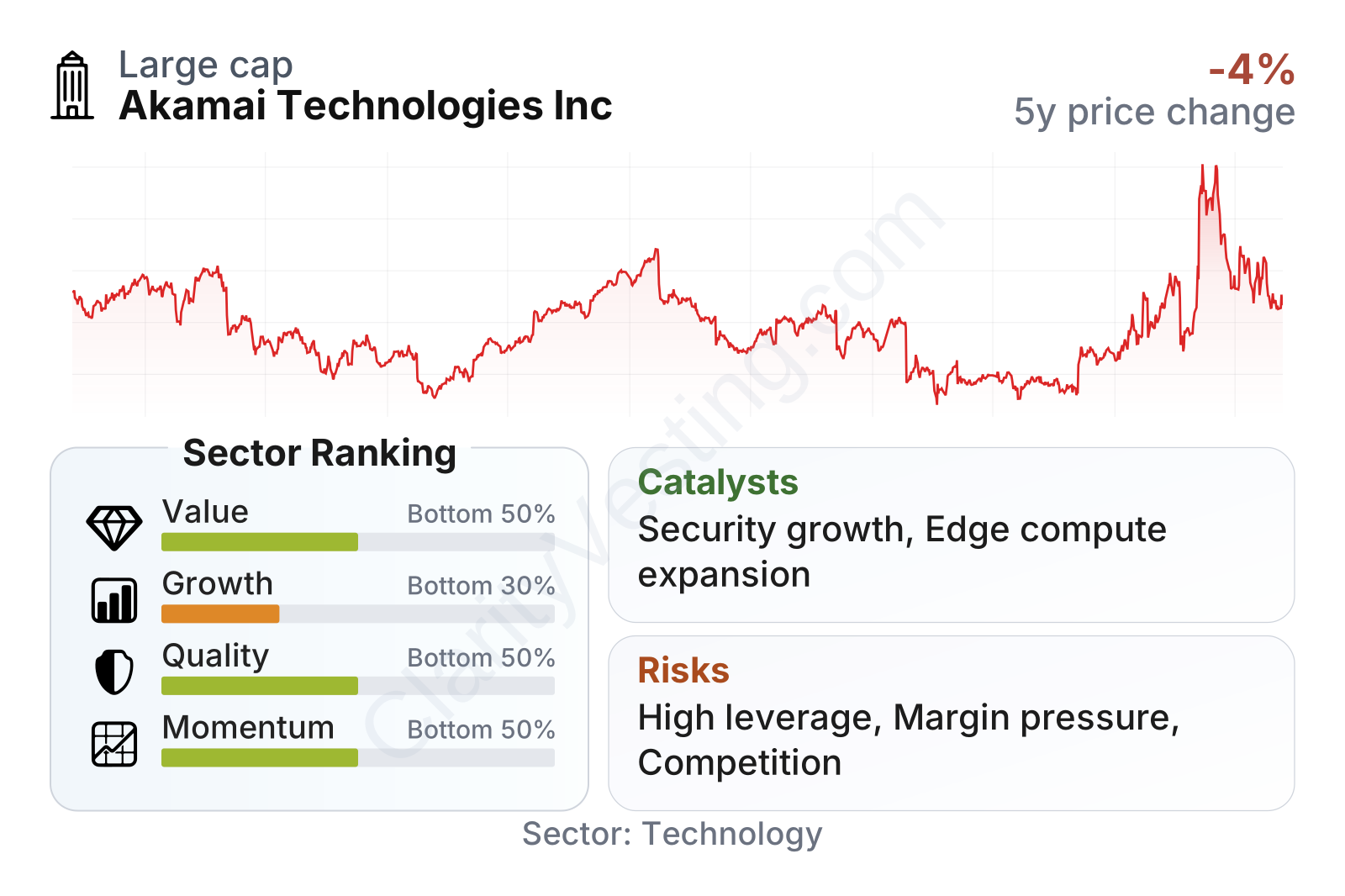
Akamai is a large infrastructure software company with a relatively low beta, which suggests the shares have historically moved less sharply than the broader market. The latest factor view is mixed: profitability remains decent, momentum has improved, but growth and valuation metrics are less favorable versus the sector. The company still generates meaningful free cash flow, yet leverage is notably higher than many software peers, which makes balance-sheet quality an important point to monitor.
Growth
Akamai operates in markets that are supported by long-term demand: cybersecurity, cloud infrastructure, API protection, application performance, and edge computing. Those are real growth areas, especially as more business activity moves online and as applications become more distributed. In that sense, the company is positioned in attractive segments of the technology sector.
The challenge is that Akamai’s total growth rate has been moderate rather than fast. Delivery is a mature activity, and that tends to limit the company’s overall top-line acceleration even when security and compute perform better. Recent year-over-year revenue growth has generally stayed in the mid-single digits, which is positive but below the sector median for software infrastructure companies.
The revenue trend points to a business that is still expanding, but not at the pace often seen in higher-growth software names. For a long-term view, the key question is whether security and compute can become large enough to outweigh the slower delivery segment. That strategic direction makes sense: security is a sticky, mission-critical category, while compute gives Akamai another way to monetize its global network beyond content delivery.
A potentially important catalyst is the company’s push to use its large distributed infrastructure as a platform for cloud and AI-adjacent workloads at the edge. Enterprises increasingly want lower-latency processing, better geographic reach, and more resilience across applications. Akamai already owns one of the world’s most extensive distributed platforms, so the strategy has industrial logic even if execution takes time.
Another positive sign is cash generation. Free cash flow has softened from earlier peaks, but it remains solid in absolute terms and has shown some recovery from lower levels, giving Akamai room to invest in product development, infrastructure, and acquisitions.
That cash profile supports the broader transformation effort. It does not remove execution risk, but it does mean Akamai is not trying to reinvent itself from a position of weak liquidity.
Risks
This article is for informational purposes only and does not constitute financial advice. Some content is AI-generated. See Disclaimer


