Stock Analysis · Arteris Inc (AIP)
Overview
Arteris is a semiconductor intellectual property company. It does not manufacture chips itself. Instead, it develops and licenses system IP and software used by chip designers to connect, manage, and secure the many computing blocks inside modern semiconductors. Its products are especially relevant for complex system-on-chip designs used in automotive electronics, artificial intelligence, data centers, communications, and industrial applications.
The company’s core offering is interconnect IP, which acts like the internal traffic system of a chip by moving data efficiently between processors, memory, accelerators, and other functions. Arteris also offers network-on-chip software tools that help customers design and optimize those internal chip connections before production. This makes the company part of the broader semiconductor design infrastructure layer: it helps customers build more capable chips without owning fabrication plants.
Based on company filings, Arteris generates revenue mainly from licensing its IP and from support or maintenance arrangements tied to those products. The exact mix can shift by period, but the business model is generally organized around:
- License and related revenue: typically the largest source. This includes upfront or term-based rights to use Arteris IP and design tools in customer chip programs.
- Royalties: recurring payments earned when customer chips containing Arteris technology reach production and shipment. This is strategically important because it can scale over time if customer programs move into volume manufacturing.
- Maintenance, support, and other services: smaller but recurring revenue tied to technical support, updates, and customer enablement.
For long-term analysis, the most important point is that Arteris has a layered model: licensing supports current revenue, while royalties can provide delayed but potentially more durable upside as customer designs enter production.
Recent financial flow trends show revenue rising steadily from 2021 through 2025, gross profit staying very high, and research spending remaining the largest operating expense. That pattern is typical of a design-IP company trying to expand its technology footprint before profitability fully catches up.
Key Figures
| Metric | Value | Sector ⓘ |
|---|---|---|
| Date | Sep 12, 2026 | |
| Context | ||
| Sector | Technology | |
| Industry | Semiconductors | |
| Market Cap ⓘ | $1.10B | |
| Beta ⓘ | 1.91 | |
Value (Cheapness) | ||
| P/E Ratio ⓘ | N/A | 29.51 |
| FCF Yield ⓘ | 0.61% | 4.25% |
| EBIT / EV ⓘ | -2.68% | 2.85% |
| PEG ⓘ | N/A | |
Growth (Business expansion) | ||
| Revenue Growth ⓘ | 46.20% | 15.40% |
| RPS Growth (5Y CAGR) ⓘ | -0.80% | 8.56% |
| EPS Growth (5Y CAGR) ⓘ | -2.91% | -11.88% |
| Margin Growth (5Y Trend) ⓘ | N/A | 0.46% |
| FCF Growth (5Y CAGR) ⓘ | N/A | 9.80% |
Quality (Business durability) | ||
| ROIC (Latest) ⓘ | N/A | 9.44% |
| ROIC (5Y Median) ⓘ | -81.34% | 8.30% |
| Net Debt / EBIT (Latest) ⓘ | N/A | 0.54 |
| Net Debt / EBIT (5Y Median) ⓘ | N/A | 0.44 |
| Operating Margin (Latest) ⓘ | -46.91% | 9.58% |
| Operating Margin (5Y Median) ⓘ | -54.45% | 8.25% |
| Debt to Equity (Latest) ⓘ | 12.84% | 33.33% |
| Profit Margin (Latest) ⓘ | -46.70% | 7.14% |
| Free Cash Flow (Latest) ⓘ | $6.77M | |
Momentum (Price trend) | ||
| 3Y Return ⓘ | +204.97% | +45.48% |
| 12M Return (excl. last month) ⓘ | +182.93% | +23.48% |
| 6M Return ⓘ | +54.56% | +20.93% |
| Price vs. 200-Day MA ⓘ | -5.77% | +7.43% |
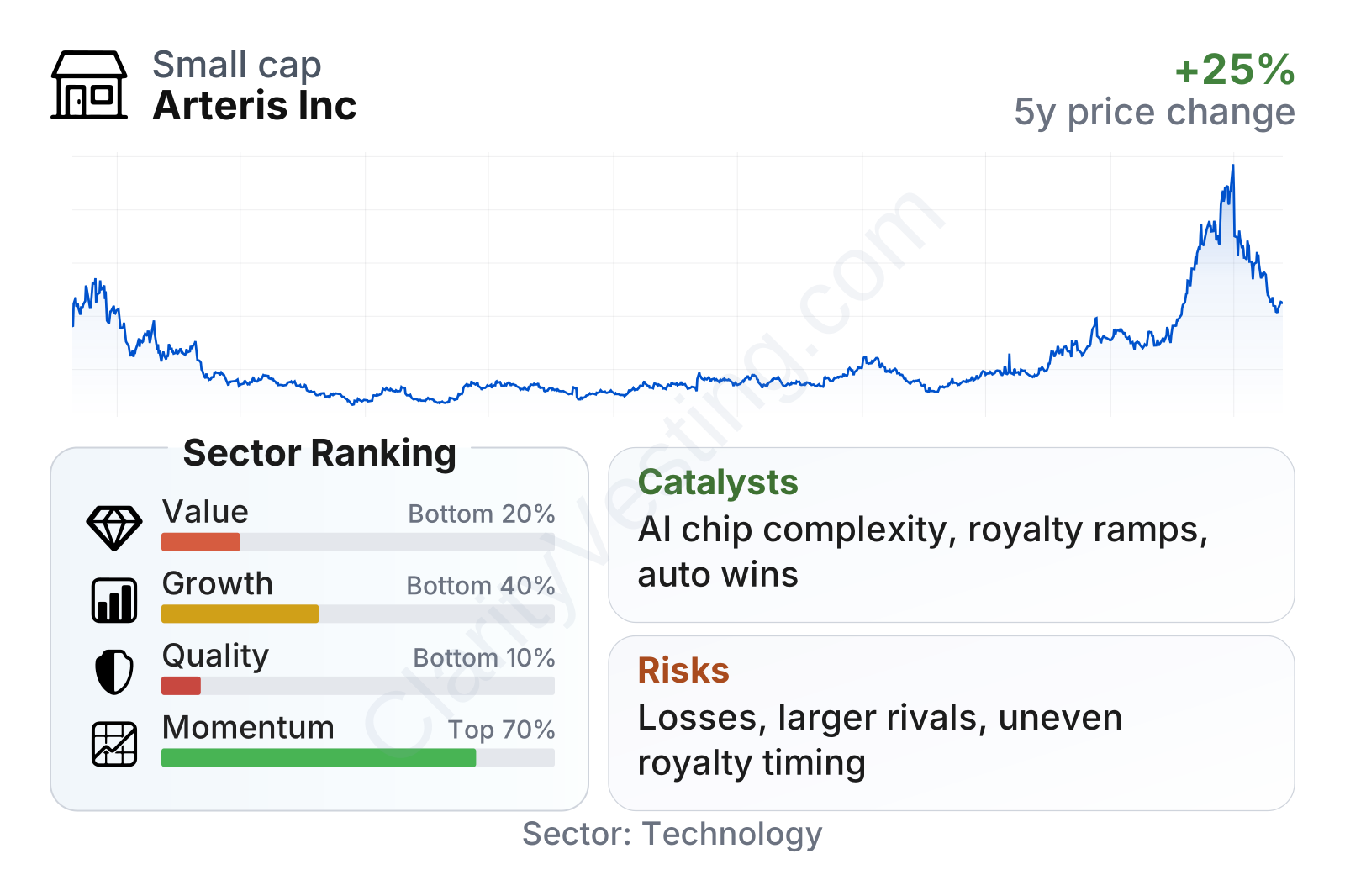
Arteris is still a relatively small public technology company, with a market value around the lower end of the semiconductor universe and a high beta near 2.0, which points to above-average share-price volatility. The market has clearly reassessed the company upward over the last year, and its stock momentum has been much stronger than the sector median. At the same time, the factor profile remains mixed: growth and market performance look much better than value and quality metrics, mainly because profitability is still negative and cash flow generation is only starting to improve.
Growth
Arteris operates in a market with attractive long-term tailwinds. Semiconductor designs are becoming more complex as chips integrate more CPU, GPU, AI, memory, and specialized accelerator blocks. That increases the need for sophisticated on-chip communication and system design tools. In simple terms, the more crowded and demanding a chip becomes, the more important Arteris’ technology can be.
The sector backdrop also supports this view. Demand for AI infrastructure, advanced driver-assistance systems, software-defined vehicles, edge computing, and custom silicon continues to push chip designers toward larger and more intricate architectures. Arteris’ strategy fits that trend well because it focuses on the “inside the chip” problem: how all those computing blocks communicate reliably and efficiently.
Revenue growth has accelerated sharply, with year-over-year expansion recently running well above the broader sector median. That matters because it suggests Arteris is not just participating in a good market, but currently winning more business within it. However, growth has not been perfectly linear over the last several years, which reflects the timing-driven nature of semiconductor design wins and customer program ramps.
Cash generation is improving, but it is not yet firmly established. Free cash flow was negative for much of the recent period, then briefly turned positive before dipping again in an interim period. Even so, the broader direction is better than it was a few years ago, and that is important for a business with meaningful ongoing research spending.
A major long-term catalyst is the company’s royalty base. When Arteris wins a place in a customer chip design, revenue often starts with licensing, but the more scalable payoff can arrive later if that chip reaches mass production. This creates a backlog-like effect: today’s design wins can become tomorrow’s royalty streams. Another catalyst is the automotive market, where semiconductor content per vehicle is rising and product life cycles can be longer once programs are secured.
Recent company communications have also emphasized growing traction in AI-related and automotive applications, both of which are important because they combine increasing chip complexity with a willingness by customers to invest in differentiated system architecture. That does not guarantee smooth execution, but it does support the case that Arteris is aligned with some of the most active semiconductor end markets.
Risks
This article is for informational purposes only and does not constitute financial advice. Some content is AI-generated. See Disclaimer


