Stock Analysis · Albany International Corporation (AIN)
Overview
Albany International Corporation is an industrial materials company with two main businesses. The larger business supplies specialized machine clothing and process belts used by paper producers to manufacture paper, packaging, tissue, and other paper-based products. The smaller but strategically important business makes advanced composite components, especially engineered parts for aircraft and defense programs. In simple terms, Albany sells mission-critical materials that customers need to keep large industrial systems running efficiently.
The company’s revenue base is diversified across these two segments, with the paper-related business still providing the majority of sales and the aerospace-focused operation supplying most of the remainder. Based on recent annual reporting, the revenue mix is approximately:
- Machine Clothing: about 73% of revenue. This includes forming, pressing, drying, and processing fabrics and belts used in paper and packaging production. These products are consumable, replacement-driven, and tied to ongoing mill operations.
- Albany Engineered Composites: about 27% of revenue. This segment includes composite structures and parts used in commercial aerospace, defense platforms, and other demanding applications where weight, strength, and precision matter.
The business mix matters because it combines a steadier industrial replacement cycle with a more cyclical but potentially faster-growing aerospace exposure. Over the last several years, companywide revenue expanded meaningfully, but the profit flow became much less favorable in 2025 as costs rose sharply and margins turned negative. That split between a resilient installed-base business and a weaker recent earnings profile is central to understanding Albany today.
The financial flow also highlights that recent pressure came less from a collapse in sales than from deteriorating profitability. Revenue rose from roughly $0.9 billion in 2021 to above $1.2 billion in 2024 before easing in 2025, while gross profit and operating income weakened much more sharply. That suggests the key issue recently has been execution, mix, and cost absorption rather than simple lack of demand.
Key Figures
| Metric | Value | Sector ⓘ |
|---|---|---|
| Date | Sep 12, 2026 | |
| Context | ||
| Sector | Consumer Cyclical | |
| Industry | Textile Manufacturing | |
| Market Cap ⓘ | $1.71B | |
| Beta ⓘ | 1.16 | |
Value (Cheapness) | ||
| P/E Ratio ⓘ | N/A | 17.10 |
| FCF Yield ⓘ | 3.44% | 8.53% |
| EBIT / EV ⓘ | -1.48% | 6.46% |
| PEG ⓘ | 1.44 | |
Growth (Business expansion) | ||
| Revenue Growth ⓘ | 5.80% | 5.75% |
| RPS Growth (5Y CAGR) ⓘ | 8.73% | 9.14% |
| EPS Growth (5Y CAGR) ⓘ | -24.93% | -18.21% |
| Margin Growth (5Y Trend) ⓘ | -22.75% | -0.23% |
| FCF Growth (5Y CAGR) ⓘ | -15.72% | 4.91% |
Quality (Business durability) | ||
| ROIC (Latest) ⓘ | -3.12% | 12.61% |
| ROIC (5Y Median) ⓘ | 8.67% | 10.72% |
| Net Debt / EBIT (Latest) ⓘ | N/A | 2.10 |
| Net Debt / EBIT (5Y Median) ⓘ | 1.62 | 2.32 |
| Operating Margin (Latest) ⓘ | -3.01% | 9.25% |
| Operating Margin (5Y Median) ⓘ | 14.48% | 9.64% |
| Debt to Equity (Latest) ⓘ | 60.44% | 75.78% |
| Profit Margin (Latest) ⓘ | -4.18% | 5.33% |
| Free Cash Flow (Latest) ⓘ | $58.91M | |
Momentum (Price trend) | ||
| 3Y Return ⓘ | -25.91% | +14.53% |
| 12M Return (excl. last month) ⓘ | +3.65% | +3.08% |
| 6M Return ⓘ | +11.91% | +0.55% |
| Price vs. 200-Day MA ⓘ | +1.38% | -0.54% |
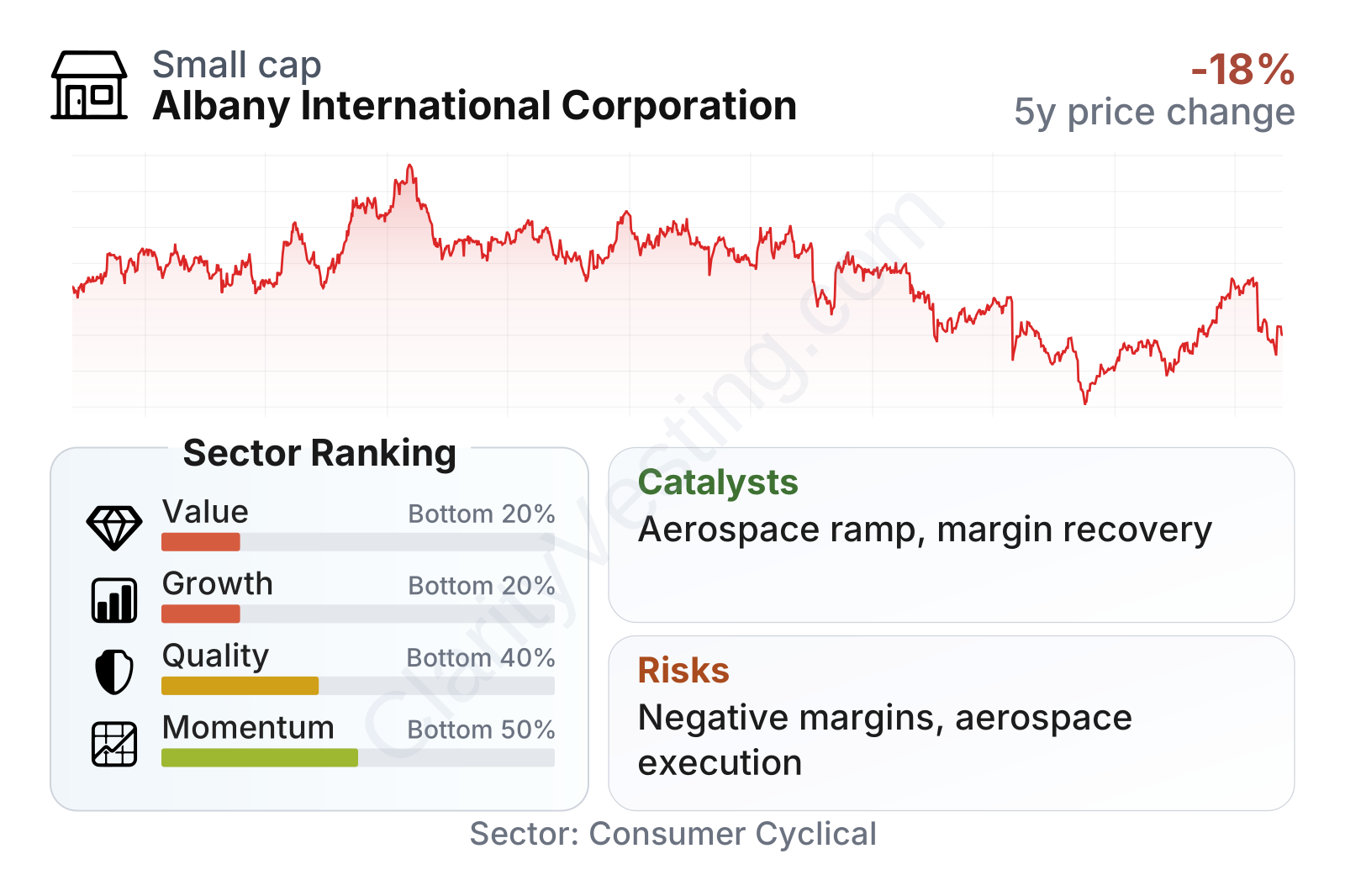
Albany is a mid-sized industrial company with a stock that has been volatile over the last few years. The recent picture is mixed. Shorter-term share performance has improved from the late-2025 lows, but the longer-term record still trails much of the broader sector. The metrics table also shows a weak current ranking in value, growth, and quality versus peers, largely because profitability has slipped into negative territory and free cash flow generation, while still positive, is not especially strong relative to the current market value.
At the same time, the balance sheet is not the main problem. Leverage remains moderate compared with the sector median, which gives the company some room to navigate through an operational reset. The contrast is important: Albany does not look financially distressed, but it does look like a business that needs to restore margins and returns.
Growth
Albany operates in markets with different growth profiles. The Machine Clothing segment serves the paper and packaging industry, which is generally mature rather than high-growth. Even so, it benefits from recurring replacement demand because paper mills need these fabrics and belts to keep operating. Growth here tends to come from product upgrades, pricing, customer retention, and demand tied to packaging and tissue rather than from rapid expansion in the underlying market.
The more interesting long-term growth driver is Albany Engineered Composites. Aerospace composites remain an attractive niche because aircraft manufacturers and defense programs continue pushing for lighter, stronger, and more durable materials. If commercial aircraft build rates normalize upward and defense demand stays solid, this business has a logical path to expand over time. Albany’s strategy of pairing a dependable industrial base with a higher-value composites business makes sense in principle, especially if the engineered composites segment can scale more efficiently.
Recent sales trends show that growth has become uneven. Albany moved from strong double-digit year-over-year revenue growth in several 2024 periods to declines during much of 2025, then returned to modest positive growth in the latest periods of 2026. That pattern suggests the company is no longer in a clean expansion phase. It is stabilizing, but not yet demonstrating a powerful rebound.
Cash generation offers a more constructive sign. Free cash flow remained positive and recovered meaningfully from the low point seen in 2023, even though it has come down from the stronger 2025 level. Positive free cash flow during a weaker earnings period can matter because it supports debt management, capital spending, and ongoing investment in product development.
A visible catalyst is the aerospace cycle. Albany has exposure to programs where production increases at major aircraft manufacturers can translate into higher component demand. Another catalyst is internal: if management can improve manufacturing efficiency, pricing discipline, and business mix, even modest revenue growth could have an outsized effect on earnings because margins have fallen so far from prior levels. Recent company communications have also continued to emphasize advanced materials and aerospace program execution, reinforcing that this segment remains central to the long-term growth plan.
Risks
This article is for informational purposes only and does not constitute financial advice. Some content is AI-generated. See Disclaimer