Stock Analysis · C3 Ai Inc (AI)
Overview
C3.ai is an enterprise software company focused on artificial intelligence applications. In simple terms, it sells software that helps large organizations use AI to analyze data, automate decisions, detect problems, and improve operations. Its products are used in areas such as predictive maintenance, supply chain management, fraud detection, energy operations, defense, and customer service. The company has increasingly emphasized generative AI as well, offering tools that let businesses build AI-powered search, chat, and workflow applications on top of their own internal information.
The business mainly makes money from software subscriptions and from professional services that help customers deploy and tailor the software. Based on the company’s recent annual reporting, revenue can be summarized approximately as follows:
- Subscription revenue: about 85% to 90% of total revenue. This includes access to the C3 AI platform and packaged AI applications, generally under recurring contracts.
- Professional services: about 10% to 15% of total revenue. This includes consulting, implementation, training, and support work tied to customer deployments.
C3.ai also works through major cloud and technology partners such as Amazon Web Services, Microsoft Azure, and Google Cloud, which helps it reach large enterprise customers without building every sales channel on its own. A notable point in its business mix is that subscription revenue has historically been the core driver, but the latest annual results show a sharp overall revenue decline while operating expenses remained very high. That means the company still has a software-like revenue model, yet it has not converted that model into stable scale or profitability.
The flow of revenue and expenses shows a business with substantial spending on research and development and sales, which is typical for a growth software company. The problem is that in the latest year revenue fell sharply while costs stayed elevated, causing gross profit and operating results to worsen materially.
Key Figures
| Metric | Value | Sector ⓘ |
|---|---|---|
| Date | Sep 12, 2026 | |
| Context | ||
| Sector | Technology | |
| Industry | Software - Infrastructure | |
| Market Cap ⓘ | $1.68B | |
| Beta ⓘ | 2.09 | |
Value (Cheapness) | ||
| P/E Ratio ⓘ | N/A | 29.51 |
| FCF Yield ⓘ | -9.17% | 4.25% |
| EBIT / EV ⓘ | N/A | 2.85% |
| PEG ⓘ | N/A | |
Growth (Business expansion) | ||
| Revenue Growth ⓘ | -25.50% | 15.40% |
| RPS Growth (5Y CAGR) ⓘ | -7.39% | 8.56% |
| EPS Growth (5Y CAGR) ⓘ | N/A | -11.88% |
| Margin Growth (5Y Trend) ⓘ | N/A | 0.46% |
| FCF Growth (5Y CAGR) ⓘ | N/A | 9.80% |
Quality (Business durability) | ||
| ROIC (Latest) ⓘ | N/A | 9.44% |
| ROIC (5Y Median) ⓘ | -24.13% | 8.30% |
| Net Debt / EBIT (Latest) ⓘ | N/A | 0.54 |
| Net Debt / EBIT (5Y Median) ⓘ | N/A | 0.44 |
| Operating Margin (Latest) ⓘ | N/A | 9.58% |
| Operating Margin (5Y Median) ⓘ | -89.80% | 8.25% |
| Debt to Equity (Latest) ⓘ | 0.85% | 33.33% |
| Profit Margin (Latest) ⓘ | -192.10% | 7.14% |
| Free Cash Flow (Latest) ⓘ | -$154.33M | |
Momentum (Price trend) | ||
| 3Y Return ⓘ | -62.49% | +45.48% |
| 12M Return (excl. last month) ⓘ | -40.39% | +23.48% |
| 6M Return ⓘ | +18.83% | +20.93% |
| Price vs. 200-Day MA ⓘ | -0.25% | +7.43% |
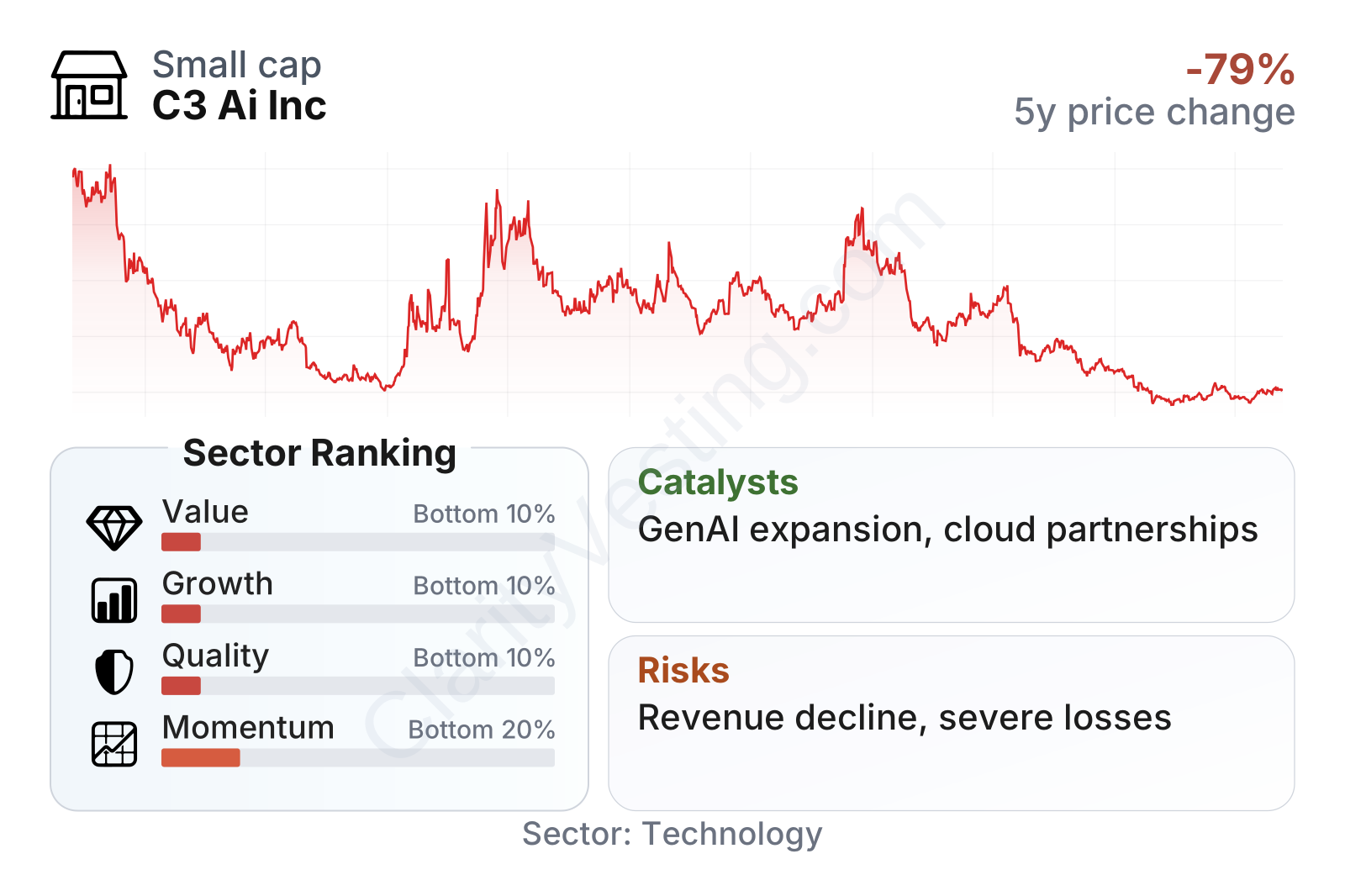
The overall profile is weak relative to the broader software sector. The company ranks near the bottom of the sector on value, growth, quality, and share-price momentum. The main positives are its modest balance-sheet leverage and its still meaningful scale as a publicly listed AI software provider, but profitability and cash generation remain far below sector norms.
C3.ai’s stock has been highly volatile over the past several years. The shares traded much higher during periods of AI enthusiasm, but the longer-term trend has been negative, reflecting the gap between investor expectations and the company’s financial results. With a beta above 2, the stock has tended to move much more sharply than the market in both directions.
Growth
Artificial intelligence software is clearly a growing market over the long run. Companies across industries are trying to use AI to improve productivity, automate tasks, reduce costs, and get more value from their existing data. That broad industry backdrop supports the logic of C3.ai’s strategy: sell enterprise AI tools that are easier and faster to adopt than building everything internally from scratch.
The company’s strategy also makes sense on paper. It targets large organizations, focuses on high-value use cases, and partners with big cloud platforms that already serve enterprise customers. It has also pushed a consumption-based pricing model in recent years to reduce friction for new customers, which can help adoption if customers want to start small and expand later.
The challenge is that recent execution has been inconsistent. After a period of improving growth through much of 2024 and early 2025, revenue growth turned sharply negative. The latest reading is down roughly 25% year over year, far worse than the typical software company in the sector, where median growth remains positive. For a business positioned around a major technology theme, that reversal raises questions about sales efficiency, customer expansion, and the durability of demand.
Cash generation tells a similar story. Free cash flow had shown improvement at one point, with losses narrowing materially, but the latest trailing twelve-month figure moved back to a much deeper outflow of roughly $150 million. That suggests the business is still far from self-funding and remains dependent on its balance sheet and market confidence to support continued investment.
Even so, there are still visible catalysts. C3.ai remains closely associated with enterprise AI adoption, and that keeps it relevant when businesses accelerate AI spending. Its generative AI offerings, government and defense work, and alliances with major cloud providers could create opportunities if the company converts pilot projects into larger production deployments. Recent company communications have continued to emphasize expansion in enterprise AI and generative AI use cases, which is where a significant opportunity would most likely emerge.
Risks
This article is for informational purposes only and does not constitute financial advice. Some content is AI-generated. See Disclaimer


