Stock Analysis · Agilysys Inc (AGYS)
Overview
Agilysys is a hospitality software company. Its products are used by hotels, resorts, casinos, cruise lines, restaurants, stadiums, and other venue-based operators to manage reservations, property operations, point-of-sale transactions, inventory, payments, loyalty, and guest engagement. In simple terms, Agilysys provides the digital systems that help hospitality businesses run day-to-day operations and serve customers more efficiently.
The company’s business model has been shifting toward recurring software revenue, especially subscription and maintenance income tied to cloud-based products. That matters because recurring revenue is usually more predictable than one-time software sales or hardware-related activity.
Based on the latest annual filing and recent quarterly disclosures, Agilysys generates revenue from the following main sources:
- Subscription and maintenance revenue: about 59% to 61% of total revenue. This includes SaaS subscriptions, support, software updates, and maintenance tied to installed systems. This is the company’s largest and most strategic revenue stream.
- Professional services revenue: about 21% to 23%. This includes implementation, training, consulting, and deployment work that helps customers install and optimize Agilysys products.
- Product revenue: about 18% to 20%. This includes software licenses, hardware, and related product sales. This category tends to be less recurring and can fluctuate with customer project timing.
Geographically, the business is still centered on North America, although Agilysys also serves customers internationally, especially in hospitality-heavy markets. The company is not a broad enterprise software vendor; it is focused on a specific vertical. That narrower focus gives it a clearer identity and allows product development to be tailored to hospitality workflows rather than generic business needs.
The financial profile has improved meaningfully over the last several years. Revenue has expanded steadily, gross profit has climbed, and operating income has improved faster than sales, showing increasing scale. Research and development remains a major expense, which is typical for a software company still investing for growth, but the business now converts much more of its revenue into profit and cash than it did earlier in the decade.
The business mix shows a favorable pattern: revenue and gross profit have risen consistently, while operating income and net income have expanded faster over time. One unusually high profit year included a tax-related benefit, so the broader trend is more important than that single spike. The key takeaway is that Agilysys has been growing while also becoming more efficient.
Key Figures
| Metric | Value | Sector ⓘ |
|---|---|---|
| Date | Sep 12, 2026 | |
| Context | ||
| Sector | Technology | |
| Industry | Software - Application | |
| Market Cap ⓘ | $2.97B | |
| Beta ⓘ | 0.38 | |
Value (Cheapness) | ||
| P/E Ratio ⓘ | 69.85 | 29.51 |
| FCF Yield ⓘ | 2.70% | 4.25% |
| EBIT / EV ⓘ | 1.90% | 2.85% |
| PEG ⓘ | 2.39 | |
Growth (Business expansion) | ||
| Revenue Growth ⓘ | 14.30% | 15.40% |
| RPS Growth (5Y CAGR) ⓘ | 15.19% | 8.56% |
| EPS Growth (5Y CAGR) ⓘ | -27.57% | -11.88% |
| Margin Growth (5Y Trend) ⓘ | 11.29% | 0.46% |
| FCF Growth (5Y CAGR) ⓘ | 25.72% | 9.80% |
Quality (Business durability) | ||
| ROIC (Latest) ⓘ | 13.57% | 9.44% |
| ROIC (5Y Median) ⓘ | 12.70% | 8.30% |
| Net Debt / EBIT (Latest) ⓘ | -1.92 | 0.54 |
| Net Debt / EBIT (5Y Median) ⓘ | -5.85 | 0.44 |
| Operating Margin (Latest) ⓘ | 16.60% | 9.58% |
| Operating Margin (5Y Median) ⓘ | 8.71% | 8.25% |
| Debt to Equity (Latest) ⓘ | 5.45% | 33.33% |
| Profit Margin (Latest) ⓘ | 12.99% | 7.14% |
| Free Cash Flow (Latest) ⓘ | $80.44M | |
Momentum (Price trend) | ||
| 3Y Return ⓘ | +52.47% | +45.48% |
| 12M Return (excl. last month) ⓘ | -0.93% | +23.48% |
| 6M Return ⓘ | +49.38% | +20.93% |
| Price vs. 200-Day MA ⓘ | +10.69% | +7.43% |
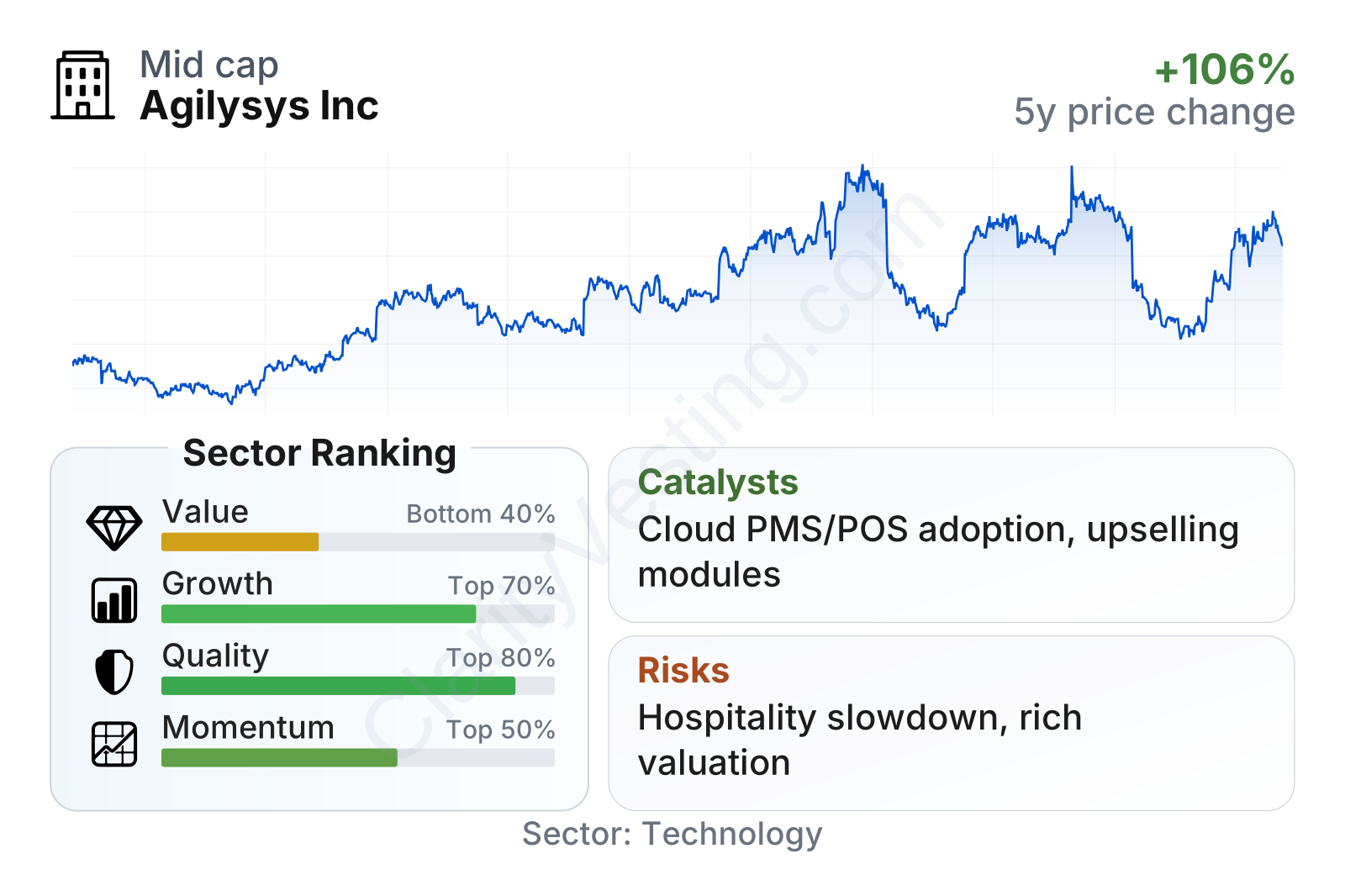
Agilysys is a mid-sized software company with unusually low share-price volatility for a technology stock, as suggested by its beta well below 1. In the factor breakdown, quality stands out most: returns on invested capital, operating margins, and balance-sheet strength are all ahead of the sector median. Growth is solid rather than exceptional on a one-year basis, but the longer-term record in revenue per share, margin improvement, and free cash flow is stronger. Value is the weak point, with a high earnings multiple and lower cash flow yield than the sector median, which means the market is already pricing in a meaningful amount of future progress.
Growth
Agilysys operates in a part of software that still has room to expand. Hospitality businesses continue to modernize legacy systems, move workloads to the cloud, unify guest data across properties, and adopt more integrated software stacks. Hotels, resorts, casinos, and food-service venues increasingly want fewer disconnected tools and more end-to-end platforms. That broader industry direction supports companies like Agilysys that offer specialized operational software rather than generic back-office applications.
The company’s strategy appears coherent. Management has been emphasizing a broader platform approach, cross-selling multiple modules into the same customer, and increasing the share of recurring subscription revenue. That can create a useful cycle: once a customer uses the company for property management, point-of-sale, booking, loyalty, and payments-related workflows, switching becomes more disruptive and the account can become more valuable over time.
Revenue growth has remained positive through the full period shown, with many quarters in the mid-teens to above 20% range. Growth has moderated from the strongest post-recovery periods, but the company is still expanding at a pace that compares well with the software sector median. That consistency matters more than a single fast quarter because it suggests demand is not tied to just one temporary rebound.
Cash generation has strengthened sharply. Over roughly four years, trailing free cash flow rose from the high-$20 million range to around $68 million, and the latest quality metrics point to about $80 million on a trailing basis. That indicates the business is not only adding revenue but also turning a rising share of that activity into real cash, which gives management more flexibility for product investment, acquisitions, or balance-sheet resilience.
A notable catalyst is the company’s continued movement toward cloud-native hospitality software and guest-facing tools. Agilysys has been introducing and expanding products around property management, POS, booking and stay management, mobile guest engagement, and analytics. Another meaningful opportunity comes from selling more products to existing customers. In hospitality, a customer relationship can start with one system and later expand into several, which can lift revenue without requiring a completely new client acquisition each time.
Recent company updates have continued to emphasize record levels of recurring revenue, a growing backlog of implementations, and demand for next-generation platforms. That does not guarantee the same pace will continue every quarter, but it supports the idea that the company still has room to deepen its footprint in a specialized market where digital modernization is ongoing.
Risks
This article is for informational purposes only and does not constitute financial advice. Some content is AI-generated. See Disclaimer