Stock Analysis · Aeva Technologies Inc (AEVA)
Overview
Aeva Technologies develops sensing systems that use a technology it calls 4D LiDAR. In simple terms, these sensors are designed to help machines not only detect where objects are, but also how fast they are moving. The company is targeting markets where that extra information can matter a lot, especially automotive applications such as advanced driver-assistance systems and automated driving, as well as industrial uses including automation, monitoring, and security.
Aeva is still in an early commercial phase, so its business is not yet driven by broad, recurring product sales at scale. Based on its recent filings, revenue mainly comes from a mix of development work, product-related programs, and collaboration arrangements tied to customers preparing future deployments. That means current sales are still small compared with the company’s spending, and reported revenue can move sharply from quarter to quarter depending on milestones and program timing.
The company’s revenue sources are best understood as follows:
- Engineering services and development arrangements: a meaningful share of current revenue appears to come from work performed for customers under collaboration or development contracts tied to future vehicle or industrial programs.
- Product and prototype shipments: this includes sensors, modules, and related hardware delivered for testing, evaluation, or early program integration.
- Other contract-related revenue: smaller amounts can come from non-recurring milestones, software-related elements, and support tied to customer programs.
Because Aeva does not yet operate at large commercial scale, precise revenue mix percentages are not consistently useful from public filings in the same way they would be for a mature company with steady segment reporting. What is clear is that the business remains concentrated in a limited number of customer programs rather than broad end-market diversification.
The financial flow also shows the core challenge clearly: revenue has improved from the very low base seen in prior years, but research and development still absorbs far more cash than the company brings in. That is typical for a deep-tech company trying to win future production programs, but it also means the investment case depends heavily on whether today’s engineering effort turns into much larger future volumes.
The long-term pattern is encouraging on one point: revenue has risen from a few million dollars to the high teens recently, while operating expenses have come down from earlier peaks. Even so, the business has not yet crossed into consistently positive gross profit or earnings.
Key Figures
| Metric | Value | Sector ⓘ |
|---|---|---|
| Date | Sep 12, 2026 | |
| Context | ||
| Sector | Technology | |
| Industry | Software - Infrastructure | |
| Market Cap ⓘ | $1.04B | |
| Beta ⓘ | 2.43 | |
Value (Cheapness) | ||
| P/E Ratio ⓘ | N/A | 29.51 |
| FCF Yield ⓘ | -11.18% | 4.25% |
| EBIT / EV ⓘ | 6.58% | 2.85% |
| PEG ⓘ | N/A | |
Growth (Business expansion) | ||
| Revenue Growth ⓘ | 11.30% | 15.40% |
| RPS Growth (5Y CAGR) ⓘ | 8.28% | 8.56% |
| EPS Growth (5Y CAGR) ⓘ | -21.35% | -11.88% |
| Margin Growth (5Y Trend) ⓘ | N/A | 0.46% |
| FCF Growth (5Y CAGR) ⓘ | N/A | 9.80% |
Quality (Business durability) | ||
| ROIC (Latest) ⓘ | 85.89% | 9.44% |
| ROIC (5Y Median) ⓘ | -41.72% | 8.30% |
| Net Debt / EBIT (Latest) ⓘ | 0.89 | 0.54 |
| Net Debt / EBIT (5Y Median) ⓘ | N/A | 0.44 |
| Operating Margin (Latest) ⓘ | 308.52% | 9.58% |
| Operating Margin (5Y Median) ⓘ | -1620.21% | 8.25% |
| Debt to Equity (Latest) ⓘ | 371.85% | 33.33% |
| Profit Margin (Latest) ⓘ | -150.12% | 7.14% |
| Free Cash Flow (Latest) ⓘ | -$116.67M | |
Momentum (Price trend) | ||
| 3Y Return ⓘ | +235.21% | +45.48% |
| 12M Return (excl. last month) ⓘ | +82.58% | +23.48% |
| 6M Return ⓘ | +1.44% | +20.93% |
| Price vs. 200-Day MA ⓘ | -9.76% | +7.43% |
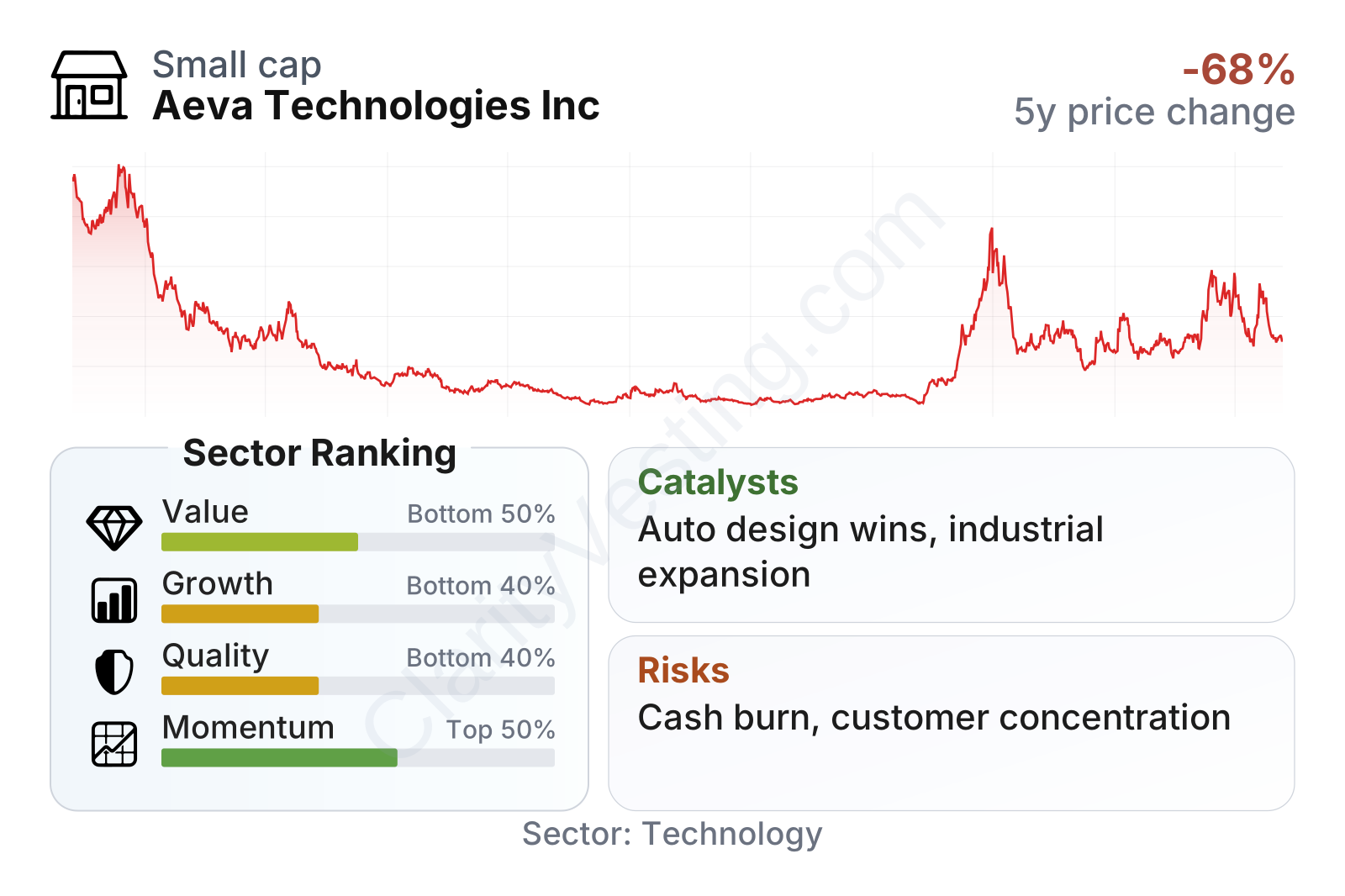
Aeva is a small-cap technology company with very high share-price volatility, reflected in a beta well above 2. The stock has rebounded strongly over the last several years from depressed levels, but that recovery has come with sharp swings. On the fundamentals table, the company ranks in the lower part of the sector on value, growth, and quality, while momentum is somewhat better. That combination usually points to a market that is reacting more to future expectations and contract wins than to established profitability or cash generation.
Growth
Aeva operates in a sector with real long-term growth potential. Vehicle sensing, automation, and machine perception are expanding markets as automakers and industrial customers push for higher safety, more autonomy, and better real-time awareness. If LiDAR adoption continues to increase beyond premium pilot programs into larger production platforms, the addressable market could become much larger than Aeva’s current revenue base suggests.
The company’s strategy is logically aligned with that opportunity. Rather than competing only on object detection, Aeva is emphasizing its ability to measure both distance and velocity directly. That can be attractive in situations where reliability at longer range and better tracking of moving objects matter. The strategy also includes working closely with automotive and industrial customers before full production, which is common in this industry because winning a design slot can lead to multi-year revenue once a platform launches.
Revenue growth has been highly uneven, which is normal for a company at this stage but still important to watch carefully. Some periods showed very strong year-over-year gains from a low base, while the most recent annual growth rate has slowed to roughly 11%, below the sector median. That does not cancel the longer-term opportunity, but it does show that commercialization is still developing rather than accelerating smoothly.
Free cash flow remains deeply negative, staying around a loss of more than $100 million on a trailing basis for several years. In practical terms, Aeva is still funding future opportunity rather than harvesting returns from an established business. A more convincing growth profile would likely require not only more revenue wins, but clearer evidence that higher sales are starting to reduce cash burn.
Recent company announcements have centered on new partnerships, industrial progress, and automotive program development, which matter because this business can change quickly if a supplier moves from validation into production. For Aeva, the strongest catalyst is not a single quarter of revenue, but the possibility that one or more major design wins convert into durable, high-volume shipments over time.
Risks
This article is for informational purposes only and does not constitute financial advice. Some content is AI-generated. See Disclaimer


