Stock Analysis · Aehr Test Systems (AEHR)
Overview
Aehr Test Systems designs and sells equipment used to test, burn-in, and qualify semiconductors. In simple terms, its systems help chipmakers and device companies find early failures and improve reliability before chips are shipped into demanding applications. The company is best known for test and burn-in solutions used in power semiconductors, especially silicon carbide devices, which are important in electric vehicles, charging infrastructure, industrial power systems, and some data center applications.
The business is relatively focused. Based on the company’s recent filings, revenue primarily comes from test and burn-in systems, consumable contactors and related accessories, and services or support. Aehr has also emphasized wafer-level burn-in, where entire wafers can be stressed and tested before chips are packaged, which can lower customer cost and improve manufacturing efficiency.
Revenue sources are concentrated in a few categories, with equipment sales still dominating.
- Test and burn-in systems: approximately 75% to 85% of revenue in recent years. This includes FOX systems and other production test platforms purchased by semiconductor manufacturers.
- WaferPak contactors, consumables, and related items: approximately 10% to 20% of revenue. These are recurring or repeat-purchase components used with installed systems.
- Services, support, and other revenue: generally 0% to 10% of revenue. This includes maintenance, engineering support, and smaller miscellaneous items.
The customer base is also concentrated by end market. Public company disclosures indicate that silicon carbide has been the main growth engine, while the company has also been expanding its message around silicon photonics, AI-related optical interconnects, gallium nitride, and hard disk drive components. That mix matters because Aehr is not a broad semiconductor equipment company; it is a specialized supplier whose results can move sharply depending on a few programs and customer spending cycles.
The business model has become less profitable over the last two fiscal years. Revenue has declined from the peak reached around fiscal 2024, while research and development and other operating costs have continued to rise. Gross profit has also narrowed, turning what had been a strong earnings phase into a recent loss-making period. That does not erase the strategic niche, but it does show how sensitive the company is to order timing and customer concentration.
The financial flow illustrates a clear shift: revenue and gross profit were much stronger in fiscal 2023 and 2024, but by fiscal 2025 and 2026, operating expenses had risen while gross profit weakened. The result is a move from healthy profitability to operating losses, which is a key point for long-term analysis.
Key Figures
| Metric | Value | Sector ⓘ |
|---|---|---|
| Date | Sep 12, 2026 | |
| Context | ||
| Sector | Technology | |
| Industry | Semiconductor Equipment & Materials | |
| Market Cap ⓘ | $3.09B | |
| Beta ⓘ | 3.07 | |
Value (Cheapness) | ||
| P/E Ratio ⓘ | N/A | 29.51 |
| FCF Yield ⓘ | -0.17% | 4.25% |
| EBIT / EV ⓘ | -0.40% | 2.85% |
| PEG ⓘ | 0.90 | |
Growth (Business expansion) | ||
| Revenue Growth ⓘ | 33.70% | 15.40% |
| RPS Growth (5Y CAGR) ⓘ | -2.85% | 8.56% |
| EPS Growth (5Y CAGR) ⓘ | N/A | -11.88% |
| Margin Growth (5Y Trend) ⓘ | -26.05% | 0.46% |
| FCF Growth (5Y CAGR) ⓘ | 43.43% | 9.80% |
Quality (Business durability) | ||
| ROIC (Latest) ⓘ | -5.99% | 9.44% |
| ROIC (5Y Median) ⓘ | 24.95% | 8.30% |
| Net Debt / EBIT (Latest) ⓘ | N/A | 0.54 |
| Net Debt / EBIT (5Y Median) ⓘ | -3.19 | 0.44 |
| Operating Margin (Latest) ⓘ | -23.05% | 9.58% |
| Operating Margin (5Y Median) ⓘ | 18.79% | 8.25% |
| Debt to Equity (Latest) ⓘ | 4.50% | 33.33% |
| Profit Margin (Latest) ⓘ | -14.25% | 7.14% |
| Free Cash Flow (Latest) ⓘ | -$5.38M | |
Momentum (Price trend) | ||
| 3Y Return ⓘ | +99.60% | +45.48% |
| 12M Return (excl. last month) ⓘ | +564.42% | +23.48% |
| 6M Return ⓘ | +151.50% | +20.93% |
| Price vs. 200-Day MA ⓘ | +47.46% | +7.43% |
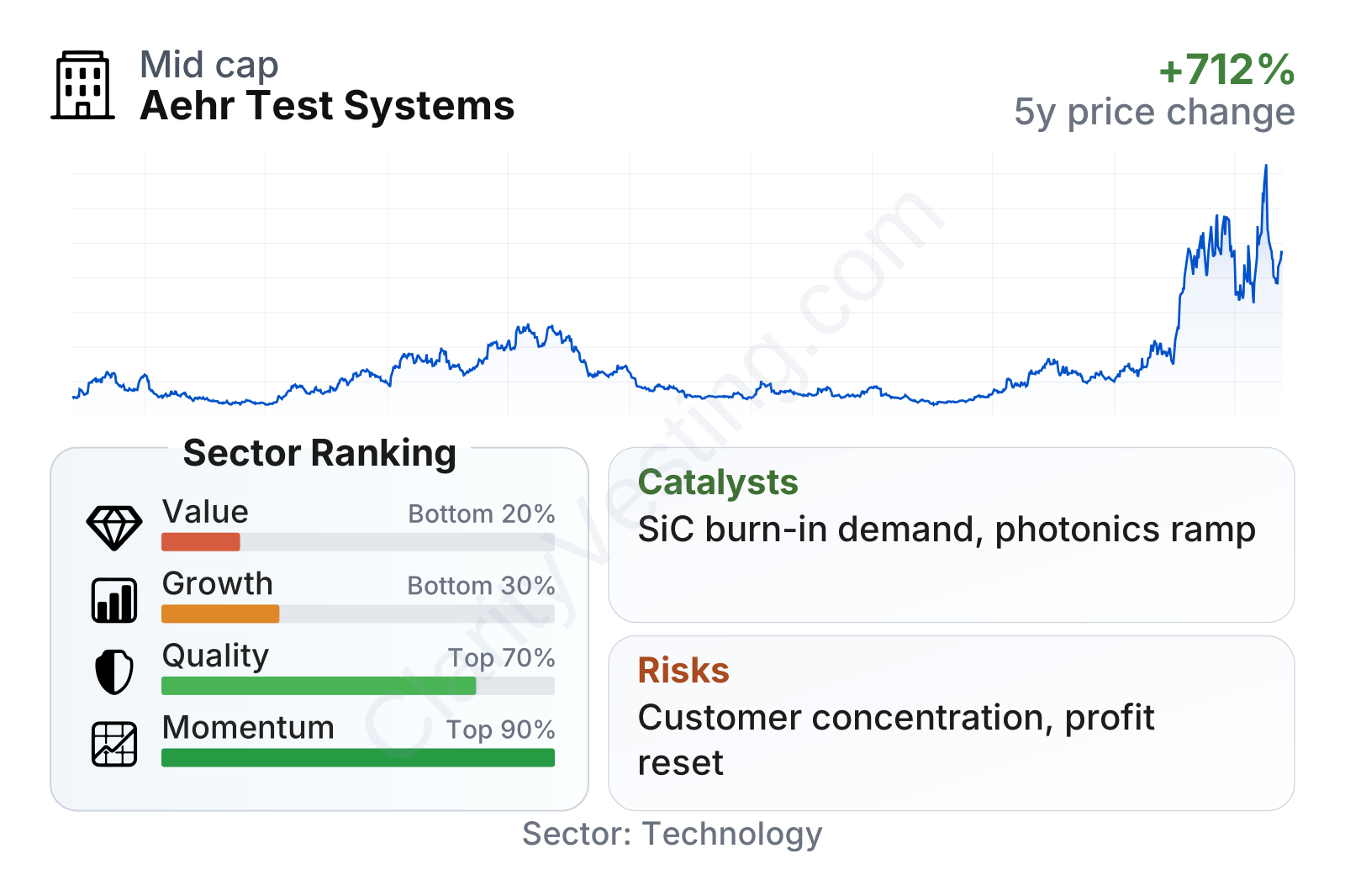
Aehr is a small-cap semiconductor equipment company with unusually high share-price volatility, reflected in a beta above 3. The factor profile is mixed. Momentum is very strong, meaning the stock has recently outperformed much of the sector, but value and growth rankings are weak relative to peers because profitability and cash generation have turned negative. Quality is more balanced: the balance sheet remains conservative, with debt-to-equity near 5%, far below the sector median near 30%, but current returns on capital and margins are under pressure.
The stock’s price history shows how quickly sentiment can swing. Shares moved from single digits in 2021 to much higher levels during the silicon carbide expansion, then corrected sharply, and more recently rebounded dramatically. That pattern fits a company whose outlook depends heavily on a few major customers, large equipment orders, and expectations for adoption in newer chip markets.
Growth
Aehr operates in a part of the semiconductor industry that still has attractive long-term drivers. Power semiconductors are benefiting from electrification, especially electric vehicles, onboard charging, renewable energy systems, and industrial power control. The company’s wafer-level burn-in positioning is especially relevant in silicon carbide because these devices are expensive and reliability requirements are strict. If customers can screen wafers earlier and more efficiently, the value proposition can be meaningful.
Beyond silicon carbide, management has been highlighting newer opportunities in silicon photonics and optical I/O. That matters because high-speed optical connections are increasingly discussed as a bottleneck for AI infrastructure and next-generation data center architectures. Aehr’s systems are being positioned for reliability screening of these devices, which could broaden the company beyond its current dependence on power semiconductors if design and production ramps materialize.
The recent revenue trend shows a business coming off a difficult stretch rather than moving in a straight line. Year-over-year growth turned negative for multiple quarters after the fiscal 2024 peak, then returned to positive territory more recently. That suggests the downturn may be cyclical and tied to customer spending pauses, but it also confirms that growth has been uneven and highly sensitive to program timing.
Cash generation tells a similar story. Free cash flow was positive in earlier periods, then turned negative over the last two years as profits weakened and the company continued spending on operations and development. For a niche equipment maker, this is important: future growth may still be credible, but the business needs order recovery to turn that growth narrative back into durable cash production.
Aehr’s strategy makes sense if its target markets continue expanding. The installed-base model can also help over time, because equipment placements create follow-on demand for contactors and consumables. A larger system footprint at leading customers would therefore improve revenue visibility and reduce dependence on one-off machine shipments. The strongest catalyst remains broader production adoption in silicon carbide and successful expansion into photonics-related testing, where industry needs are increasing and specialized reliability screening could become more important.
Recent company communications have pointed to growing engagement in these newer optical and AI-adjacent markets, alongside continuing silicon carbide opportunities. The significance is not that these markets are already large for Aehr, but that they could give the company a second major growth leg if qualification activity converts into high-volume production orders.
Risks
This article is for informational purposes only and does not constitute financial advice. Some content is AI-generated. See Disclaimer