Stock Analysis · Autodesk Inc (ADSK)
Overview
Autodesk is a software company best known for tools used to design buildings, infrastructure, manufactured products, and digital media. Its products help architects, engineers, construction teams, product designers, and manufacturing companies create 2D and 3D designs, simulate performance, manage projects, and collaborate across the full life cycle of a project. Well-known products include AutoCAD, Revit, Civil 3D, Inventor, Maya, and Fusion.
The business model is now centered mainly on subscriptions, which makes revenue more recurring and easier to forecast than the old perpetual-license model. Autodesk reports revenue by product family and geography, with subscriptions representing the large majority of sales in recent years.
Based on Autodesk’s latest annual reporting for fiscal 2026, the main revenue sources are approximately:
- Architecture, Engineering and Construction (AEC): about 50% — software for building design, BIM workflows, civil infrastructure, and construction coordination, including products such as Revit, Civil 3D, and Autodesk Construction Cloud.
- AutoCAD and AutoCAD LT: about 30% — general-purpose design and drafting tools used across many industries.
- Manufacturing: about 12% — tools such as Inventor and Fusion used for mechanical design, product development, simulation, and manufacturing workflows.
- Media and Entertainment: about 4% — animation, visual effects, and content creation software such as Maya and 3ds Max.
- Other and legacy items: about 4% — includes smaller product lines and remaining non-core activities.
Geographically, Autodesk remains broadly diversified, with the Americas contributing the largest share, followed by EMEA and Asia Pacific. That spread reduces dependence on a single economy, although construction and industrial spending still matter a lot to demand.
Financially, the company has become larger and more efficient over the last five years. Revenue rose from about $4.4 billion in fiscal 2022 to about $7.2 billion in fiscal 2026, while gross profit stayed very high because software delivery costs are relatively low. Research and development spending also increased steadily, showing that Autodesk is still reinvesting heavily in product depth rather than simply harvesting mature software franchises.
The business mix shows a classic software profile: very high gross profit, growing operating income, and meaningful reinvestment in engineering. The most notable trend is that revenue and operating profit have expanded together, which suggests growth has not come at the expense of profitability.
Key Figures
| Metric | Value | Sector ⓘ |
|---|---|---|
| Date | Sep 12, 2026 | |
| Context | ||
| Sector | Technology | |
| Industry | Software - Application | |
| Market Cap ⓘ | $44.39B | |
| Beta ⓘ | 1.31 | |
Value (Cheapness) | ||
| P/E Ratio ⓘ | 27.41 | 29.51 |
| FCF Yield ⓘ | 6.38% | 4.25% |
| EBIT / EV ⓘ | 4.93% | 2.85% |
| PEG ⓘ | 0.80 | |
Growth (Business expansion) | ||
| Revenue Growth ⓘ | 16.10% | 15.40% |
| RPS Growth (5Y CAGR) ⓘ | 14.13% | 8.56% |
| EPS Growth (5Y CAGR) ⓘ | -8.97% | -11.88% |
| Margin Growth (5Y Trend) ⓘ | 7.63% | 0.46% |
| FCF Growth (5Y CAGR) ⓘ | 13.24% | 9.80% |
Quality (Business durability) | ||
| ROIC (Latest) ⓘ | 28.05% | 9.44% |
| ROIC (5Y Median) ⓘ | 23.95% | 8.30% |
| Net Debt / EBIT (Latest) ⓘ | -0.19 | 0.54 |
| Net Debt / EBIT (5Y Median) ⓘ | 0.69 | 0.44 |
| Operating Margin (Latest) ⓘ | 27.05% | 9.58% |
| Operating Margin (5Y Median) ⓘ | 20.67% | 8.25% |
| Debt to Equity (Latest) ⓘ | 109.52% | 33.33% |
| Profit Margin (Latest) ⓘ | 21.08% | 7.14% |
| Free Cash Flow (Latest) ⓘ | $2.83B | |
Momentum (Price trend) | ||
| 3Y Return ⓘ | +0.28% | +45.48% |
| 12M Return (excl. last month) ⓘ | -11.84% | +23.48% |
| 6M Return ⓘ | -15.00% | +20.93% |
| Price vs. 200-Day MA ⓘ | -13.45% | +7.43% |
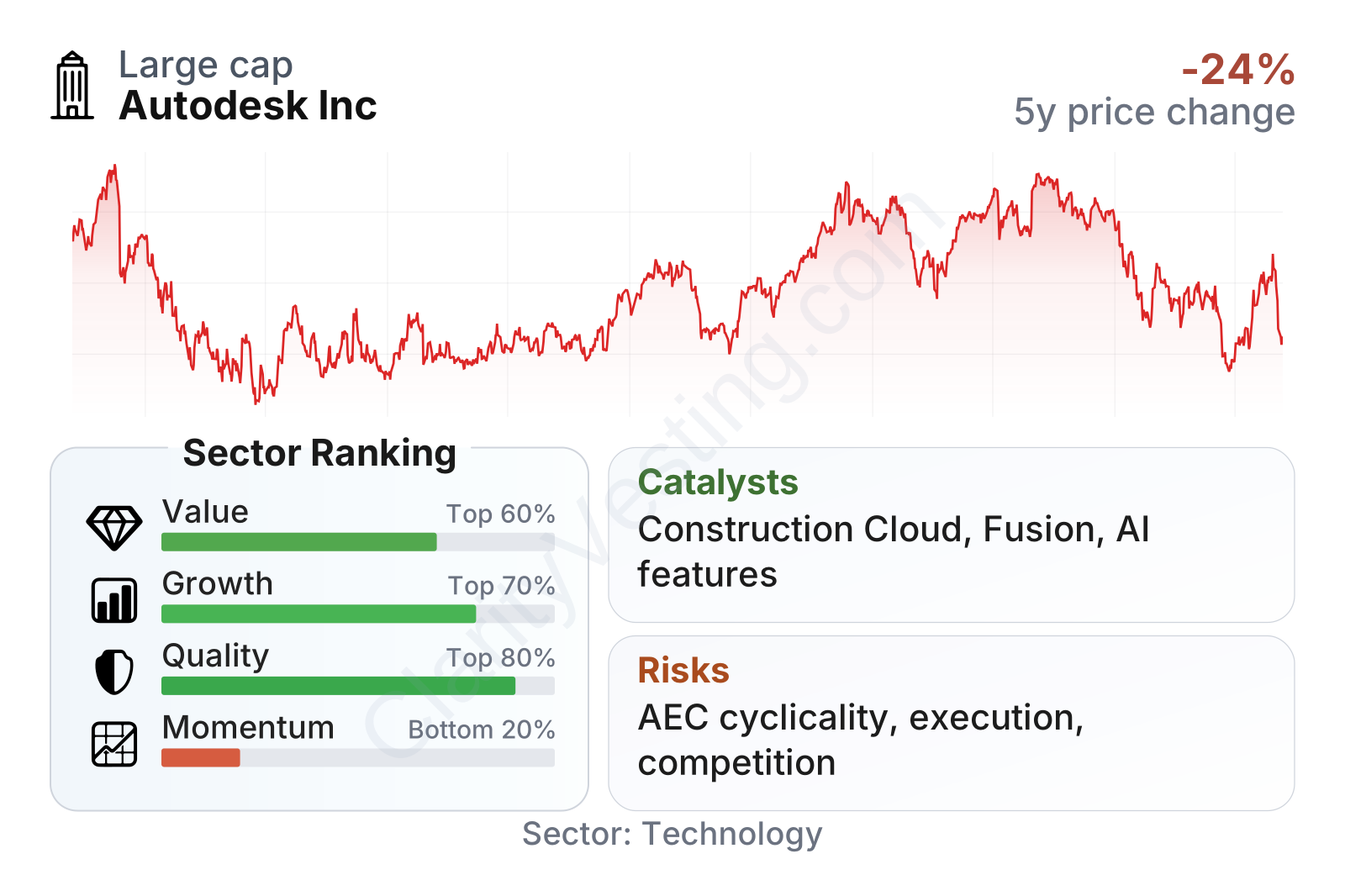
Autodesk is a large software company with above-average business quality. Profitability stands out: operating margin is around 28% versus a sector median near 10%, profit margin is around 21% versus about 7% for the median software peer, and return on invested capital is far stronger than typical sector levels. Growth is solid rather than exceptional, with revenue expansion roughly in line with the sector recently but stronger multiyear revenue-per-share growth and improving margins. Valuation is not cheap on earnings, yet cash generation looks comparatively better, with free cash flow yield and EBIT relative to enterprise value both stronger than the sector median. Share-price momentum has been weak compared with many technology names, which helps explain why the valuation premium has narrowed.
Growth
Autodesk operates in markets with durable long-term demand. Digitization in architecture and engineering, more complex infrastructure projects, demand for collaborative cloud workflows, industrial automation, and the rise of digital twins all support continued software spending. These are not short-lived trends. Design and construction remain large industries that are still far from fully digitized, especially when it comes to connecting planning, design, cost control, field execution, and long-term asset management.
A big part of Autodesk’s strategy is to move customers from stand-alone desktop tools toward connected platforms. In practical terms, that means linking design software such as Revit, AutoCAD, and Inventor with cloud collaboration, construction management, and data-sharing tools. This approach makes sense because customers increasingly want fewer disconnected systems and more continuity across teams. It also tends to raise switching costs once a company has embedded Autodesk across many workflows.
Revenue growth slowed in fiscal 2023, then reaccelerated and moved back into the mid-to-high teens more recently. That matters because it suggests demand has remained resilient despite uneven macro conditions in construction, manufacturing, and enterprise software spending. Over a five-year view, Autodesk’s revenue expansion has been consistent enough to support the idea of a still-growing franchise rather than a mature business stuck at low-single-digit growth.
Cash generation has also improved meaningfully. Free cash flow was volatile for a period, but the broader direction has been upward, reaching roughly $2.4 billion on a trailing basis in the latest view provided here, with about $2.8 billion in the most recent table snapshot. For a subscription software business, rising cash flow is important because it shows that growth is translating into financial flexibility, not just accounting earnings.
Autodesk also has several concrete growth catalysts. One is continued adoption of Autodesk Construction Cloud, where the company is trying to capture more value after the design phase and move deeper into project execution. Another is Fusion, which aims to unify design, engineering, simulation, and manufacturing in a more integrated environment. A third is artificial intelligence: Autodesk has been embedding generative design, automation, and assistant features into products to reduce repetitive work and improve productivity. In industries facing labor shortages and project complexity, time-saving tools can become a strong selling point.
Recent company communications have also emphasized platform integration, cloud collaboration, and industry clouds. That is significant because it points to a broader ambition than selling individual software seats. If Autodesk succeeds, more of its revenue base could come from connected ecosystems and workflow subscriptions, which usually carry better retention and more opportunities for expansion within existing customers.
Risks
This article is for informational purposes only and does not constitute financial advice. Some content is AI-generated. See Disclaimer