Stock Analysis · Automatic Data Processing Inc (ADP)
Overview
Automatic Data Processing, better known as ADP, provides software and services that help employers manage payroll, human resources, tax filing, benefits administration, time tracking, talent management, and related compliance tasks. In simple terms, ADP handles many of the back-office processes that companies need in order to pay employees correctly, stay compliant with labor and tax rules, and organize workforce data. It serves businesses of many sizes, from small companies to large multinational employers.
Its business is built around recurring service relationships. Once a company uses ADP for payroll, tax withholding, benefits, scheduling, and HR administration, switching providers can be disruptive and costly. That creates a relatively stable revenue base and helps explain why ADP has remained one of the largest payroll and human capital management providers in the market.
Based on the company’s latest annual reporting structure, ADP’s revenue is mainly divided into two operating segments.
- Employer Services: about 94% of revenue — payroll processing, payroll tax administration, HR management software, benefits administration, retirement services, time and attendance tools, recruiting, and outsourcing solutions for employers.
- Professional Employer Organization Services: about 6% of revenue — co-employment and outsourced HR services through ADP TotalSource, where ADP helps small and midsize businesses with HR administration, benefits access, compliance support, and other employment-related functions.
There is also an important profit driver beyond service fees: ADP earns interest income on client funds it temporarily holds before payroll and tax payments are disbursed. That is not usually presented as a separate top-line segment, but it matters to earnings because higher interest rates can lift the return on those balances.
Over the last several years, the company’s revenue, operating income, and net income have all moved higher. The broad pattern has been steady expansion rather than explosive growth, which fits the nature of a mature, mission-critical business serving employers at scale.
The business mix shows a company with a large core payroll and HR engine, while profit has generally grown faster than costs. That points to operating discipline and the benefits of scale, even though expense growth has become more visible in the latest period.
Key Figures
| Metric | Value | Sector ⓘ |
|---|---|---|
| Date | Sep 12, 2026 | |
| Context | ||
| Sector | Technology | |
| Industry | Software - Application | |
| Market Cap ⓘ | $106.57B | |
| Beta ⓘ | 0.83 | |
Value (Cheapness) | ||
| P/E Ratio ⓘ | 24.54 | 29.51 |
| FCF Yield ⓘ | 4.67% | 4.25% |
| EBIT / EV ⓘ | 5.51% | 2.85% |
| PEG ⓘ | 2.46 | |
Growth (Business expansion) | ||
| Revenue Growth ⓘ | 6.80% | 15.40% |
| RPS Growth (5Y CAGR) ⓘ | 8.82% | 8.56% |
| EPS Growth (5Y CAGR) ⓘ | 12.23% | -11.88% |
| Margin Growth (5Y Trend) ⓘ | 3.13% | 0.46% |
| FCF Growth (5Y CAGR) ⓘ | 19.80% | 9.80% |
Quality (Business durability) | ||
| ROIC (Latest) ⓘ | 38.22% | 9.44% |
| ROIC (5Y Median) ⓘ | 40.20% | 8.30% |
| Net Debt / EBIT (Latest) ⓘ | 0.18 | 0.54 |
| Net Debt / EBIT (5Y Median) ⓘ | 0.27 | 0.44 |
| Operating Margin (Latest) ⓘ | 26.71% | 9.58% |
| Operating Margin (5Y Median) ⓘ | 26.71% | 8.25% |
| Debt to Equity (Latest) ⓘ | 87.39% | 33.33% |
| Profit Margin (Latest) ⓘ | 20.11% | 7.14% |
| Free Cash Flow (Latest) ⓘ | $4.98B | |
Momentum (Price trend) | ||
| 3Y Return ⓘ | +16.22% | +45.48% |
| 12M Return (excl. last month) ⓘ | -7.61% | +23.48% |
| 6M Return ⓘ | +32.21% | +20.93% |
| Price vs. 200-Day MA ⓘ | +14.71% | +7.43% |
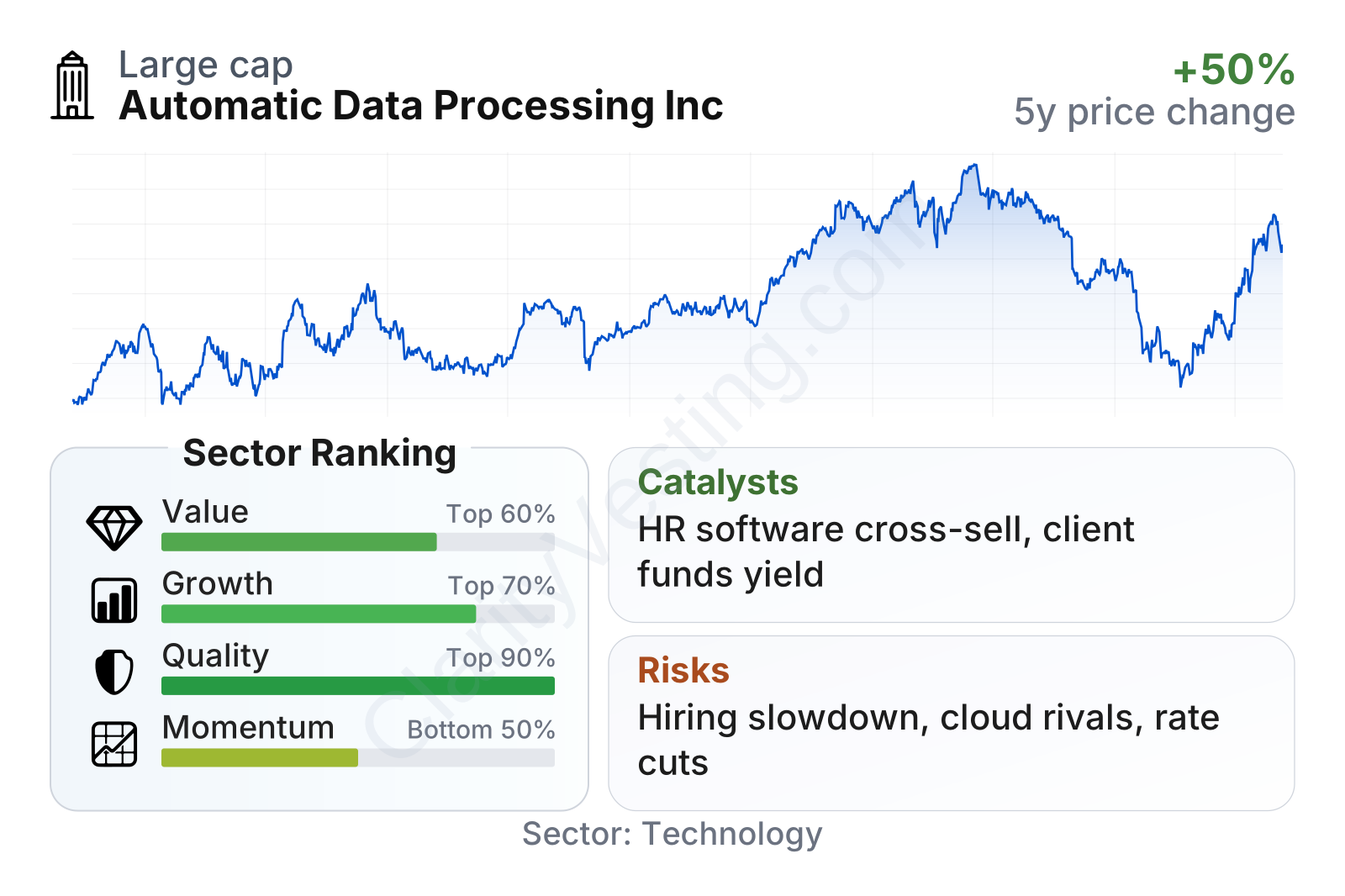
ADP is a very large company with relatively low share-price volatility, as reflected by a beta below 1. In broad terms, the quality profile stands out much more than the growth or momentum profile. Profitability metrics are far above the sector median, returns on invested capital are exceptionally strong, and leverage looks manageable when compared with earnings, even if balance-sheet debt relative to equity runs above the software sector median. Growth remains positive but moderate, which is typical for a mature market leader rather than a fast-scaling younger software company.
Growth
ADP operates in a sector with durable long-term demand. Every employer needs payroll, tax withholding, employee records, and compliance support. Over time, that need is becoming more complex, not less. Labor regulations keep changing, multistate and multinational employment creates more administrative work, and companies increasingly want integrated software rather than separate tools for payroll, scheduling, benefits, and performance management. This creates a favorable backdrop for providers that already have scale, trusted brands, and broad product suites.
ADP’s strategy for future expansion is sensible because it builds on areas where the company already has credibility: cross-selling more HR modules into existing payroll customers, moving clients onto broader cloud platforms, expanding outsourcing relationships, and using analytics and automation to improve customer retention and efficiency. The company also benefits from its large client base, which gives it many opportunities to deepen relationships without relying entirely on new customer wins.
Revenue growth has generally stayed in the mid- to high-single-digit range in recent periods. That is slower than the median company in the software sector, but it is also more stable than many younger firms. For ADP, consistency matters because long-term compounding often comes from recurring services, retention, pricing discipline, and gradual client expansion rather than sudden bursts of demand.
Cash generation has strengthened meaningfully over the last several years, with trailing free cash flow rising from a little above $2 billion to more than $5 billion. That trend matters because it shows that earnings are being converted into real cash that can support dividends, acquisitions, product investment, and share repurchases. Five-year free cash flow growth has also outpaced the sector median, which is a positive sign for business durability.
A meaningful catalyst for ADP is the continued digitization of HR and payroll for small and midsize businesses. Many employers still run fragmented systems or rely on older processes, creating room for platform upgrades. Another catalyst is the interest income earned on client funds. When rates remain elevated relative to the last decade, ADP can earn more from this float-like balance, which supports margins and earnings. Recent company updates have also highlighted ongoing demand for broader human capital management solutions and resilience in client retention, both of which reinforce the company’s ability to grow steadily even in a mixed macroeconomic environment.
Risks
This article is for informational purposes only and does not constitute financial advice. Some content is AI-generated. See Disclaimer