Stock Analysis · Adient PLC (ADNT)
Overview
Adient PLC is one of the world’s largest automotive seating companies. It designs, engineers, manufactures, and assembles vehicle seats and related interior components for major automakers. In simple terms, when a car, SUV, or truck leaves the factory, Adient may have supplied the complete seat system, the seat structures underneath, the foam and trim, or the mechanisms that allow seats to recline, slide, heat, cool, or adjust.
The business is closely tied to global vehicle production. Adient mainly sells to original equipment manufacturers, meaning carmakers rather than consumers. Its products are installed in passenger vehicles across North America, Europe, China, and other regions. Because seating is a required component in every vehicle, Adient operates in a large and recurring market, but one that is also highly competitive and sensitive to auto production cycles.
Revenue is primarily generated from complete seating systems and seating components sold to automakers. Public filings indicate the business is organized geographically, so the clearest breakdown is by region rather than by individual product line.
- Americas: approximately 35% to 40% of revenue. This includes seating systems and components supplied to vehicle manufacturers in North and South America.
- Europe, Middle East and Africa: approximately 30% to 35% of revenue. This region serves major European auto platforms and related production programs.
- Asia-Pacific excluding China joint ventures: approximately 10% to 15% of revenue. This includes business with automakers in countries such as Japan, Korea, and India.
- China joint venture income and related activities: economically significant but not fully reflected as consolidated product revenue because much of the China business operates through joint ventures. China remains important to Adient’s global footprint and earnings mix even when reported revenue percentages understate its industrial presence there.
At a high level, Adient’s cost structure shows a classic auto-parts profile: most revenue is consumed by manufacturing and material costs, leaving a relatively thin gross margin. That means execution, scale, and cost control matter a great deal more here than in software or branded consumer goods.
Over the last several years, revenue has stayed in the mid-teen billions of dollars, but profits have moved around much more sharply. The business recovered meaningfully in 2023, then profitability weakened again in 2024 and 2025, which highlights how small margin shifts can have a large effect on earnings in this industry.
Key Figures
| Metric | Value | Sector ⓘ |
|---|---|---|
| Date | Sep 12, 2026 | |
| Context | ||
| Sector | Consumer Cyclical | |
| Industry | Auto Parts | |
| Market Cap ⓘ | $1.48B | |
| Beta ⓘ | 1.53 | |
Value (Cheapness) | ||
| P/E Ratio ⓘ | 34.29 | 17.10 |
| FCF Yield ⓘ | 20.35% | 8.53% |
| EBIT / EV ⓘ | 17.21% | 6.46% |
| PEG ⓘ | 0.12 | |
Growth (Business expansion) | ||
| Revenue Growth ⓘ | 5.00% | 5.75% |
| RPS Growth (5Y CAGR) ⓘ | 5.21% | 9.14% |
| EPS Growth (5Y CAGR) ⓘ | 100.25% | -18.21% |
| Margin Growth (5Y Trend) ⓘ | -11.61% | -0.23% |
| FCF Growth (5Y CAGR) ⓘ | -40.31% | 4.91% |
Quality (Business durability) | ||
| ROIC (Latest) ⓘ | 5.95% | 12.61% |
| ROIC (5Y Median) ⓘ | 5.29% | 10.72% |
| Net Debt / EBIT (Latest) ⓘ | 2.96 | 2.10 |
| Net Debt / EBIT (5Y Median) ⓘ | 4.51 | 2.32 |
| Operating Margin (Latest) ⓘ | 3.27% | 9.25% |
| Operating Margin (5Y Median) ⓘ | 2.21% | 9.64% |
| Debt to Equity (Latest) ⓘ | 138.11% | 75.78% |
| Profit Margin (Latest) ⓘ | 0.32% | 5.33% |
| Free Cash Flow (Latest) ⓘ | $301.00M | |
Momentum (Price trend) | ||
| 3Y Return ⓘ | -51.17% | +14.53% |
| 12M Return (excl. last month) ⓘ | -18.80% | +3.08% |
| 6M Return ⓘ | -4.28% | +0.55% |
| Price vs. 200-Day MA ⓘ | -8.00% | -0.54% |
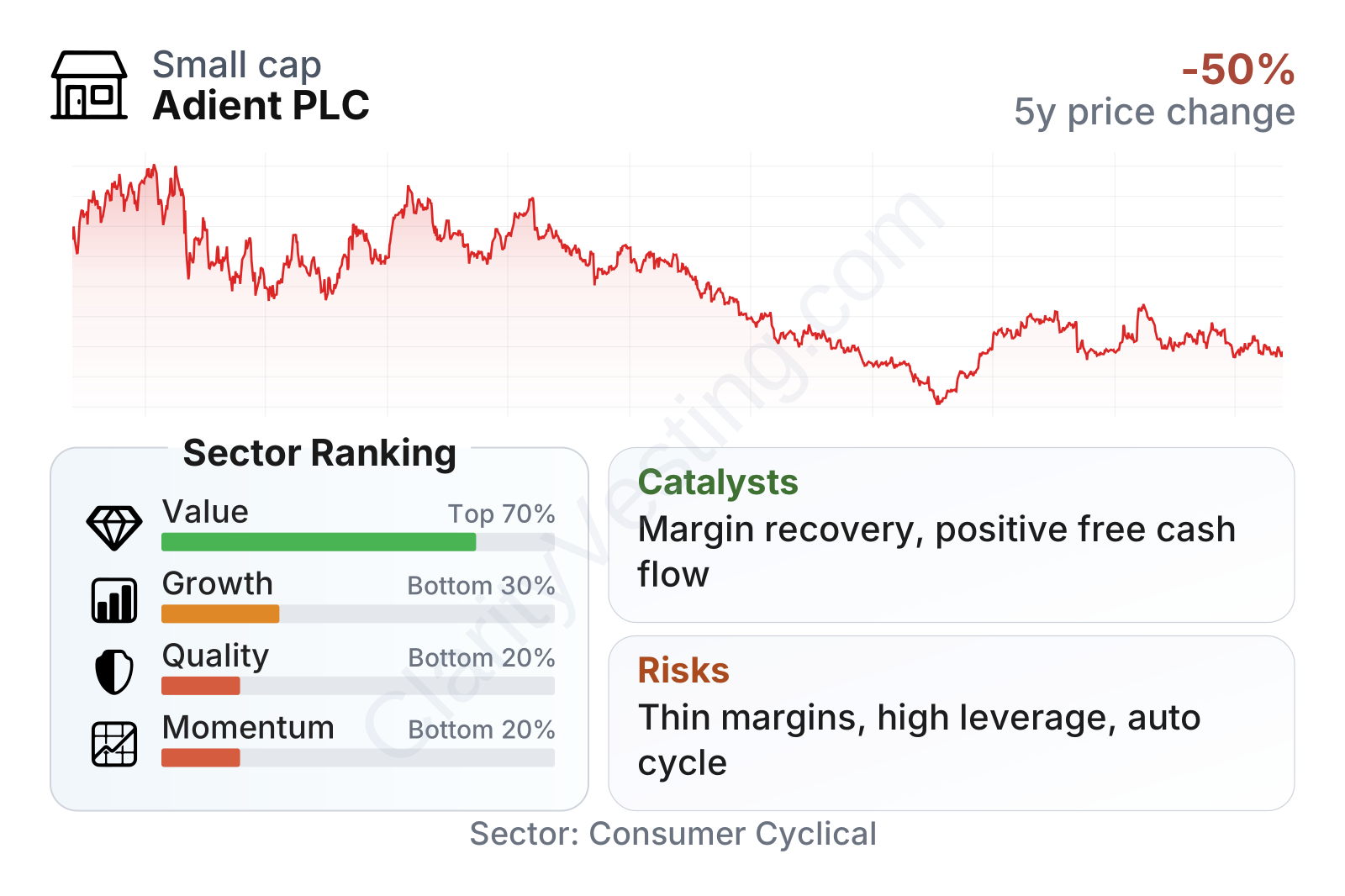
Adient is a mid-sized public company with a stock that has been notably volatile, as reflected by a beta above 1.5. The share price has trended down over the last few years, which matches the weak momentum profile. At the same time, the metrics show a more mixed underlying picture: value measures look relatively strong on cash flow and enterprise-value-based measures, while growth, quality, and momentum rank weakly against the broader sector. In other words, the market appears to be discounting the company for inconsistent profitability and balance-sheet pressure rather than for lack of scale or cash generation alone.
Growth
Adient operates in a mature industry, so this is not a classic high-growth company. Long-term expansion depends less on creating a brand-new market and more on winning vehicle programs, improving content per vehicle, expanding in attractive regions, and raising margins through operational discipline. The sector itself should remain relevant because every mass-produced vehicle needs seats, and the shift toward electric vehicles does not remove that need. If anything, evolving vehicle interiors can create demand for more advanced comfort, safety, and configuration features.
That said, volume growth in automotive seating usually follows global vehicle production rather than outrunning it by a wide margin. This limits how fast the top line can expand over long periods. Adient’s strategy therefore makes the most sense when focused on program wins, engineering capabilities, lower-cost manufacturing, and tighter capital allocation rather than on headline revenue growth alone.
Recent revenue trends suggest stabilization rather than breakout growth. After a difficult stretch of declines in 2024 and early 2025, year-over-year growth turned positive again and recently moved into the mid-single-digit range. That is a constructive shift, but it still places the company below many sector peers on broader multi-year growth measures. The more important question is whether returning sales growth can translate into durable margin recovery.
Cash generation is one of the more encouraging elements in the current profile. Free cash flow turned strongly positive after earlier weakness and has remained positive in recent periods, even though earnings have been uneven. For a manufacturing supplier, that matters because cash can support debt reduction, restructuring, and investment in new programs. One notable catalyst is any sustained conversion of operating improvements into free cash flow, especially if management can keep working capital and capital spending under control.
Another possible tailwind comes from the company’s exposure to major global automakers and its large installed manufacturing base. If vehicle production normalizes further and supply chain disruptions continue to ease, suppliers like Adient can benefit from smoother plant utilization and better operating efficiency. Public company communications in recent years have also emphasized footprint optimization and cost actions, which could help earnings more than revenue growth by itself.
Risks
This article is for informational purposes only and does not constitute financial advice. Some content is AI-generated. See Disclaimer


