Stock Analysis · Analog Devices Inc (ADI)
Overview
Analog Devices, Inc. designs and sells semiconductor chips that help electronic systems measure, interpret, and control real-world signals such as sound, temperature, motion, pressure, light, and power. In simple terms, its components act as the “bridge” between the physical world and digital processing. The company focuses on higher-value analog, mixed-signal, power management, radio-frequency, and embedded processing products that are used in industrial equipment, cars, communications infrastructure, healthcare devices, and other specialized electronics.
Its business is spread across several end markets, which is important because it reduces dependence on a single product cycle. Based on the company’s recent reporting, revenue is mainly generated from the following areas:
- Industrial: approximately 45% to 50% of revenue. This includes factory automation, instrumentation, energy systems, aerospace, defense, healthcare equipment, and other industrial applications.
- Automotive: approximately 25% to 30%. This segment includes chips for advanced driver assistance systems, electrification, battery management, in-cabin electronics, and safety systems.
- Communications: approximately 10% to 15%. This covers wired and wireless communications infrastructure, including base stations and network equipment.
- Consumer: approximately 5% to 10%. This includes audio, wearables, personal electronics, and other consumer devices.
What makes Analog Devices different from many chip companies is that it is less exposed to short product cycles in smartphones or PCs and more exposed to long-life markets where customers value reliability, precision, and long-term supply. That tends to support steadier pricing and better margins over time, even though results still move with the broader semiconductor cycle.
The long-term financial profile also shows a business that converts a large share of revenue into gross profit, while continuing to spend heavily on research and development. Revenue and earnings expanded sharply after the Maxim Integrated acquisition, then softened during the industry downturn in 2024 before recovering again in 2025. That pattern fits the company’s position in cyclical end markets rather than pointing to a broken business model.
Key Figures
| Metric | Value | Sector ⓘ |
|---|---|---|
| Date | Sep 12, 2026 | |
| Context | ||
| Sector | Technology | |
| Industry | Semiconductors | |
| Market Cap ⓘ | $183.54B | |
| Beta ⓘ | 1.21 | |
Value (Cheapness) | ||
| P/E Ratio ⓘ | 42.90 | 29.51 |
| FCF Yield ⓘ | 2.69% | 4.25% |
| EBIT / EV ⓘ | 2.22% | 2.85% |
| PEG ⓘ | 0.54 | |
Growth (Business expansion) | ||
| Revenue Growth ⓘ | 39.60% | 15.40% |
| RPS Growth (5Y CAGR) ⓘ | 5.02% | 8.56% |
| EPS Growth (5Y CAGR) ⓘ | -1.68% | -11.88% |
| Margin Growth (5Y Trend) ⓘ | 6.81% | 0.46% |
| FCF Growth (5Y CAGR) ⓘ | 15.65% | 9.80% |
Quality (Business durability) | ||
| ROIC (Latest) ⓘ | 8.47% | 9.44% |
| ROIC (5Y Median) ⓘ | 8.32% | 8.30% |
| Net Debt / EBIT (Latest) ⓘ | 1.47 | 0.54 |
| Net Debt / EBIT (5Y Median) ⓘ | 2.03 | 0.44 |
| Operating Margin (Latest) ⓘ | 33.46% | 9.58% |
| Operating Margin (5Y Median) ⓘ | 27.46% | 8.25% |
| Debt to Equity (Latest) ⓘ | 27.19% | 33.33% |
| Profit Margin (Latest) ⓘ | 29.79% | 7.14% |
| Free Cash Flow (Latest) ⓘ | $4.94B | |
Momentum (Price trend) | ||
| 3Y Return ⓘ | +126.82% | +45.48% |
| 12M Return (excl. last month) ⓘ | +67.91% | +23.48% |
| 6M Return ⓘ | +23.99% | +20.93% |
| Price vs. 200-Day MA ⓘ | +8.51% | +7.43% |
Analog Devices is a very large semiconductor company with above-average share-price volatility for a mature industrial chip supplier, though not at the extreme end of the technology sector. The overall picture from the latest metrics is mixed but understandable: growth and profitability are strong, while valuation is clearly richer than the sector median. Quality is supported by very high operating margins and solid long-term returns on capital, although leverage remains higher than many peers when measured against EBIT.
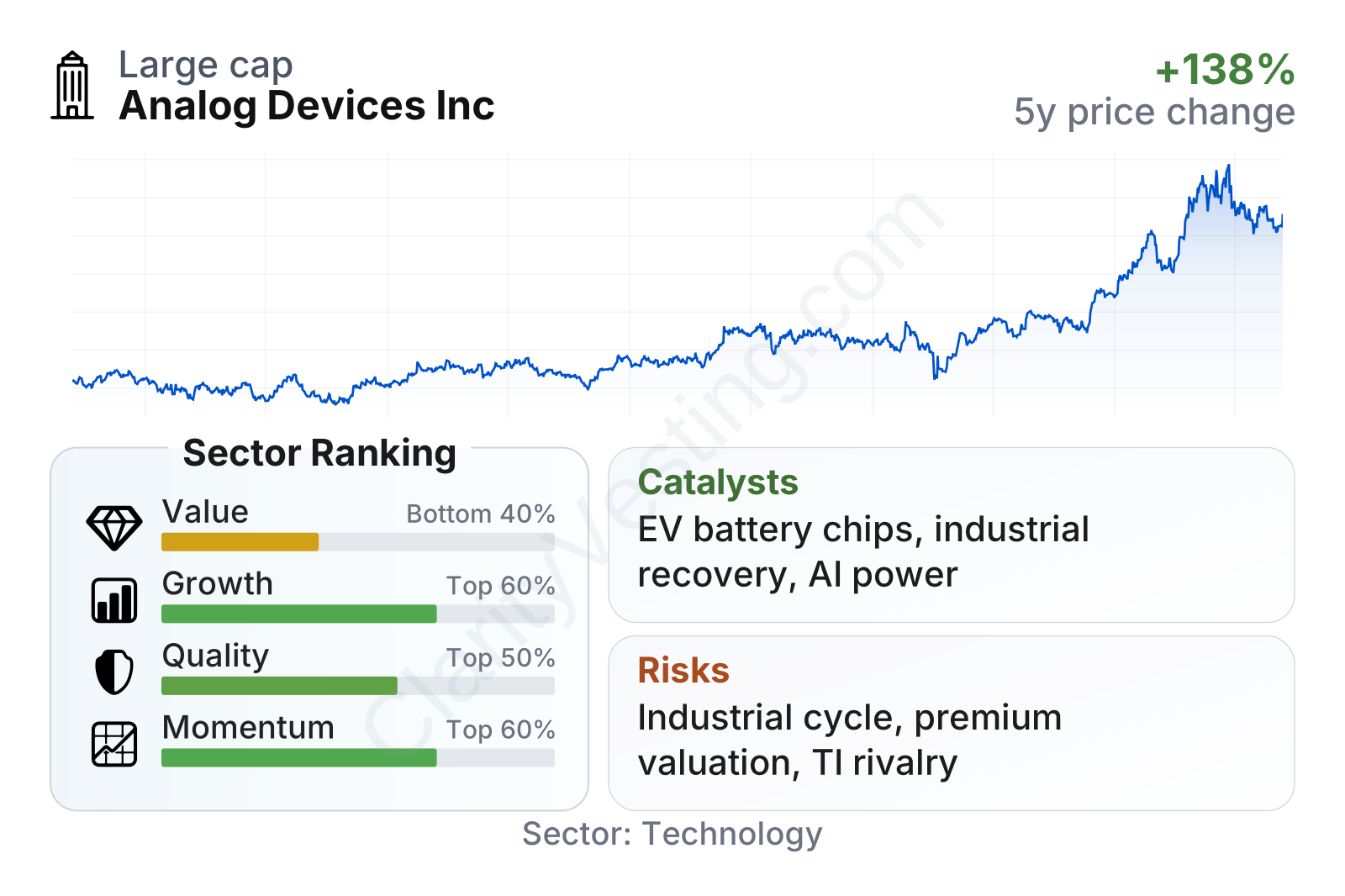
The recent stock performance has been strong over multi-year periods, especially compared with the broader semiconductor sector median. That suggests the market has been rewarding the company’s recovery, margin resilience, and positioning in industrial and automotive chips. At the same time, the valuation section of the table shows that much of that optimism is already reflected in the share price.
Growth
Analog Devices operates in a part of the semiconductor market that still has attractive long-term demand drivers. Industrial automation, electrified vehicles, battery systems, edge intelligence, digital health, energy efficiency, and communications infrastructure all require more sensing, signal conversion, power management, and data movement. These are areas where analog and mixed-signal chips remain essential even as digital processors receive more public attention.
The company’s strategy is logical for this environment. It concentrates on specialized chips that are hard to replace, often designed into systems that stay in service for many years. That creates sticky customer relationships and can support repeat revenue across long product lives. Its combination of analog, power, radio-frequency, and software-enabled solutions also helps it sell broader platforms rather than isolated components.
Recent revenue trends suggest the business has moved out of the downcycle that hit much of the industrial semiconductor market. Growth turned negative through 2023 and much of 2024, then recovered strongly, with year-over-year revenue growth rising back into the 20% to 40% range by 2026. That kind of rebound indicates improving customer demand and inventory normalization rather than only cost cutting.
Cash generation has also stayed strong through the cycle. Free cash flow pulled back from earlier highs during the downturn, but it remained substantial in absolute terms and has recovered to roughly the mid-$4 billion range on a trailing basis. For a company in capital-intensive technology markets, that level of cash generation provides flexibility for research spending, acquisitions, debt management, dividends, and buybacks.
A key catalyst is automotive electrification. Battery management systems, power conversion, and sensing content per vehicle are all rising, especially in electric and hybrid platforms. Another catalyst is industrial digitization, where more connected factories and energy systems need high-performance signal-chain and power components. The company has also recently highlighted stronger demand linked to AI-related infrastructure at the edge and in power-heavy systems, which can indirectly benefit analog suppliers even if they are not the headline providers of AI processors.
Recent company updates have also pointed to improving bookings and a broader recovery across industrial demand. For a business with meaningful exposure to long-cycle customers, that matters because orders often reflect multi-quarter planning rather than short-lived consumer trends.
Risks
This article is for informational purposes only and does not constitute financial advice. Some content is AI-generated. See Disclaimer


