Stock Analysis · Adobe Systems Incorporated (ADBE)
Overview
Adobe is a software company best known for creative tools such as Photoshop, Illustrator, Premiere Pro, Acrobat, and PDF-related services. Over time, it has shifted from selling one-time software licenses to a subscription-based model, which makes revenue more recurring and usually more predictable. Its products are used by individual creators, freelancers, large enterprises, marketing teams, publishers, and businesses that need document management and digital workflows.
Adobe’s business is organized around three main revenue engines. Based on the company’s latest annual reporting structure, the mix is led by Digital Media, followed by Digital Experience, with Publishing and Advertising contributing a much smaller amount.
- Digital Media: about 73% of revenue — This is the largest business by far. It includes Creative Cloud tools such as Photoshop, Illustrator, Lightroom, Premiere Pro, After Effects, InDesign, and related services, as well as Document Cloud products such as Acrobat, Acrobat AI Assistant, and e-signature tools. This segment is the core of Adobe’s recurring subscription model.
- Digital Experience: about 25% of revenue — This segment sells software for marketing, analytics, customer journey management, commerce, and content workflows. It serves enterprises that want to manage digital campaigns, customer data, and personalized experiences across websites and apps.
- Publishing and Advertising: about 2% of revenue — This is a much smaller legacy activity that includes older publishing-related products and certain advertising offerings.
Adobe’s economics are attractive for a software company: revenue has continued to climb, gross profit remains very high, and research spending has also increased meaningfully, which shows management is still investing heavily in product development while preserving strong profitability.
Key Figures
| Metric | Value | Sector ⓘ |
|---|---|---|
| Date | Sep 14, 2026 | |
| Context | ||
| Sector | Technology | |
| Industry | Software - Application | |
| Market Cap ⓘ | $100.26B | |
| Beta ⓘ | 1.42 | |
Value (Cheapness) | ||
| P/E Ratio ⓘ | 14.08 | 29.51 |
| FCF Yield ⓘ | 10.56% | 4.25% |
| EBIT / EV ⓘ | 9.15% | 2.85% |
| PEG ⓘ | 0.61 | |
Growth (Business expansion) | ||
| Revenue Growth ⓘ | 12.90% | 15.40% |
| RPS Growth (5Y CAGR) ⓘ | 14.12% | 8.56% |
| EPS Growth (5Y CAGR) ⓘ | 5.50% | -11.88% |
| Margin Growth (5Y Trend) ⓘ | 0.74% | 0.46% |
| FCF Growth (5Y CAGR) ⓘ | 9.34% | 9.80% |
Quality (Business durability) | ||
| ROIC (Latest) ⓘ | 40.68% | 9.44% |
| ROIC (5Y Median) ⓘ | 28.56% | 8.30% |
| Net Debt / EBIT (Latest) ⓘ | -0.43 | 0.54 |
| Net Debt / EBIT (5Y Median) ⓘ | 0.06 | 0.44 |
| Operating Margin (Latest) ⓘ | 35.73% | 9.58% |
| Operating Margin (5Y Median) ⓘ | 35.61% | 8.25% |
| Debt to Equity (Latest) ⓘ | 3.39% | 33.33% |
| Profit Margin (Latest) ⓘ | 28.05% | 7.14% |
| Free Cash Flow (Latest) ⓘ | $10.59B | |
Momentum (Price trend) | ||
| 3Y Return ⓘ | -53.48% | +45.48% |
| 12M Return (excl. last month) ⓘ | -23.54% | +23.48% |
| 6M Return ⓘ | -6.51% | +20.93% |
| Price vs. 200-Day MA ⓘ | -5.39% | +7.43% |
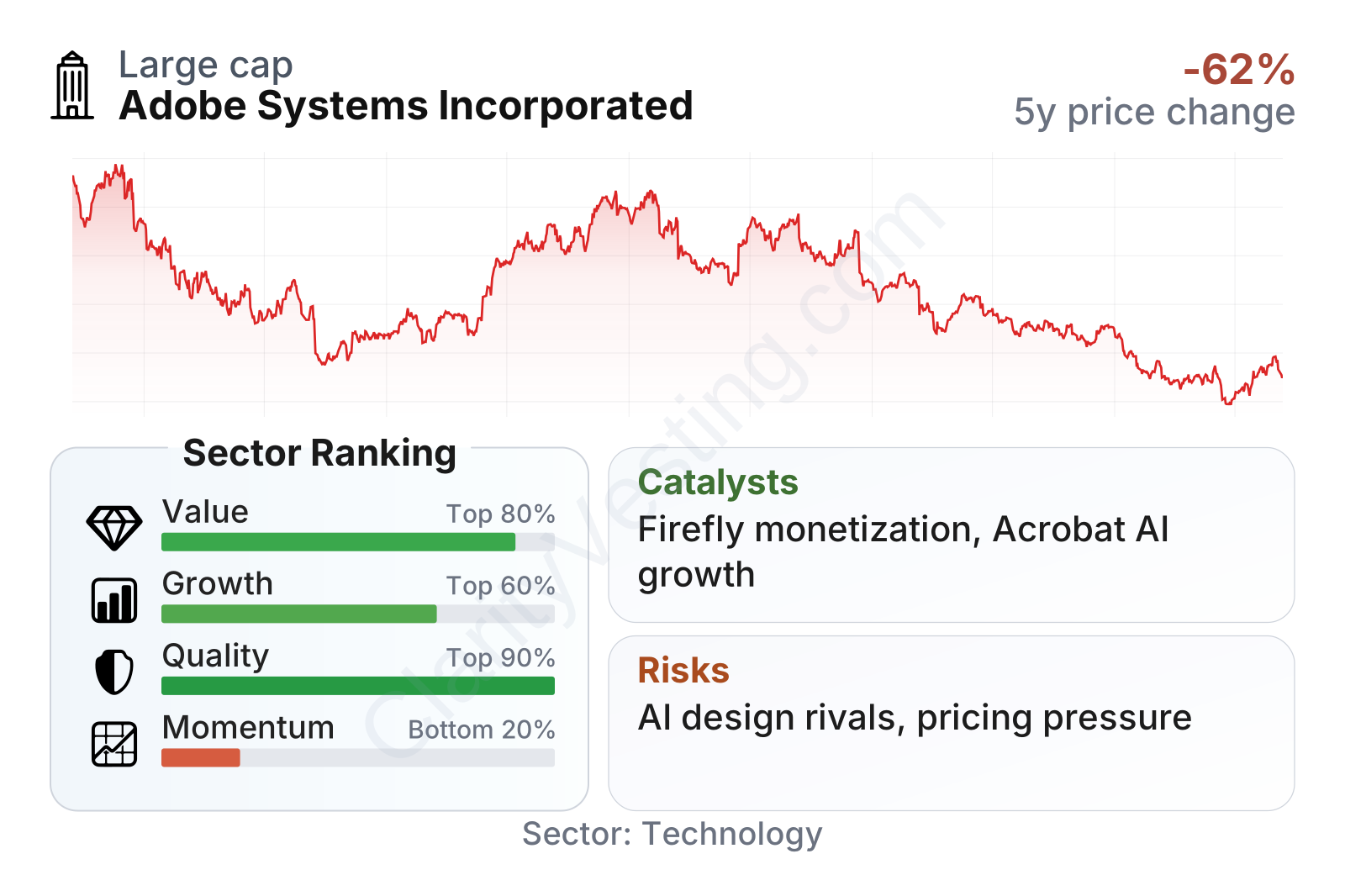
Adobe remains a very large software company, but the market’s view has clearly cooled over the last few years, with the share price far below its 2021 peak. The table points to a business with unusually strong quality metrics for its sector: returns on invested capital are high, operating margins are far above the industry median, and free cash generation is substantial. Growth is still positive rather than explosive, while recent market momentum has been weak. Valuation metrics now look much lower than what the stock traded at historically and below typical sector levels, which changes the discussion from “premium franchise” to “premium franchise at a far less demanding multiple.”
Growth
Adobe operates in several areas that still have long-term expansion potential: digital content creation, digital documents, e-signatures, marketing automation, and generative AI tools for image, video, design, and business workflows. These are not niche markets. Content creation keeps spreading beyond professional designers toward small businesses, social media creators, educators, and corporate teams. At the same time, document digitization remains a broad structural trend as companies continue moving approvals, forms, contracts, and collaboration into software.
Its strategy is coherent for this environment. Adobe already owns strong brands in creative software and PDF workflows, and it is trying to protect that position by embedding AI directly into products users already know. Firefly, the company’s generative AI family, has been integrated across Creative Cloud and enterprise workflows. That matters because Adobe is not starting from zero: it already has distribution, paid subscribers, and daily usage across professional creative work. If AI features increase productivity, Adobe can defend pricing, improve retention, and create new upsell opportunities rather than depending only on adding brand-new customers.
Revenue growth has not returned to the very high rates seen in some earlier software cycles, but it has remained consistently positive and recently improved into the low-teens range. That is important because it suggests Adobe is still expanding at scale despite its already large size. Over a five-year period, revenue per share growth has also been stronger than the sector median, which indicates the company has converted its market position into durable business expansion.
Cash generation reinforces the growth case. Free cash flow has risen meaningfully over time and now sits above $10 billion on a trailing basis. That gives Adobe room to invest in AI, product development, infrastructure, and acquisitions while still preserving financial flexibility. For a long-term business analysis, this matters because many software companies can show revenue growth, but fewer combine it with this level of cash production.
A major catalyst in recent years has been Adobe’s push to commercialize generative AI in a way that fits professional workflows and enterprise requirements. The company has emphasized commercially safer content generation, integration with existing applications, and tools that support creators rather than replace them. New AI assistants in Acrobat and broader document intelligence features also create an opportunity beyond the traditional design market. If these additions deepen usage across both Creative Cloud and Document Cloud, Adobe could capture more value per customer over time.
Risks
This article is for informational purposes only and does not constitute financial advice. Some content is AI-generated. See Disclaimer