Stock Analysis · ACS Actividades de Construcción y Servicios S.A (ACSAF)
Overview
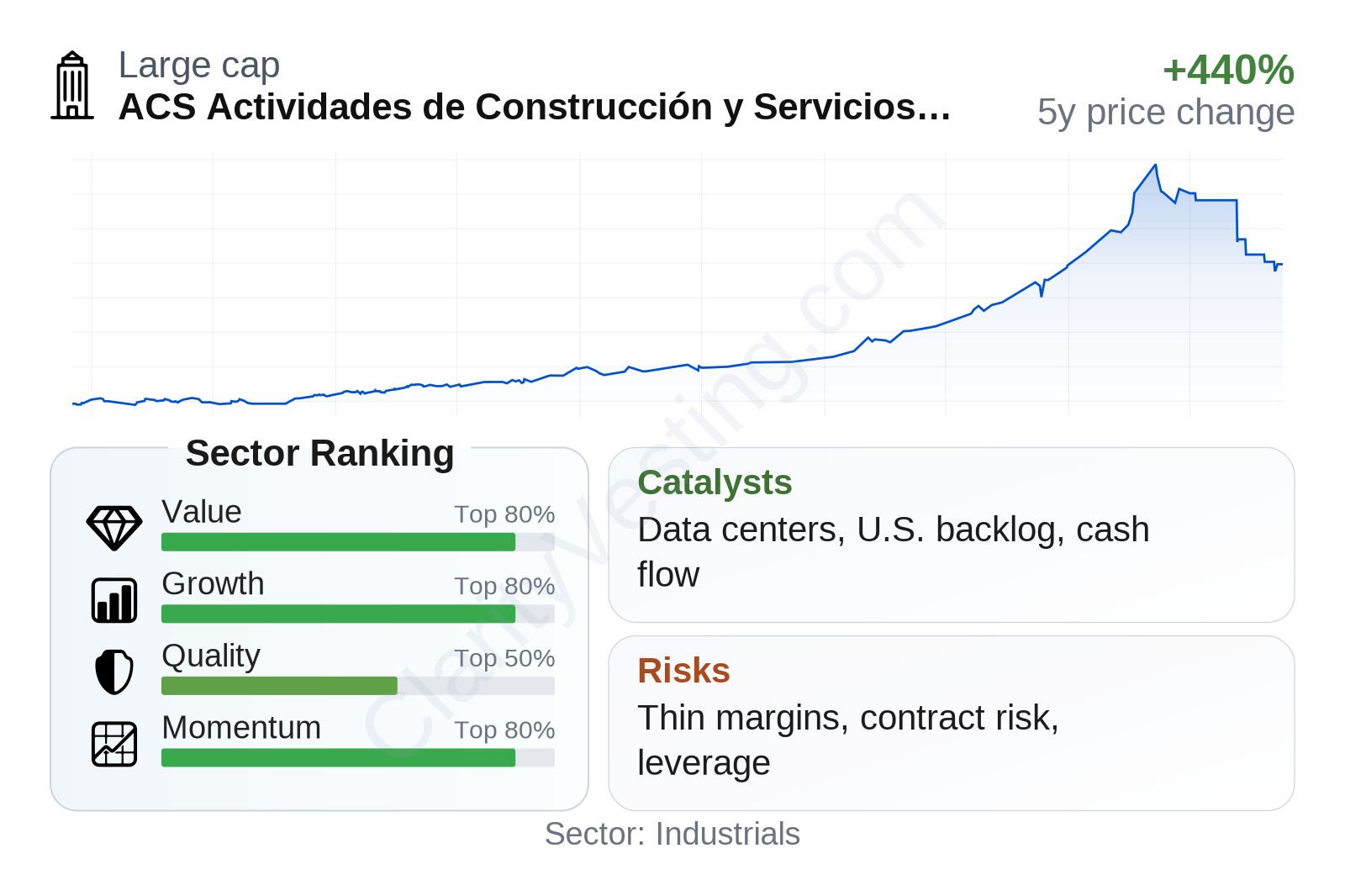
ACS Actividades de Construcción y Servicios S.A. is a large Spanish infrastructure and engineering group. Its business is centered on designing, building, financing, operating, and maintaining complex projects such as transportation infrastructure, data centers, power and industrial facilities, mining-related works, water systems, and selected telecommunications assets. For long-term analysis, the most important point is that ACS is no longer just a traditional construction company: it is increasingly tied to large-scale infrastructure demand, especially through its majority stake in Hochtief and Hochtief’s controlling interest in Turner in the United States.
Based on recent annual reporting, ACS generates most of its revenue from construction and engineering activities, with a smaller but still meaningful contribution from infrastructure concessions and services. The revenue mix can vary year to year because the group consolidates several listed and operating subsidiaries, but the broad picture is clear:
- Construction and engineering: about 90% to 95%. This includes civil engineering, buildings, industrial projects, mining services, and increasingly digital and energy-related infrastructure. Hochtief, Turner, CIMIC, and Dragados are the main operating names behind this segment.
- Infrastructure concessions and related assets: about 5% to 10%. This area includes participation in toll roads and other long-duration infrastructure assets, where value often comes from dividends, asset rotations, and capital gains rather than only reported revenue.
- Other activities: limited contribution. Smaller items can include development, maintenance, or corporate-level adjustments depending on the reporting period.
Geographically, ACS is highly international. North America has become the largest earnings engine, supported by Turner’s U.S. building activity and demand for advanced facilities such as data centers, manufacturing plants, and institutional projects. Australia and Asia-Pacific also matter through CIMIC, while Europe remains important through Dragados and Hochtief operations.
The business profile is attractive in one specific way: ACS is positioned where governments and private companies are spending heavily on physical assets that are difficult to postpone for long, including transportation, energy transition infrastructure, and digital capacity.
The long-term operating picture shows a clear rise in revenue and gross profit over the last several years. At the same time, final profit has been much thinner than gross profit, which is typical in contracting businesses where labor, subcontracting, financing costs, and one-off items can absorb a large part of the value created at the project level.
Key Figures
| Metric | Value | Sector ⓘ |
|---|---|---|
| Date | Nov 21, 2026 | |
| Context | ||
| Sector | Industrials | |
| Industry | Engineering & Construction | |
| Market Cap ⓘ | $25.85B | |
| Beta ⓘ | 0.63 | |
Value (Cheapness) | ||
| P/E Ratio ⓘ | 17.59 | 20.77 |
| P/B Ratio ⓘ | N/A | 3.20 |
| FCF Yield ⓘ | 10.51% | 4.98% |
| Dividend Yield ⓘ | 1.88% | 1.88% |
| EBIT / EV ⓘ | N/A | 6.24% |
| PEG ⓘ | N/A | |
Growth (Business expansion) | ||
| Revenue Growth ⓘ | 19.40% | 9.60% |
| RPS Growth (5Y CAGR) ⓘ | 15.13% | 7.69% |
| EPS Growth (5Y CAGR) ⓘ | -3.85% | -5.74% |
| BVPS Growth (5Y CAGR) ⓘ | -8.86% | 6.13% |
| Margin Growth (5Y Trend) ⓘ | 3.94% | 0.72% |
| FCF Growth (5Y CAGR) ⓘ | N/A | 11.01% |
| DPS Growth (5Y CAGR) ⓘ | 1.03% | 9.09% |
Quality (Business durability) | ||
| ROIC (Latest) ⓘ | N/A | 10.48% |
| ROA (Latest) ⓘ | 3.34% | 5.38% |
| ROIC (5Y Median) ⓘ | 9.00% | 9.45% |
| ROA (5Y Median) ⓘ | 2.11% | 4.91% |
| Net Debt / EBIT (Latest) ⓘ | N/A | 2.12 |
| Net Debt / EBIT (5Y Median) ⓘ | 1.09 | 2.28 |
| Net Debt / EBITDA (Latest) ⓘ | 0.63 | 1.42 |
| Net Debt / Assets ⓘ | 7.84% | 19.19% |
| EBITDA / Interest ⓘ | N/A | 10.09 |
| Operating Margin (Latest) ⓘ | N/A | 10.44% |
| Operating Margin (5Y Median) ⓘ | 4.41% | 10.29% |
| Debt to Equity (Latest) ⓘ | 255.14% | 66.48% |
| Profit Margin (Latest) ⓘ | 2.00% | 6.98% |
| Free Cash Flow (Latest) ⓘ | $2.72B | |
Momentum (Price trend) | ||
| 3Y Return ⓘ | +184.79% | +48.25% |
| 12M Return (excl. last month) ⓘ | +35.96% | +10.31% |
| 6M Return ⓘ | -34.21% | +0.15% |
| Price vs. 200-Day MA ⓘ | +15.38% | 0.00% |
ACS stands out as a large industrial company with relatively low share-price volatility, strong cash generation, and above-sector growth metrics. Valuation multiples look moderate rather than stretched, with earnings valuation below the sector median and free cash flow yield clearly stronger than the industry norm. The weaker side is profitability quality: returns on assets and profit margins remain below many peers, which reflects the low-margin nature of contracting and the complexity of large projects.
Growth
ACS operates in sectors that still have structural tailwinds. Infrastructure renewal, grid expansion, energy transition spending, semiconductor and advanced manufacturing construction, and data center development all support demand for large contractors with proven execution capacity. This matters because ACS is exposed to several of these themes at once, especially in the United States and other developed markets where project sizes are large and funding visibility is often better.
The company’s strategy also makes industrial sense. Instead of depending only on one local construction market, ACS uses a diversified platform: Turner is strong in U.S. non-residential building, Hochtief provides global engineering reach, Dragados adds civil infrastructure capability, and CIMIC broadens exposure to mining, services, and Asia-Pacific projects. That combination gives ACS access to public infrastructure budgets as well as private capital spending.
Revenue growth has been strong compared with the sector median, and the longer-term trend in revenue per share is also ahead of many peers. That suggests ACS has not only benefited from inflation or one-off contract timing, but has also expanded its activity base over multiple years.
Cash generation is an important supporting factor. Free cash flow is solid on a trailing basis and the free cash flow yield is notably stronger than the sector median. For a project-based company, this is significant because accounting profit alone can be misleading; cash conversion gives a better signal about contract discipline, working-capital management, and the company’s ability to fund dividends, investments, and balance-sheet needs.
Recent company communications have continued to emphasize a strong order backlog and demand linked to data centers, energy infrastructure, transportation, and industrial projects. That backdrop creates a visible pipeline for future activity. One of the most meaningful catalysts is the wave of advanced facility construction in North America, where specialized contractors with scale, safety records, and execution credibility can secure very large projects.
Risks
This article is for informational purposes only and does not constitute financial advice. Some content is AI-generated. See Disclaimer