Stock Analysis · Accenture plc (ACN)
Overview
Accenture plc is a global professional services company focused on helping large organizations improve how they operate and use technology. In simple terms, it advises businesses and governments on strategy, builds and manages digital systems, helps move operations to the cloud, supports cybersecurity, and increasingly works on artificial intelligence projects. Its client base is broad, spanning financial services, healthcare, communications, public sector, industrial companies, and consumer businesses.
The company makes money mainly by selling expertise and long-term services rather than physical products. Its revenue mix is usually presented by service lines and by markets. Based on recent company reporting, the largest sources are roughly as follows:
- Consulting: about half of revenue, including strategy, business transformation, technology consulting, data, AI, and industry-specific advisory work.
- Managed Services: about half of revenue, including operating clients’ technology systems, business processes, cloud environments, security operations, and application support.
- By capability area: revenue is heavily tied to Technology, Operations, Strategy & Consulting, Song (marketing, commerce, and customer experience), and Industry X (engineering and industrial digital services), with technology-related work representing the biggest share.
- By geography: North America is the largest region, followed by Europe, then growth markets.
What stands out is the balance of the model. Accenture is not dependent on one product cycle. Instead, it earns recurring revenue from a large installed base of enterprise clients while also capturing new projects in areas such as cloud modernization, data platforms, and generative AI.
Revenue and profit have expanded meaningfully over the last several years, and operating income has generally risen with sales. The cost structure remains labor-heavy, which is normal for a services firm, but the business still converts a solid share of revenue into profit and cash.
The long-term pattern shows a company that has grown steadily from the low-$50 billion range in annual revenue to nearly $70 billion, while keeping profitability relatively stable. That combination matters because it suggests scale has not come at the expense of discipline.
Key Figures
| Metric | Value | Sector ⓘ |
|---|---|---|
| Date | Sep 12, 2026 | |
| Context | ||
| Sector | Technology | |
| Industry | Information Technology Services | |
| Market Cap ⓘ | $112.54B | |
| Beta ⓘ | 1.09 | |
Value (Cheapness) | ||
| P/E Ratio ⓘ | 14.69 | 29.51 |
| FCF Yield ⓘ | 11.18% | 4.25% |
| EBIT / EV ⓘ | 10.19% | 2.85% |
| PEG ⓘ | 1.29 | |
Growth (Business expansion) | ||
| Revenue Growth ⓘ | 5.60% | 15.40% |
| RPS Growth (5Y CAGR) ⓘ | 8.93% | 8.56% |
| EPS Growth (5Y CAGR) ⓘ | -0.35% | -11.88% |
| Margin Growth (5Y Trend) ⓘ | -0.41% | 0.46% |
| FCF Growth (5Y CAGR) ⓘ | 6.68% | 9.80% |
Quality (Business durability) | ||
| ROIC (Latest) ⓘ | 22.33% | 9.44% |
| ROIC (5Y Median) ⓘ | 29.33% | 8.30% |
| Net Debt / EBIT (Latest) ⓘ | -0.16 | 0.54 |
| Net Debt / EBIT (5Y Median) ⓘ | -0.49 | 0.44 |
| Operating Margin (Latest) ⓘ | 14.93% | 9.58% |
| Operating Margin (5Y Median) ⓘ | 15.04% | 8.25% |
| Debt to Equity (Latest) ⓘ | 26.30% | 33.33% |
| Profit Margin (Latest) ⓘ | 10.66% | 7.14% |
| Free Cash Flow (Latest) ⓘ | $12.58B | |
Momentum (Price trend) | ||
| 3Y Return ⓘ | -37.55% | +45.48% |
| 12M Return (excl. last month) ⓘ | -21.75% | +23.48% |
| 6M Return ⓘ | -4.26% | +20.93% |
| Price vs. 200-Day MA ⓘ | -7.36% | +7.43% |
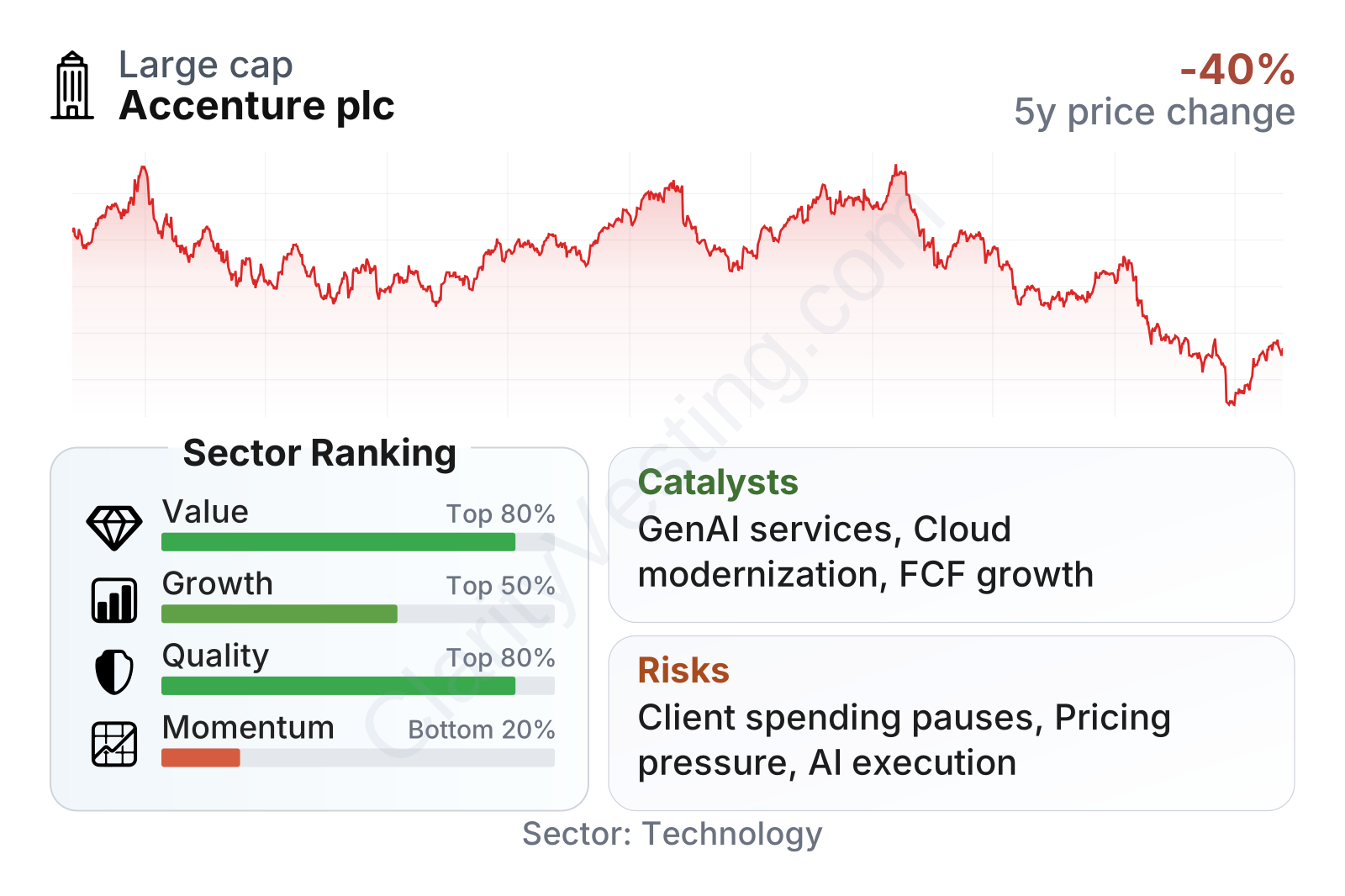
Accenture’s overall profile looks unusual in a good way: quality is very strong, valuation metrics screen attractively compared with much of the technology services sector, but recent stock performance has been weak. Profitability remains above sector norms, leverage is moderate, and free cash flow generation is especially strong. Growth is positive but not fast by sector standards, which helps explain why the market has recently treated the shares more cautiously.
The stock price history shows a business that had strong appreciation through 2021, then moved through a more uneven period and has recently traded well below prior highs. That weak momentum contrasts with the company’s still-solid operating profile and is one reason valuation looks much lower than its own recent history.
Growth
Accenture operates in a sector with durable long-term demand. Large enterprises continue to spend on cloud migration, cybersecurity, software modernization, data infrastructure, automation, and AI adoption. These are not one-off trends. They reflect a broader shift in how companies run their operations and compete. That makes the company’s addressable market structurally attractive even if spending can pause during weaker economic periods.
Its strategy also makes sense for the next phase of enterprise technology spending. Accenture has been investing in industry expertise, acquisitions, partnerships with major cloud and software providers, and AI capabilities that can be inserted into existing client relationships. That is important because many companies want a partner that can advise on AI strategy, build the systems, and then manage them afterward. Accenture’s mix of consulting and managed services fits that full-cycle demand well.
Growth has slowed from the very strong rebound period seen a few years ago, but the more recent pattern still points to expansion rather than contraction. Revenue growth has normalized into the mid-single-digit range after a much hotter post-pandemic phase. That is slower than the broader sector median, yet it is relatively resilient for a company of this size and maturity.
Cash generation has been one of the strongest parts of the story. Free cash flow has trended materially higher over the last several years and now sits well above prior levels. For a services company, that matters because it shows earnings are not just accounting profits; the business is producing real cash that can support acquisitions, dividends, and share repurchases.
A major catalyst is generative AI. Accenture has repeatedly highlighted rising client demand for AI-led transformation and has built dedicated capabilities, training programs, and service offerings around this area. The company has also continued to announce partnerships and tools tied to large enterprise software ecosystems. The opportunity is not only in advising on AI, but also in redesigning workflows, modernizing data architecture, and managing AI-enabled operations over time. That could expand both project volume and the stickiness of customer relationships.
Another favorable point is that many clients are still early in their modernization journeys. Even when discretionary consulting budgets tighten, mission-critical technology upgrades, cyber resilience work, and cost-efficiency programs tend to remain relevant. Accenture is well placed where those priorities overlap.
Risks
This article is for informational purposes only and does not constitute financial advice. Some content is AI-generated. See Disclaimer


