Stock Analysis · Axcelis Technologies Inc (ACLS)
Overview
Axcelis Technologies is a semiconductor equipment company. In simple terms, it builds machines used by chip manufacturers during the production process. Its specialty is ion implantation, a manufacturing step that changes the electrical properties of silicon by inserting ions into the wafer with very high precision. This step is essential in many types of chips, especially power semiconductors and mature-node devices used in electric vehicles, industrial systems, and many consumer and communications products.
The company generates most of its revenue from selling equipment systems, with the rest coming from parts, maintenance, upgrades, and other support services. Based on the company’s recent annual reporting structure, revenue is primarily split into:
- Equipment systems: approximately 75% to 85% of revenue in recent years. This includes the company’s Purion ion implantation platforms sold to chip manufacturers.
- Customer support and services: approximately 15% to 25% of revenue. This includes spare parts, field service, refurbishments, and upgrades for installed machines.
Geographically, Axcelis has meaningful exposure to Asia, where much of global chip manufacturing capacity is located, alongside sales in the United States and Europe. That gives the company access to the biggest production hubs, but it also ties results to semiconductor capital spending cycles and trade policy.
Financially, the company expanded strongly from 2021 through 2023, then moved into a softer phase as customer spending slowed. Revenue climbed from roughly $662 million in 2021 to about $1.13 billion in 2023, before easing to about $1.02 billion in 2024 and about $839 million in 2025. Even with that pullback, the business remained profitable, which matters in a cyclical industry where weaker demand can quickly pressure margins.
At a high level, the business model is attractive when demand is healthy: once a machine is installed, customer support revenue can continue for years, and the installed base can help smooth some of the volatility from new equipment orders. The challenge is that the equipment side is still the main driver, so annual results can move sharply when large chipmakers delay spending.
The long-term pattern shows a business that scaled well during the upcycle, with revenue and operating income rising sharply through 2023. More recently, profitability has narrowed as sales cooled and operating expenses, especially research and development, stayed elevated. That suggests Axcelis is still investing for the next demand phase rather than simply maximizing near-term earnings.
Key Figures
| Metric | Value | Sector ⓘ |
|---|---|---|
| Date | Sep 12, 2026 | |
| Context | ||
| Sector | Technology | |
| Industry | Semiconductor Equipment & Materials | |
| Market Cap ⓘ | $3.50B | |
| Beta ⓘ | 1.86 | |
Value (Cheapness) | ||
| P/E Ratio ⓘ | 38.06 | 29.51 |
| FCF Yield ⓘ | 1.87% | 4.25% |
| EBIT / EV ⓘ | 3.43% | 2.85% |
| PEG ⓘ | 1.45 | |
Growth (Business expansion) | ||
| Revenue Growth ⓘ | 10.60% | 15.40% |
| RPS Growth (5Y CAGR) ⓘ | 8.20% | 8.56% |
| EPS Growth (5Y CAGR) ⓘ | -29.36% | -11.88% |
| Margin Growth (5Y Trend) ⓘ | -1.79% | 0.46% |
| FCF Growth (5Y CAGR) ⓘ | -6.74% | 9.80% |
Quality (Business durability) | ||
| ROIC (Latest) ⓘ | 9.24% | 9.44% |
| ROIC (5Y Median) ⓘ | 21.92% | 8.30% |
| Net Debt / EBIT (Latest) ⓘ | -1.03 | 0.54 |
| Net Debt / EBIT (5Y Median) ⓘ | -0.66 | 0.44 |
| Operating Margin (Latest) ⓘ | 12.70% | 9.58% |
| Operating Margin (5Y Median) ⓘ | 22.88% | 8.25% |
| Debt to Equity (Latest) ⓘ | 3.90% | 33.33% |
| Profit Margin (Latest) ⓘ | 10.71% | 7.14% |
| Free Cash Flow (Latest) ⓘ | $65.55M | |
Momentum (Price trend) | ||
| 3Y Return ⓘ | -36.53% | +45.48% |
| 12M Return (excl. last month) ⓘ | +74.79% | +23.48% |
| 6M Return ⓘ | +33.17% | +20.93% |
| Price vs. 200-Day MA ⓘ | -3.42% | +7.43% |
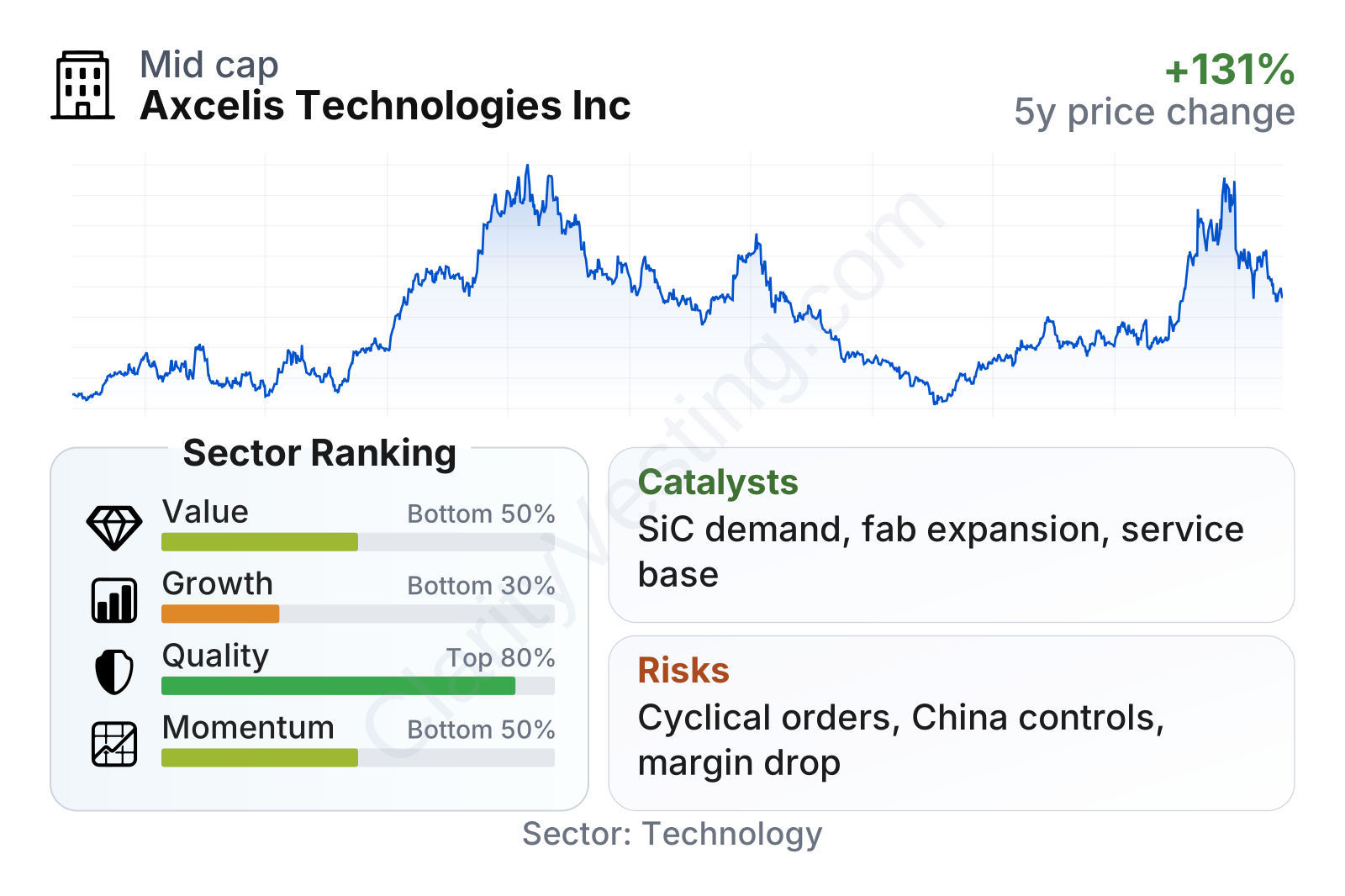
Axcelis is a mid-sized semiconductor equipment company with a stock that has been very volatile over the past few years. The shares surged strongly in recent months after a long decline from prior highs, which fits the cyclical nature of the industry. On fundamentals, the company stands out more for quality than for value or growth right now: profitability and returns on capital remain solid versus the sector, and the balance sheet is unusually clean, but recent growth and cash flow trends have weakened and the valuation has risen above typical sector levels.
Growth
Axcelis operates in a sector with favorable long-term demand drivers. Semiconductor content keeps increasing in electric vehicles, industrial automation, power management, and connected devices. This matters because ion implantation is a core step in chip manufacturing, and Axcelis has built a strong position in power semiconductor applications, especially silicon carbide and other devices tied to high-voltage and energy-efficient systems.
The company’s strategy also makes sense for future expansion. Rather than trying to cover every category of chip equipment, Axcelis focuses on a narrower area where it has technical depth and a recognized product family. That focus can be a strength: in semiconductor tools, being highly competitive in one essential step can be more valuable than being average across many steps.
Recent growth has clearly slowed after the very strong post-pandemic expansion. Year-over-year revenue growth was exceptionally high in 2021 and 2022, stayed positive in 2023, then turned negative through much of 2024 and 2025 before returning to positive territory in 2026. That pattern points to a cyclical downturn rather than a broken business, but it also shows that recovery is still in progress rather than fully established.
Cash generation tells a similar story. Free cash flow remains positive, which is important, but it has trended lower from earlier peaks. In practical terms, Axcelis is still producing cash, yet not at the same level as during its strongest operating years. For a long-term view, the key question is whether new demand from power semiconductors, silicon carbide manufacturing, and future fab investments can lift cash flow back toward prior levels.
A notable catalyst is the continued buildout of power chip capacity used in electric vehicles, charging infrastructure, renewable energy systems, and industrial equipment. These applications often require process steps where Axcelis is especially relevant. Another potential tailwind comes from geographic diversification in chip manufacturing, as governments and manufacturers keep expanding domestic and regional production footprints. New fabs and capacity additions can create demand for specialized tools, even if the timing remains uneven.
Recent company updates have also pointed to customer interest tied to advanced power devices and mature-node production, areas that can be more durable than the most cutting-edge logic segments. That does not remove cyclicality, but it gives Axcelis exposure to parts of the market that are supported by long-lived industrial and automotive trends rather than only consumer electronics demand.
Risks
This article is for informational purposes only and does not constitute financial advice. Some content is AI-generated. See Disclaimer


