Stock Analysis · ACI Worldwide Inc (ACIW)
Overview
ACI Worldwide is a payments software company that helps banks, merchants, and billers move money electronically. Its systems are used for card payments, account-to-account transfers, real-time payments, fraud prevention, and bill payment. In simple terms, ACI provides the software infrastructure that lets financial institutions and businesses accept, route, process, and monitor digital transactions.
The company’s business is tied to long-term shifts in how money moves: more online commerce, more instant payments, more digital bill pay, and greater fraud-control needs. ACI sells both software and services, with a mix of recurring revenue from long-term customer relationships and transaction-driven revenue that grows with payment volumes.
Based on recent company reporting, revenue comes primarily from three operating segments.
- Banks: about 44% of revenue. This includes software and services for banks and financial institutions, such as account-to-account payments, real-time payment connectivity, fraud management, and card-related payment processing.
- Merchants: about 31% of revenue. This segment serves merchants directly and through payment intermediaries, supporting e-commerce payments, in-store transactions, fraud tools, and payment orchestration.
- Billers: about 25% of revenue. This business helps utilities, telecom companies, lenders, healthcare organizations, and other billers accept and manage consumer payments across digital and traditional channels.
That mix matters because it gives ACI exposure to several corners of the payments market rather than relying on one niche. It also means growth can come from both new customer wins and rising transaction volumes from existing clients.
The business flow has improved over the last few years: revenue has expanded, operating income has grown faster than sales, and net income has climbed meaningfully. That suggests scale benefits are starting to show up more clearly in the model.
Key Figures
| Metric | Value | Sector ⓘ |
|---|---|---|
| Date | Sep 12, 2026 | |
| Context | ||
| Sector | Technology | |
| Industry | Software - Infrastructure | |
| Market Cap ⓘ | $5.26B | |
| Beta ⓘ | 0.98 | |
Value (Cheapness) | ||
| P/E Ratio ⓘ | 23.79 | 29.51 |
| FCF Yield ⓘ | 6.74% | 4.25% |
| EBIT / EV ⓘ | 6.06% | 2.85% |
| PEG ⓘ | 1.78 | |
Growth (Business expansion) | ||
| Revenue Growth ⓘ | 7.30% | 15.40% |
| RPS Growth (5Y CAGR) ⓘ | 9.80% | 8.56% |
| EPS Growth (5Y CAGR) ⓘ | -10.53% | -11.88% |
| Margin Growth (5Y Trend) ⓘ | 4.65% | 0.46% |
| FCF Growth (5Y CAGR) ⓘ | 15.34% | 9.80% |
Quality (Business durability) | ||
| ROIC (Latest) ⓘ | 11.39% | 9.44% |
| ROIC (5Y Median) ⓘ | 8.01% | 8.30% |
| Net Debt / EBIT (Latest) ⓘ | 1.90 | 0.54 |
| Net Debt / EBIT (5Y Median) ⓘ | 3.89 | 0.44 |
| Operating Margin (Latest) ⓘ | 19.74% | 9.58% |
| Operating Margin (5Y Median) ⓘ | 18.27% | 8.25% |
| Debt to Equity (Latest) ⓘ | 56.75% | 33.33% |
| Profit Margin (Latest) ⓘ | 12.40% | 7.14% |
| Free Cash Flow (Latest) ⓘ | $354.65M | |
Momentum (Price trend) | ||
| 3Y Return ⓘ | +124.24% | +45.48% |
| 12M Return (excl. last month) ⓘ | +13.83% | +23.48% |
| 6M Return ⓘ | +28.84% | +20.93% |
| Price vs. 200-Day MA ⓘ | +12.31% | +7.43% |
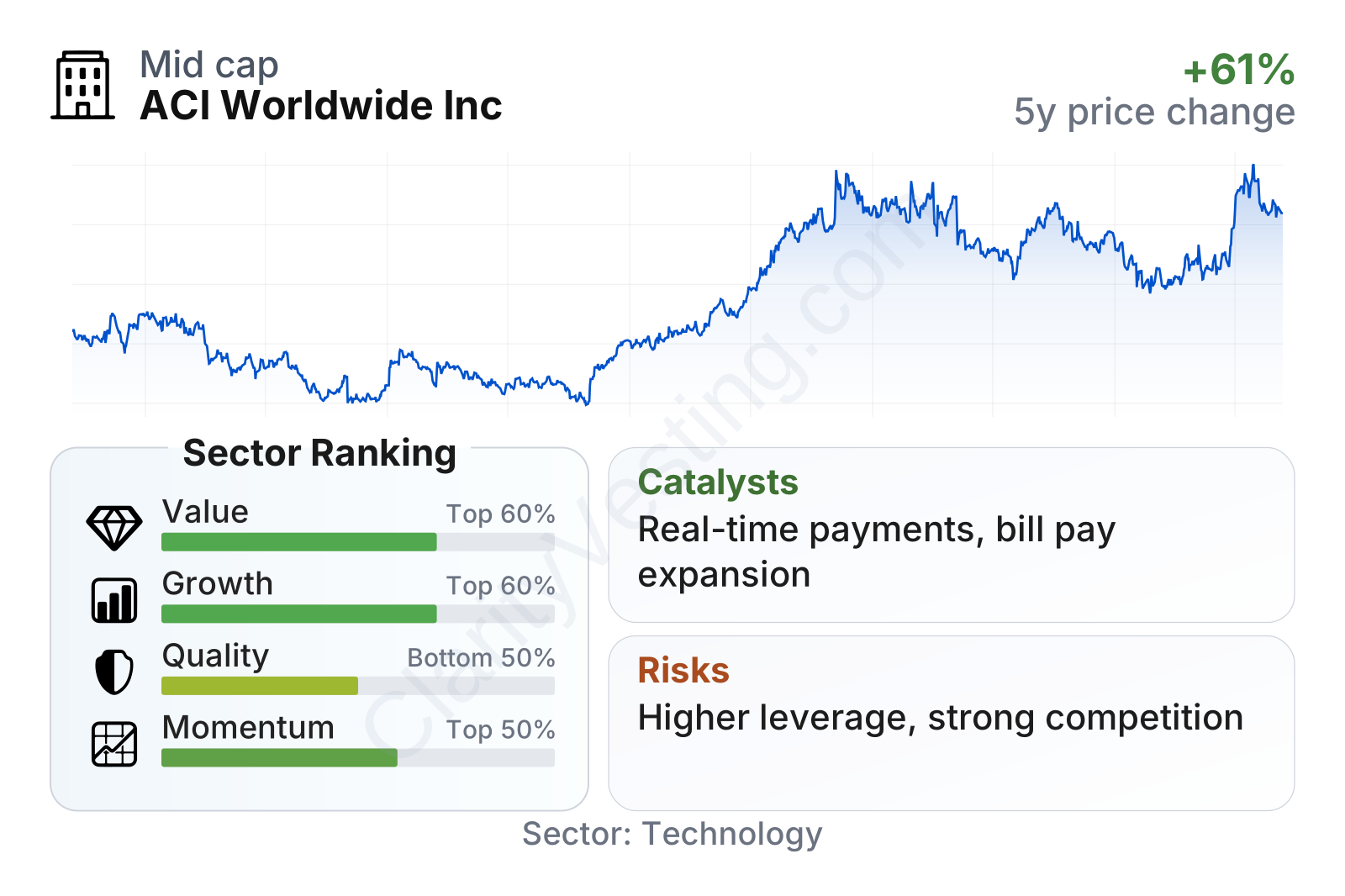
ACI Worldwide is a mid-sized software infrastructure company with a market value in the mid-single-digit billions and a beta close to 1, which suggests the stock has moved broadly in line with the market. The metric profile is mixed but understandable: value, growth, and momentum rank around the better half of the sector, while quality is held back mainly by leverage rather than weak profitability. Profitability itself looks strong, with operating margin around 20% and profit margin around 12%, both ahead of the sector median. Free cash flow generation is also solid, and valuation multiples remain below many technology peers.
Growth
ACI operates in a sector with favorable long-term demand. Payment activity keeps shifting from paper and batch-based systems toward digital, real-time, and data-rich platforms. Banks need modernization, merchants need better online checkout and fraud control, and billers want more automated and digital collection tools. Those are not short-lived trends; they are structural changes in how consumers and businesses move money.
The company’s strategy fits that backdrop reasonably well. ACI has built positions in mission-critical payment software, where switching costs can be meaningful because customers integrate these systems deeply into their operations. Its focus on real-time payments is especially important. Governments and banking systems in many countries are pushing faster-payment rails, and banks need software partners to connect, comply, and operate at scale.
Recent revenue growth has not been as fast as the median for the broader technology sector, but it has been positive and fairly resilient. The pattern has included some uneven quarters, which is common in enterprise software businesses with large contracts and payment-volume sensitivity. Over a longer period, revenue per share growth has held up well, and margin expansion has been stronger than the sector median, showing that growth has not depended only on spending more.
Cash generation is another constructive point. Free cash flow has risen sharply over the last several years, even with some recent fluctuation. That matters because strong cash flow gives the company flexibility to reduce debt, invest in product development, pursue acquisitions selectively, and return capital. In ACI’s case, the improvement in free cash flow supports the view that the business is maturing into a more efficient earnings model.
As for catalysts, one of the clearest is the continued rollout of real-time payments infrastructure in the U.S. and internationally. ACI has highlighted wins and partnerships tied to account-to-account and instant payment capabilities, and these projects can create long-duration customer relationships. Another catalyst is the bill-pay and merchant side of the business, where digital adoption and fraud-management demand remain strong. The broader opportunity is straightforward: if electronic payment volumes keep growing and customers continue consolidating around established platforms, ACI has room to expand revenue without needing explosive market-share gains.
Risks
This article is for informational purposes only and does not constitute financial advice. Some content is AI-generated. See Disclaimer


