Stock Analysis · Accel Entertainment Inc (ACEL)
Overview
Accel Entertainment is a distributed gaming operator. In simple terms, it places and manages gaming terminals such as video gaming machines, amusement-with-prize devices, and related equipment inside local businesses like bars, restaurants, convenience stores, truck stops, and gaming parlors. It also provides the back-end services around those machines, including installation, route operations, compliance support, servicing, and collections. In recent years, the company has also expanded into the ownership and operation of stand-alone gaming locations.
The business is concentrated in regulated local gaming markets rather than destination casinos. That matters because the model is based on many small venues spread across multiple locations, which can create recurring revenue and broad geographic coverage where regulations allow this form of gaming.
Based on recent company filings, Accel’s revenue mix is heavily centered on gaming operations, with a smaller contribution from its amusement segment and other activities. The broad mix can be summarized as follows:
- Gaming terminals and route operations: approximately 90%+ of revenue. This includes revenue generated from video gaming terminals and related distributed gaming operations placed at partner locations.
- Owned and operated gaming locations: a growing but still smaller portion within gaming revenue. This includes stand-alone venues acquired or developed by the company, where Accel participates more directly in the site economics.
- Amusement and other: a small share, likely in the low single-digit percentage range. This includes amusement devices and related non-core activities.
That structure makes Accel less like a traditional casino company and more like a local gaming infrastructure operator. Revenue has expanded meaningfully over the last several years, but the cost base has grown as well, which helps explain why growth in sales has not translated into equally strong growth in earnings.
The long-term pattern shows a business that has increased revenue substantially since 2021, while gross profit has also risen. At the same time, operating expenses and interest costs have climbed, so a larger top line has not consistently produced stronger net income. That tension between scale growth and profitability discipline is central to understanding the company.
Key Figures
Metric Value Sector ⓘ Date Sep 12, 2026 Context Sector Consumer Cyclical Industry Gambling Market Cap ⓘ $1.01B Beta ⓘ 1.02 P/E Ratio ⓘ 18.54 17.10 FCF Yield ⓘ 16.65% 8.53% EBIT / EV ⓘ 9.40% 6.46% PEG ⓘ N/A Revenue Growth ⓘ 9.60% 5.75% RPS Growth (5Y CAGR) ⓘ 18.70% 9.14% EPS Growth (5Y CAGR) ⓘ -29.84% -18.21% Margin Growth (5Y Trend) ⓘ 0.13% -0.23% FCF Growth (5Y CAGR) ⓘ -6.48% 4.91% ROIC (Latest) ⓘ 10.27% 12.61% ROIC (5Y Median) ⓘ 9.00% 10.72% Net Debt / EBIT (Latest) ⓘ 2.58 2.10 Net Debt / EBIT (5Y Median) ⓘ 2.84 2.32 Operating Margin (Latest) ⓘ 8.87% 9.25% Operating Margin (5Y Median) ⓘ 8.19% 9.64% Debt to Equity (Latest) ⓘ 201.97% 75.78% Profit Margin (Latest) ⓘ 4.07% 5.33% Free Cash Flow (Latest) ⓘ $167.86M 3Y Return ⓘ +12.60% +14.53% 12M Return (excl. last month) ⓘ +1.57% +3.08% 6M Return ⓘ +14.89% +0.55% Price vs. 200-Day MA ⓘ +7.69% -0.54%
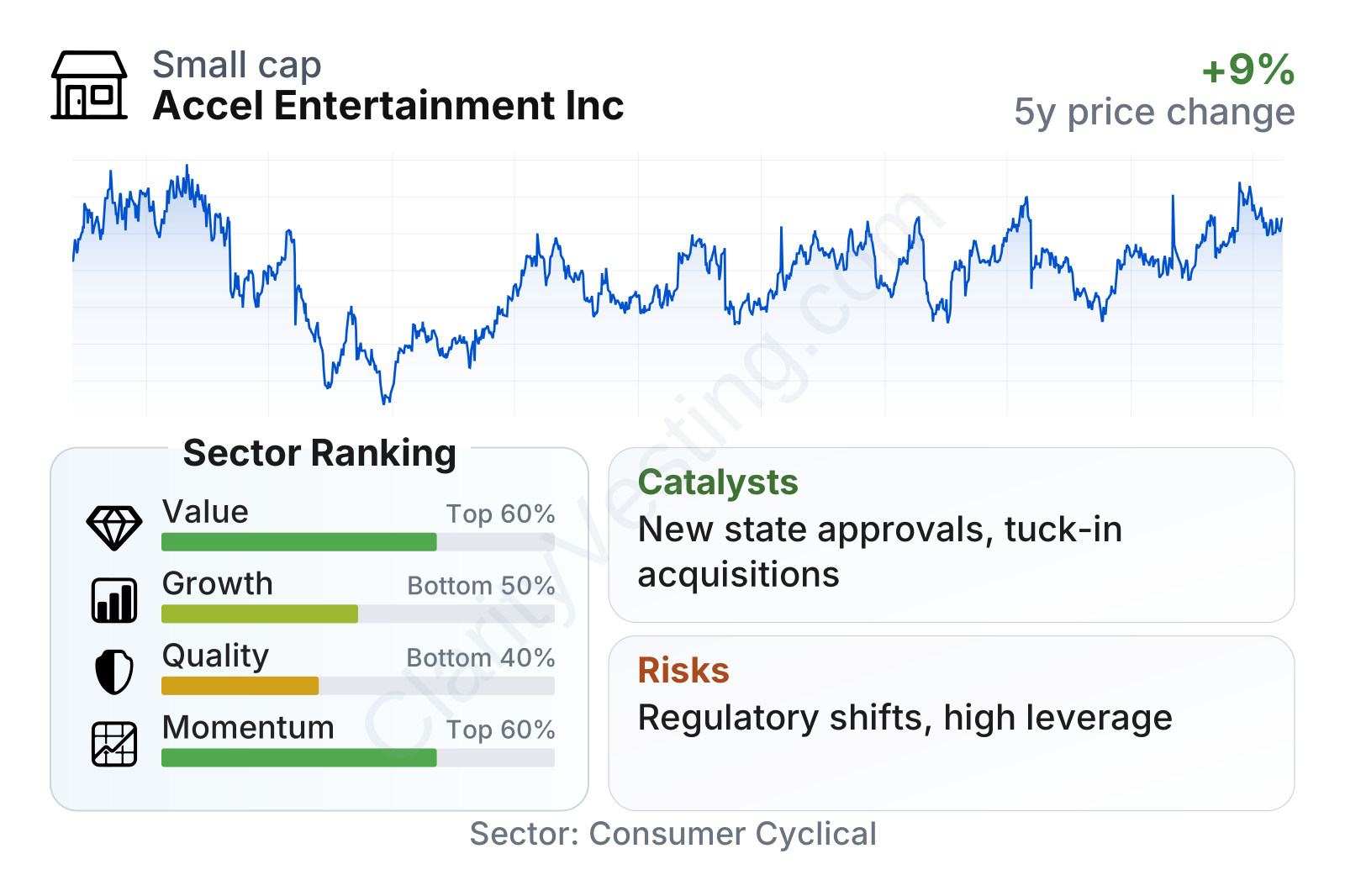
Accel is a small-cap company with market behavior close to the broader market’s volatility. On valuation, it appears roughly in line with its sector on earnings, but it stands out more positively on cash-generation measures, with free cash flow yield and EBIT relative to enterprise value running above sector medians. Growth signals are mixed: recent revenue expansion is solid, and the five-year revenue-per-share trend is strong, but earnings per share and long-term free cash flow growth have been less consistent. Profitability and balance-sheet quality sit below many sector peers, mainly because leverage is elevated and margins are not particularly strong.
Growth
Accel operates in a part of the gambling industry that can still expand as more states or local jurisdictions permit distributed gaming, route operations, or similar machine-based entertainment. This is not a fast-moving digital platform business, but it can grow steadily when regulation opens new markets, when the company wins more locations, and when it deepens its presence in existing territories.
The strategy broadly makes sense for future growth. Accel has built scale in local route gaming, where relationships with venue owners, regulatory know-how, service capabilities, and route density matter. That can create an operational advantage: once a company has a strong local footprint, adding more establishments in the same geography can improve efficiency. The push into owned locations also gives Accel another way to capture more economics per site, although it can require more capital and operational complexity.
Revenue growth has cooled from the very high post-pandemic expansion period, but it remains positive and has recently been running around the high-single-digit to near-10% range. That is a healthier picture than a flat or contracting business, especially for a company in a regulated, location-based category. The five-year revenue-per-share trend is also notably better than the sector median, suggesting growth has not relied only on financial engineering.
One encouraging development is the sharp improvement in trailing free cash flow over the most recent period. Even though the longer five-year trend is uneven, the latest level points to stronger internal cash generation. For a company that relies on equipment deployment, acquisitions, and debt management, this matters more than revenue growth alone. Better cash production can support expansion, repayments, and resilience during slower periods.
A practical catalyst for Accel is continued industry consolidation. Smaller local operators may not have the same purchasing scale, financing access, or compliance infrastructure, which can make them acquisition targets or leave room for market share gains. Another catalyst is new jurisdictional openings or rule changes that allow more machine placements, additional venue types, or expanded route gaming opportunities. Recent company communications have also highlighted ongoing tuck-in acquisitions and portfolio development, which fit the company’s existing operating model rather than changing it completely.
Risks
This article is for informational purposes only and does not constitute financial advice. Some content is AI-generated. See Disclaimer


