Stock Analysis · Ascendas Real Estate Investment Trust (ACDSF)
Overview
Ascendas Real Estate Investment Trust is a Singapore-listed real estate investment trust focused mainly on income-producing business space properties. Its portfolio is centered on industrial real estate, but that label is broader than it sounds: the trust owns logistics facilities, business parks, high-specification industrial buildings, data center-related assets, and light manufacturing properties. Geographically, it has a large base in Singapore and also owns assets in Australia, the United Kingdom, the United States, and Europe.
For a long-term reader, the important point is that this is not a homebuilder or an office landlord in the traditional sense. It collects rent from tenants that use specialized properties tied to supply chains, technology infrastructure, research, manufacturing, and business operations. That gives it exposure to parts of real estate that are often more closely linked to e-commerce, digital infrastructure, and advanced industry than to consumer foot traffic.
Its revenue comes primarily from rental income and related property income generated by its portfolio. Based on the trust’s portfolio mix in recent company materials, the main sources of revenue are approximately aligned with these property segments:
- Business parks and high-specifications industrial properties: roughly 35% to 45%. These assets typically serve technology, biomedical, research, and advanced manufacturing tenants.
- Logistics properties: roughly 25% to 35%. These include warehouses and distribution facilities tied to regional and international supply chains.
- Industrial and light manufacturing properties: roughly 15% to 25%. These are more traditional production and industrial-use buildings.
- Data center and digital-infrastructure-related assets: a smaller but strategically important share, generally under 10% as a standalone category in most portfolio disclosures, though the exact contribution can shift depending on classification.
- Other property-related income: a small residual contribution from parking, service charges, and other ancillary items.
The business model is straightforward: acquire or develop properties, keep occupancy high, raise rents when leases renew, and fund the portfolio with a mix of equity and debt. Over the last several years, total revenue has trended upward overall, while financing costs have become a more important line item as interest rates moved higher. Even so, the trust has continued to produce sizable operating income, which is a central feature for a REIT of this type.
The long-term pattern is encouraging at the operating level: revenue has risen from just under $1.0 billion in 2021 to about $1.2 billion in 2025, while property-level profitability has remained strong. The main pressure point visible in the flow of earnings has been interest expense, which climbed materially during the higher-rate period and helps explain why bottom-line results have been more volatile than rent collections.
Key Figures
| Metric | Value | Sector ⓘ |
|---|---|---|
| Date | Nov 21, 2026 | |
| Context | ||
| Sector | Real Estate | |
| Industry | REIT - Industrial | |
| Market Cap ⓘ | $8.54B | |
| Beta ⓘ | 0.53 | |
Value (Cheapness) | ||
| P/E Ratio ⓘ | 14.25 | 17.59 |
| P/B Ratio ⓘ | N/A | 1.58 |
| FCF Yield ⓘ | N/A | 5.76% |
| Dividend Yield ⓘ | 8.77% | 4.81% |
| EBIT / EV ⓘ | 5.86% | 4.97% |
| PEG ⓘ | 5.71 | |
Growth (Business expansion) | ||
| Revenue Growth ⓘ | 7.80% | 5.70% |
| RPS Growth (5Y CAGR) ⓘ | 3.37% | 5.96% |
| EPS Growth (5Y CAGR) ⓘ | -41.31% | -3.46% |
| BVPS Growth (5Y CAGR) ⓘ | -0.98% | 0.32% |
| Margin Growth (5Y Trend) ⓘ | 4.66% | -0.65% |
| FCF Growth (5Y CAGR) ⓘ | 10.12% | 5.08% |
| DPS Growth (5Y CAGR) ⓘ | 11.97% | 5.00% |
Quality (Business durability) | ||
| ROIC (Latest) ⓘ | N/A | 5.13% |
| ROE (Latest) ⓘ | N/A | 7.64% |
| ROA (Latest) ⓘ | N/A | 3.05% |
| ROIC (5Y Median) ⓘ | 4.72% | 4.20% |
| ROE (5Y Median) ⓘ | 7.37% | 6.03% |
| ROA (5Y Median) ⓘ | 4.18% | 2.41% |
| Net Debt / EBIT (Latest) ⓘ | N/A | 7.59 |
| Net Debt / EBIT (5Y Median) ⓘ | 6.44 | 8.34 |
| Net Debt / EBITDA (Latest) ⓘ | N/A | 5.43 |
| Net Debt / Assets ⓘ | 35.89% | 38.21% |
| EBITDA / Interest ⓘ | N/A | 4.20 |
| Operating Margin (Latest) ⓘ | N/A | 34.59% |
| Operating Margin (5Y Median) ⓘ | 66.61% | 37.64% |
| Debt to Equity (Latest) ⓘ | N/A | 90.32% |
| Profit Margin (Latest) ⓘ | 47.25% | 20.10% |
| Free Cash Flow (Latest) ⓘ | N/A | |
Momentum (Price trend) | ||
| 3Y Return ⓘ | +2.06% | +27.88% |
| 12M Return (excl. last month) ⓘ | -21.71% | +1.16% |
| 6M Return ⓘ | -15.20% | -3.06% |
| Price vs. 200-Day MA ⓘ | -13.60% | -0.73% |
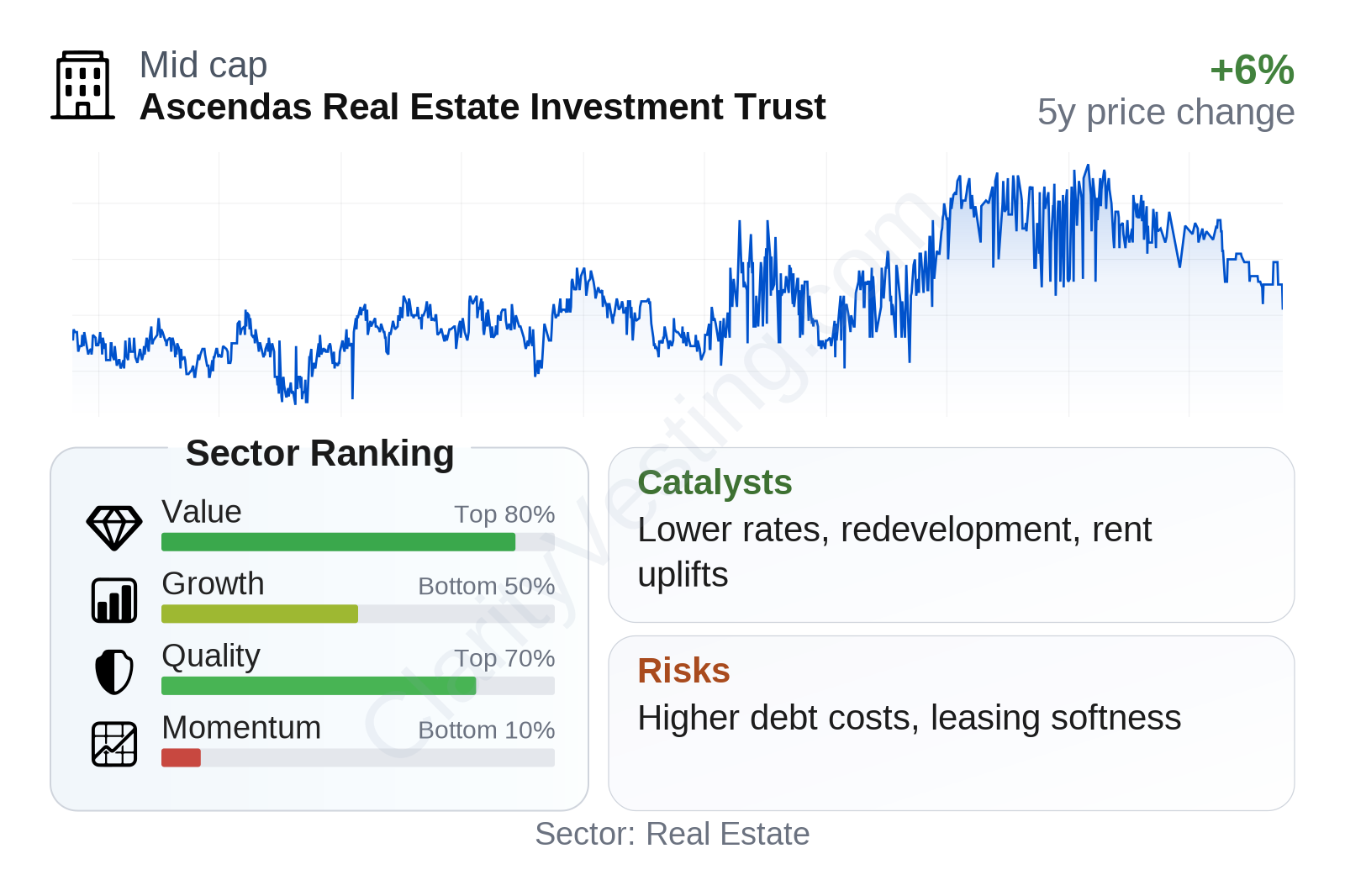
Ascendas REIT stands out as a large real estate vehicle with relatively low share-price volatility, reflected in a beta well below 1. On valuation, its earnings multiple sits below the sector median, while its trailing dividend yield is notably above typical real estate peers. That combination suggests the market is not attaching a premium growth multiple to the trust at the moment.
On operating quality, the picture is stronger than the recent share-price trend implies. Profitability metrics and long-term returns on assets and equity compare favorably with much of the sector, and leverage looks manageable relative to many peers, with net debt to assets around 36%. Growth, however, is mixed: recent revenue growth has been decent, but longer-term per-share growth has been slower, and earnings per share have been distorted by property revaluations, financing costs, and capital structure effects. Price momentum has been weak, with the shares trailing the sector over the last 6 to 12 months and sitting below their longer-term average.
Growth
Ascendas REIT operates in a part of real estate that still benefits from long-duration structural demand. Logistics space is supported by e-commerce and supply-chain redesign. Business parks and high-specification industrial properties can benefit from life sciences, technology, and advanced manufacturing. Data center exposure, even if not dominant in the portfolio, adds relevance to the digital economy. In other words, the trust is positioned in several sub-sectors that are generally more resilient than traditional discretionary retail real estate and often more adaptable than conventional offices.
Its strategy also makes sense from a long-term portfolio-management perspective. The trust is diversified by both geography and asset type, which reduces dependence on a single local market. Management has historically emphasized active asset management, redevelopment, selective acquisitions, and portfolio recycling. That matters because industrial real estate is not only about owning buildings; it is also about keeping those assets aligned with tenant demand so that occupancy, rental reversions, and property values remain competitive.
Revenue per share has moved upward over most of the last five years, although the latest year shows a mild pullback. That pattern suggests the portfolio has expanded and rents have generally improved, but also shows that growth has not been perfectly linear on a per-share basis. For a REIT, this is an important distinction: buying more assets is helpful only if it translates into durable growth for each unit outstanding, not just a larger balance sheet.
The distribution trend remains one of the more attractive features. Dividend per share rose sharply from 2021 and then stabilized at a still-elevated level, with only modest easing more recently. Combined with the high trailing yield, that points to a trust that continues to convert a meaningful share of its cash generation into income distributions, even during a period of higher borrowing costs.
A practical catalyst is the possibility of easing financing pressure if interest rates become more favorable or if debt is refinanced on better terms over time. Because rental income is relatively steady, even incremental relief on interest expense can have an outsized effect on distributable income. Another catalyst is continued rental uplift in logistics and business park assets, especially where supply is constrained or tenant demand remains healthy. Portfolio redevelopment and asset enhancement projects can also lift returns without requiring the same execution risk as large-scale expansion into unfamiliar markets.
Recent company updates have continued to emphasize capital recycling, portfolio optimization, and the resilience of industrial demand across key segments. Those themes matter because they indicate that future growth does not rely on a single major event. Instead, the opportunity set is spread across lease renewals, redevelopments, occupancy management, and selective new investments.
Risks
This article is for informational purposes only and does not constitute financial advice. Some content is AI-generated. See Disclaimer