Stock Analysis · Ameris Bancorp (ABCB)
Overview
Ameris Bancorp is a regional bank holding company built around Ameris Bank. It provides traditional banking services to individuals, businesses, and professionals, with a footprint centered in the Southeast, especially Georgia, Florida, Alabama, and the Carolinas. In simple terms, the company collects deposits, makes loans, earns interest on those loans, and supplements that income with service fees and specialized financial products.
Its revenue mix is still led by lending and deposit spread income, which is typical for a regional bank. Based on recent annual filings, the main sources of revenue can be summarized approximately as follows:
- Net interest income: about 70% to 80% of total revenue. This is the difference between what Ameris earns on loans and securities and what it pays on deposits and other funding.
- Mortgage banking and other loan-related income: about 8% to 12%. This includes mortgage production, sales activity, servicing-related items, and certain lending fees.
- Service charges and deposit-related fees: about 4% to 7%. These come from account services, treasury management, overdraft-related fees, and commercial banking services.
- Wealth, trust, and other non-interest income: about 5% to 10%. This includes asset management, interchange fees, and miscellaneous banking services.
Over the last several years, the business has shown a familiar banking pattern: revenue expanded as interest rates rose, but funding costs also increased sharply, which affected profitability. Even so, total revenue has continued to move higher over the multi-year period, while net income recovered after the 2023 banking stress period. That combination suggests a bank that has remained operationally solid rather than structurally impaired.
The revenue flow highlights two important points. First, total revenue has risen meaningfully since 2021. Second, interest expense became much heavier in 2023 and 2024 as deposit and funding costs reset upward, which explains why earnings did not rise as smoothly as revenue.
Key Figures
| Metric | Value | Sector ⓘ |
|---|---|---|
| Date | Nov 21, 2026 | |
| Context | ||
| Sector | Financial Services | |
| Industry | Banks - Regional | |
| Market Cap ⓘ | $5.47B | |
| Beta ⓘ | 0.98 | |
Value (Cheapness) | ||
| P/E Ratio ⓘ | 14.27 | 12.01 |
| P/B Ratio ⓘ | 1.31 | 1.48 |
| FCF Yield ⓘ | 11.62% | 8.77% |
| Dividend Yield ⓘ | 0.98% | 3.01% |
| EBIT / EV ⓘ | 8.69% | 8.31% |
| PEG ⓘ | 1.10 | |
Growth (Business expansion) | ||
| Revenue Growth ⓘ | 6.10% | 6.70% |
| RPS Growth (5Y CAGR) ⓘ | 12.96% | 12.35% |
| EPS Growth (5Y CAGR) ⓘ | 1.16% | -0.27% |
| BVPS Growth (5Y CAGR) ⓘ | -34.86% | 4.83% |
| Margin Growth (5Y Trend) ⓘ | -15.72% | -4.16% |
| FCF Growth (5Y CAGR) ⓘ | N/A | 4.69% |
| DPS Growth (5Y CAGR) ⓘ | 7.63% | 8.82% |
Quality (Business durability) | ||
| ROIC (Latest) ⓘ | 7.59% | 9.49% |
| ROE (Latest) ⓘ | 9.42% | 14.02% |
| ROA (Latest) ⓘ | 1.38% | 1.53% |
| ROIC (5Y Median) ⓘ | 8.70% | 7.80% |
| ROE (5Y Median) ⓘ | 8.12% | 12.09% |
| ROA (5Y Median) ⓘ | 1.42% | 1.28% |
| Net Debt / EBIT (Latest) ⓘ | 2.37 | 0.88 |
| Net Debt / EBIT (5Y Median) ⓘ | 0.92 | 0.73 |
| Net Debt / EBITDA (Latest) ⓘ | 1.64 | 0.71 |
| Operating Margin (Latest) ⓘ | 28.59% | 23.37% |
| Operating Margin (5Y Median) ⓘ | 32.05% | 24.29% |
| Debt to Equity (Latest) ⓘ | 25.79% | 59.34% |
| Profit Margin (Latest) ⓘ | 32.17% | 26.65% |
| Free Cash Flow (Latest) ⓘ | $635.22M | |
Momentum (Price trend) | ||
| 3Y Return ⓘ | +90.76% | +73.29% |
| 12M Return (excl. last month) ⓘ | +11.15% | +18.35% |
| 6M Return ⓘ | -5.70% | +3.24% |
| Price vs. 200-Day MA ⓘ | -4.74% | +2.17% |
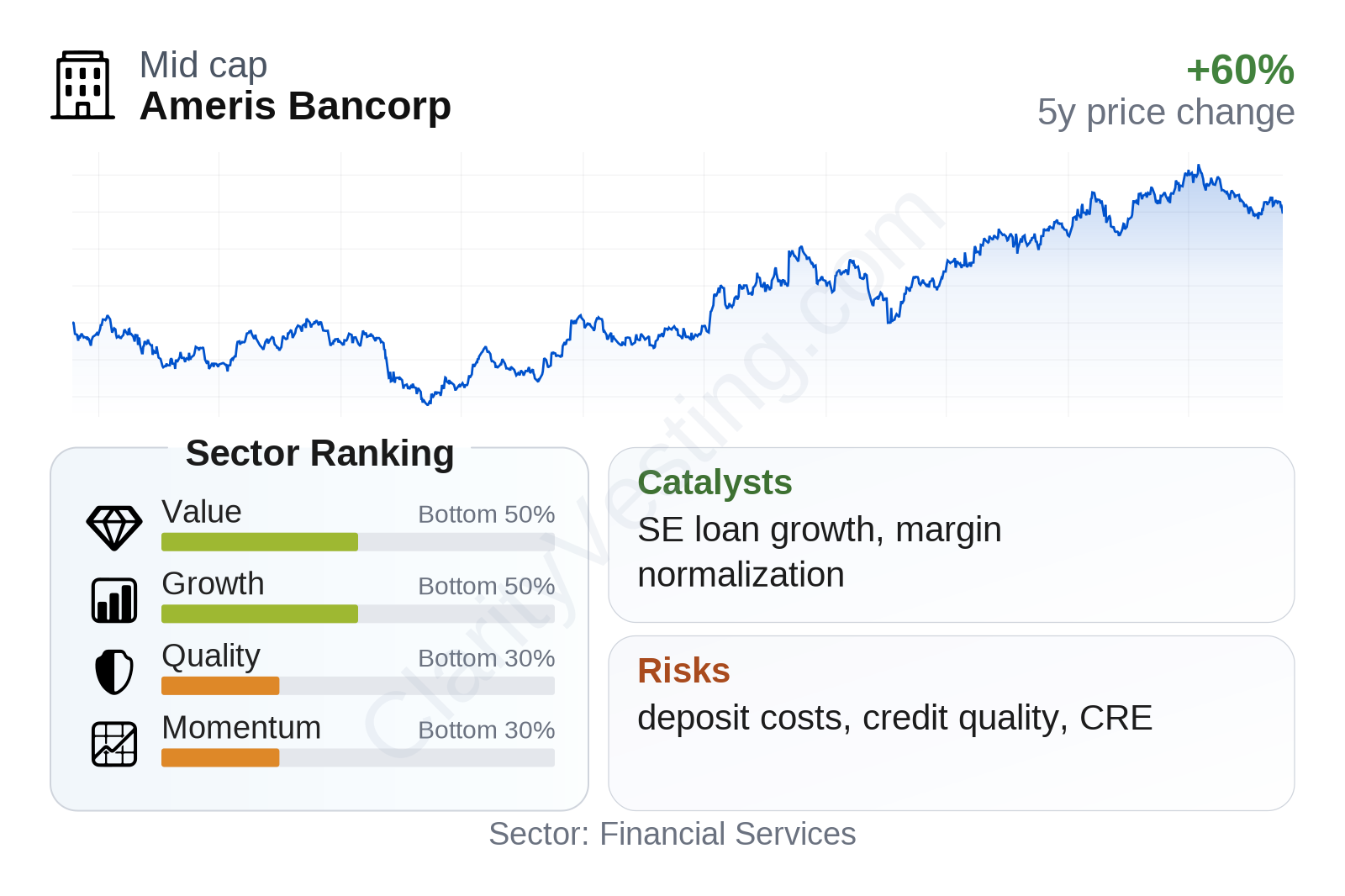
Ameris is a mid-sized regional bank with market value in the multi-billion-dollar range and a share price history that has been volatile but ultimately strong over the last three years. The stock fell hard during the 2023 regional banking scare, then recovered to new highs by 2026. In the latest factor snapshot, growth ranks around the sector’s upper half, while quality, value, and momentum sit below stronger peers. That profile points to a bank with decent expansion and profit generation, but not one that currently screens as especially cheap or especially efficient compared with the broader regional bank group.
Growth
Ameris operates in a sector that should still have room for long-term expansion, even if year-to-year results remain cyclical. Regional banking grows through a mix of population growth, business formation, deposit gathering, commercial lending, mortgage activity, and selective acquisitions. The Southeast remains one of the more attractive U.S. banking markets because of migration, construction activity, and small-to-mid-sized business formation. That backdrop supports demand for loans, treasury services, and local relationship banking.
The company’s strategy is logical for that setting. Ameris focuses on relationship-based banking in faster-growing Southern markets, while also maintaining fee-based businesses that add diversification beyond pure loan spread income. It is not trying to be a national giant; instead, it is building density in attractive local markets where branch presence, business ties, and underwriting discipline still matter. For a regional bank, that is usually a more durable approach than chasing scale everywhere.
Earnings per share show a dip in 2022 and 2023, followed by a rebound in 2024 and 2025. That matters because it suggests the pressure from higher funding costs and industry disruption was significant, but not permanent. The more recent pattern looks more like normalization than a prolonged deterioration. Five-year earnings growth is modest in absolute terms, yet still compares favorably with a sector where many banks saw profits move backward over the same period.
Book value per share has been moving upward in recent years, which is an important signal for a bank. It indicates that capital has been rebuilding and that the franchise has been adding balance-sheet value after the turbulence that hit the industry. The five-year compound figure looks distorted by an older starting point, but the recent yearly trend is clearly positive.
A useful catalyst is the possibility of a friendlier interest-rate environment for regional banks. If deposit pricing pressure eases while loan yields remain healthy, Ameris could benefit from improved net interest margin stability. Another opportunity is continued growth in Southeastern commercial markets, where the company already has an established presence. Recent company updates have also emphasized balance-sheet management, credit discipline, and capital strength, which are the right priorities for turning a cyclical recovery into steadier earnings growth.
Risks
This article is for informational purposes only and does not constitute financial advice. Some content is AI-generated. See Disclaimer