Stock Analysis · ABIVAX Société Anonyme (AAVXF)
Overview
ABIVAX Société Anonyme is a clinical-stage biotechnology company focused on treatments for chronic inflammatory diseases. Its main asset is obefazimod, an oral drug candidate being developed primarily for ulcerative colitis, a long-lasting inflammatory bowel disease. The company is also exploring the same platform in Crohn’s disease and potentially other inflammatory indications. In simple terms, ABIVAX is not yet a mature commercial drug company; it is a research-driven business whose value depends largely on whether its lead medicine can successfully complete late-stage trials and eventually reach the market.
Because ABIVAX is still in development stage, its revenue base is very limited and irregular. Recent annual reports show that income has come mainly from collaboration, licensing, and research-related items rather than recurring product sales.
- Collaboration and licensing revenue: historically the largest source when present, often linked to agreements with partners or accounting recognition tied to prior deals. In some years this represented close to 100% of reported revenue.
- Research-related and miscellaneous operating revenue: a smaller and less predictable source, including items linked to the company’s development activities. This can account for a minor share when collaboration income exists, or effectively all revenue when no major licensing payment is booked.
- Product sales: 0% based on the current business model, since ABIVAX does not yet market an approved therapy.
The broader financial picture is typical for an advanced biotech company: operating expenses are dominated by research and development, and those expenses have risen sharply as late-stage clinical trials expanded. Over the last several years, research spending has clearly represented the largest use of cash, well ahead of administrative costs, while reported revenue remained small relative to total expenses.
The revenue line has stayed modest and inconsistent, while research spending has climbed from tens of millions of euros to well above one hundred million euros annually. That imbalance shows a company investing heavily in one major development program rather than one supported by an established commercial base.
Key Figures
| Metric | Value | Sector ⓘ |
|---|---|---|
| Date | Nov 21, 2026 | |
| Context | ||
| Sector | Healthcare | |
| Industry | Biotechnology | |
| Market Cap ⓘ | $7.42B | |
| Beta ⓘ | -0.33 | |
Value (Cheapness) | ||
| P/E Ratio ⓘ | N/A | 25.50 |
| P/B Ratio ⓘ | N/A | 4.14 |
| FCF Yield ⓘ | -3.63% | 2.68% |
| Dividend Yield ⓘ | N/A | 1.52% |
| EBIT / EV ⓘ | -7.52% | 2.99% |
| PEG ⓘ | N/A | |
Growth (Business expansion) | ||
| Revenue Growth ⓘ | -6.80% | 7.10% |
| RPS Growth (5Y CAGR) ⓘ | N/A | 8.61% |
| EPS Growth (5Y CAGR) ⓘ | N/A | -10.82% |
| BVPS Growth (5Y CAGR) ⓘ | 39.72% | 3.59% |
| Margin Growth (5Y Trend) ⓘ | N/A | -0.63% |
| FCF Growth (5Y CAGR) ⓘ | N/A | 1.59% |
| DPS Growth (5Y CAGR) ⓘ | N/A | 6.65% |
Quality (Business durability) | ||
| ROIC (Latest) ⓘ | -81.94% | 5.62% |
| ROA (Latest) ⓘ | -99.52% | 2.70% |
| ROIC (5Y Median) ⓘ | -66.15% | 4.51% |
| ROA (5Y Median) ⓘ | -73.79% | 1.78% |
| Net Debt / EBIT (Latest) ⓘ | N/A | 1.33 |
| Net Debt / EBIT (5Y Median) ⓘ | N/A | 2.00 |
| Net Debt / EBITDA (Latest) ⓘ | N/A | 0.99 |
| Net Debt / Assets ⓘ | -83.68% | 6.14% |
| EBITDA / Interest ⓘ | N/A | 9.65 |
| Operating Margin (Latest) ⓘ | 23522.96% | 9.28% |
| Operating Margin (5Y Median) ⓘ | -2250.41% | 7.24% |
| Debt to Equity (Latest) ⓘ | 0.33% | 28.47% |
| Profit Margin (Latest) ⓘ | N/A | 3.67% |
| Free Cash Flow (Latest) ⓘ | -$269.18M | |
Momentum (Price trend) | ||
| 3Y Return ⓘ | +586.08% | +38.93% |
| 12M Return (excl. last month) ⓘ | +48.98% | +13.18% |
| 6M Return ⓘ | -26.68% | +10.51% |
| Price vs. 200-Day MA ⓘ | -30.66% | +3.72% |
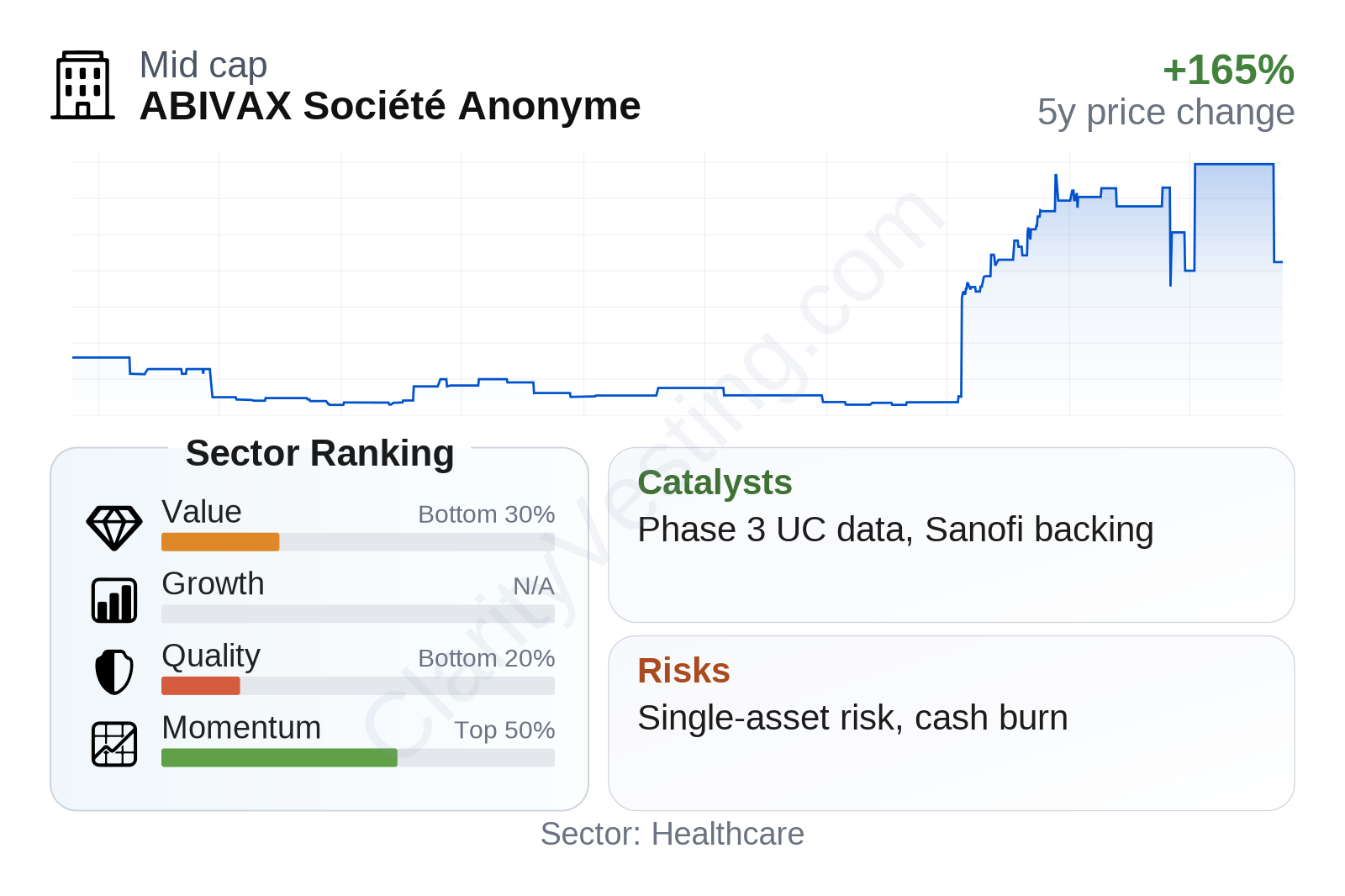
ABIVAX now sits in a large-cap range for a biotech company, which is notable given that it still has no commercial product revenue. The factor profile is unusual but understandable for this stage: valuation and quality rank weakly against the healthcare sector because the business is loss-making and cash-consuming, while momentum remains stronger over multi-year periods thanks to major clinical and financing developments. The growth profile is harder to interpret through standard ratios because reported revenue does not reflect the underlying value driver as clearly as clinical progress does. One useful balance-sheet point is that leverage appears very low compared with the sector, which reduces financial strain even though profitability remains absent.
Growth
ABIVAX operates in an attractive segment of healthcare. Inflammatory bowel disease is a large and growing market, and demand for new treatments remains strong because many patients do not respond well enough to existing options, lose response over time, or face safety and convenience trade-offs. Ulcerative colitis in particular is a commercially important field with room for additional therapies, especially oral drugs that could offer a simpler treatment path than infused biologics.
The company’s strategy is coherent: concentrate resources on obefazimod, push it through Phase 3 in ulcerative colitis, and then potentially expand into adjacent inflammatory diseases if the data remain supportive. That focus matters because ABIVAX is not trying to build a broad early-stage pipeline at the expense of its lead program. It is putting most of its resources behind the asset that currently defines the company.
A major catalyst came from the positive Phase 2 maintenance results in ulcerative colitis, which helped reposition ABIVAX from a small experimental biotech into a more visible late-stage development company. More recently, the company has continued advancing its global Phase 3 program, and that remains the central event to watch because strong late-stage data could significantly improve partnering options, funding flexibility, and eventual commercial potential.
Another point supporting the growth case is strategic backing. In 2025, Sanofi agreed to make a substantial equity investment in ABIVAX, providing external validation from a major pharmaceutical company and strengthening the company’s ability to finance development. For a clinical-stage biotech, this kind of support can matter almost as much as headline revenue because it extends the runway needed to reach key trial readouts.
Cash generation is still deeply negative, which is normal for a company funding global trials without product sales. The recent trend shows continued heavy outflows rather than a move toward self-funded growth. That means ABIVAX’s expansion is currently based on clinical progress and access to capital, not on operating cash flow.
Risks
This article is for informational purposes only and does not constitute financial advice. Some content is AI-generated. See Disclaimer