Stock Analysis · Airtel Africa Plc (AARTY)
Overview
Airtel Africa Plc is a telecommunications and mobile money company serving customers across sub-Saharan Africa. Its business is built around three core services: mobile voice calls, mobile data, and digital financial services through Airtel Money. In practical terms, the company provides phone connectivity, internet access, and mobile wallets that allow users to send money, receive payments, store value, and increasingly access broader financial tools.
The company operates in 14 African countries, with some of its largest markets including Nigeria, East Africa, and francophone Central Africa. This geographic footprint matters because Airtel Africa is exposed to countries where mobile penetration, smartphone usage, and formal banking access are still developing, which creates room for basic telecom and financial services to expand over time.
Its revenue mix is diversified, but telecom services still account for the majority of sales, while mobile money is becoming more important each year. Based on recent annual reporting, the main sources of revenue are approximately:
- Voice services: about 33% to 36% of revenue. This is traditional mobile calling and related usage.
- Data services: about 30% to 33% of revenue. This includes mobile internet usage driven by smartphones, video, messaging, and app consumption.
- Mobile money: about 16% to 18% of revenue. This includes wallet services, transfers, cash-in/cash-out, merchant payments, and other transaction-based financial services.
- Other revenue: about 14% to 18% of revenue. This generally includes messaging, handset-related activity, interconnection, infrastructure-related items, and other telecom services.
What stands out in Airtel Africa’s business model is that data and mobile money usually have stronger long-term growth potential than voice. The company is therefore not only a phone operator; it is also building a digital payments platform in markets where many consumers still have limited access to traditional banking.
The business flow also shows a notable improvement in the latest year: revenue and operating income moved up strongly, while free cash generation expanded faster than reported earnings. That is useful because telecom networks require ongoing investment, and strong cash generation gives the company more flexibility to fund expansion, reduce leverage, or return capital.
Key Figures
| Metric | Value | Sector ⓘ |
|---|---|---|
| Date | Sep 12, 2026 | |
| Context | ||
| Sector | Communication Services | |
| Industry | Telecom Services | |
| Market Cap ⓘ | $17.91B | |
| Beta ⓘ | 0.47 | |
Value (Cheapness) | ||
| P/E Ratio ⓘ | 26.53 | 18.61 |
| FCF Yield ⓘ | 11.25% | 13.68% |
| EBIT / EV ⓘ | 10.59% | 4.54% |
| PEG ⓘ | N/A | |
Growth (Business expansion) | ||
| Revenue Growth ⓘ | 30.50% | 5.40% |
| RPS Growth (5Y CAGR) ⓘ | 8.76% | 4.62% |
| EPS Growth (5Y CAGR) ⓘ | -34.81% | -18.01% |
| Margin Growth (5Y Trend) ⓘ | 1.83% | 1.10% |
| FCF Growth (5Y CAGR) ⓘ | 16.21% | 5.88% |
Quality (Business durability) | ||
| ROIC (Latest) ⓘ | N/A | 8.38% |
| ROIC (5Y Median) ⓘ | 17.48% | 8.32% |
| Net Debt / EBIT (Latest) ⓘ | 1.79 | 1.99 |
| Net Debt / EBIT (5Y Median) ⓘ | 2.61 | 2.94 |
| Operating Margin (Latest) ⓘ | 34.49% | 14.89% |
| Operating Margin (5Y Median) ⓘ | 32.54% | 12.96% |
| Debt to Equity (Latest) ⓘ | 203.38% | 59.59% |
| Profit Margin (Latest) ⓘ | 10.37% | 8.77% |
| Free Cash Flow (Latest) ⓘ | $2.01B | |
Momentum (Price trend) | ||
| 3Y Return ⓘ | +292.34% | +46.64% |
| 12M Return (excl. last month) ⓘ | +130.10% | +2.16% |
| 6M Return ⓘ | +146.96% | +5.05% |
| Price vs. 200-Day MA ⓘ | +38.75% | +2.88% |
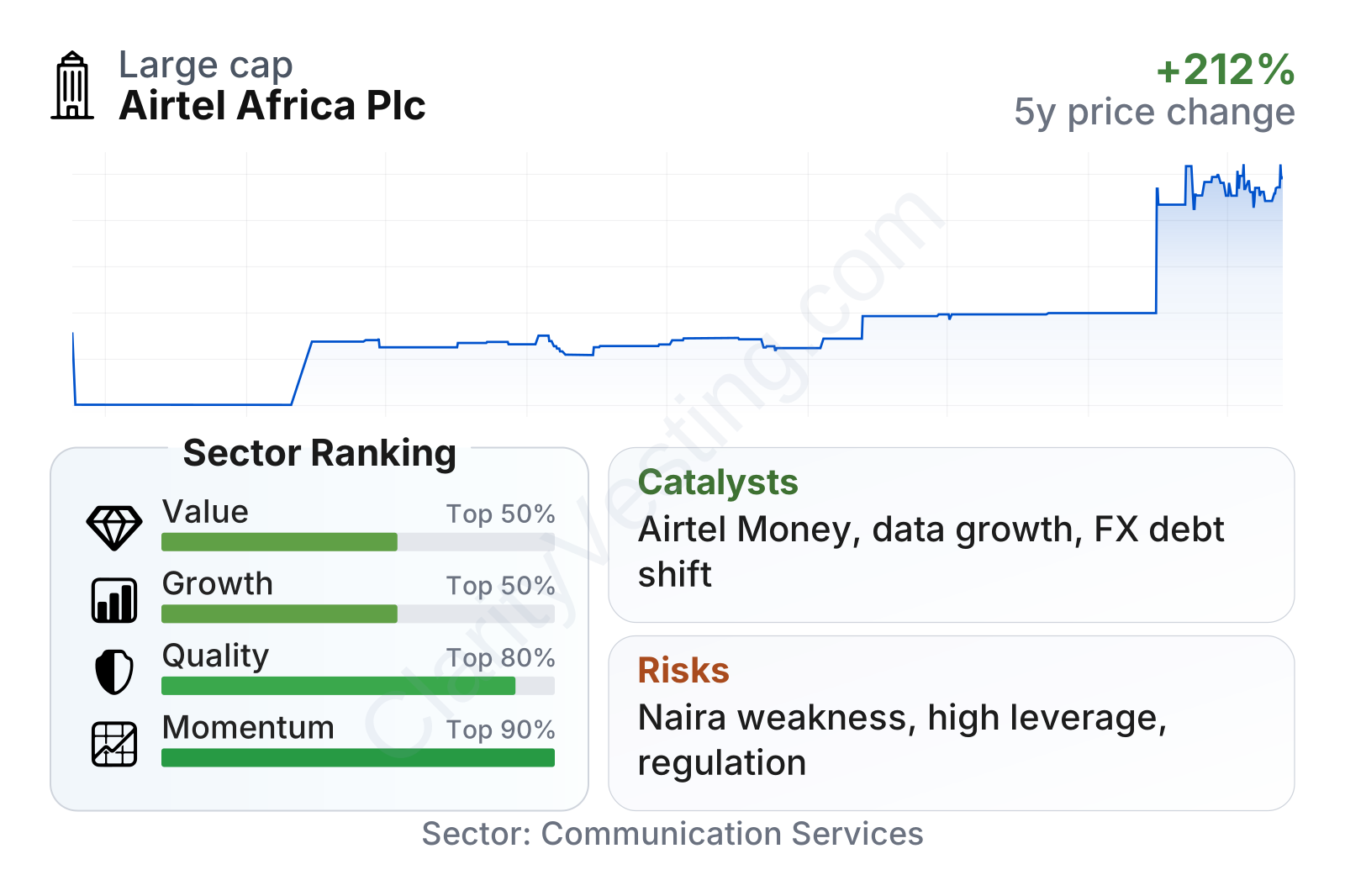
Airtel Africa currently sits in the stronger part of the sector on growth, profitability, and market momentum. Revenue growth has been far above the sector median, operating margins are clearly stronger than many peers, and free cash flow generation is sizable for a company of this scale. The weaker point is leverage: debt remains elevated compared with the broader communication services group, even though earnings power has improved enough to make that debt look more manageable than the balance sheet alone might suggest.
The share price has also moved sharply higher over the last year, which means the market has already recognized much of the recent operational improvement. That does not automatically make the stock overextended, but it does mean expectations are no longer low.
Growth
Airtel Africa operates in parts of the telecom sector that still have structural room to grow. In many of its markets, smartphone adoption, mobile internet use, digital payments, and financial inclusion remain below levels seen in more mature economies. That creates a long runway for more customers to consume data, transact through mobile wallets, and use telecom networks for everyday services beyond basic calls.
The company’s strategy is aligned with that opportunity. Management has been emphasizing four broad drivers: expanding its customer base, increasing smartphone penetration, growing data usage per customer, and scaling Airtel Money. This makes sense because the most attractive economics in African telecom are often tied to data monetization and financial services rather than relying only on voice.
Recent revenue trends show a meaningful rebound. After a weak period that included currency pressure and reported declines, year-over-year growth turned positive and then accelerated into the 20% to 30% range by the latest periods. Part of that improvement reflects pricing, part comes from stronger usage, and part is helped by a more favorable comparison base. Even so, the direction is important: Airtel Africa is no longer simply defending its position, it is producing broad-based top-line expansion again.
Cash generation has been even more impressive. Free cash flow has risen from under $1 billion a few years ago to above $2 billion on a trailing basis. That suggests the business is converting growth into cash rather than just accounting profits. For a network operator, this is especially important because infrastructure spending can easily absorb operating gains if a business lacks discipline. Airtel Africa’s recent profile points to stronger financial capacity than its income statement alone might imply.
One of the clearest catalysts is mobile money. Across African markets, digital wallets can become daily financial infrastructure, especially where bank branch networks are limited and informal cash usage is still common. If Airtel Money continues to grow users, transaction volumes, merchant acceptance, and adjacent services, it can deepen customer relationships while also lifting margins.
Another meaningful catalyst is the company’s ongoing network and distribution investment in large markets such as Nigeria and East Africa. Better 4G coverage, more data capacity, and broader agent networks can support both telecom revenue and financial services adoption. Airtel Africa has also highlighted efforts to improve its capital structure and increase local currency debt, which could gradually reduce vulnerability to exchange-rate shocks.
Recent company communications have also pointed to continued demand for data services and mobile money expansion, alongside progress in reducing foreign-currency exposure in parts of the debt stack. Those developments are not transformational on their own, but together they support the case that the operating model is becoming more resilient and more scalable.
Risks
This article is for informational purposes only and does not constitute financial advice. Some content is AI-generated. See Disclaimer


