Stock Analysis · Advance Auto Parts Inc (AAP)
Overview
Advance Auto Parts is a U.S. automotive aftermarket retailer and distributor focused on replacement parts, maintenance items, accessories, and related services for cars, vans, sport utility vehicles, and light and heavy-duty trucks. In simple terms, it sells the parts needed to keep vehicles running after they leave the dealership. The company serves both do-it-yourself customers and professional repair shops, using a large store network, distribution centers, and delivery capabilities to get parts to customers quickly.
The business is mainly tied to vehicle maintenance and repair rather than new car sales. That matters because an aging vehicle fleet tends to support ongoing demand for brakes, batteries, filters, engine components, and other replacement parts. Advance also operates through well-known banners including Advance Auto Parts, Carquest, and Worldpac, which broadens its reach across retail customers, independent garages, and specialty import-part buyers.
Based on company disclosures, revenue is primarily generated from product sales in North America, with the professional channel representing the larger share and retail the smaller share. A practical breakdown is:
- Professional customers: about 55% to 60% — sales to repair shops, garages, dealerships, and commercial installers that need frequent replenishment and fast delivery.
- Do-it-yourself retail customers: about 40% to 45% — in-store and online sales to individual vehicle owners buying maintenance and repair parts.
- Specialty and other: a small share — includes more specialized categories such as import and original-equipment-quality parts through Worldpac, plus limited ancillary revenue.
One notable trend in recent years is that sales have stayed large in absolute terms, but a much smaller portion of revenue has been turning into operating profit and net income. That points to execution and cost-control issues rather than a collapse in end-market demand.
The financial flow shows a business that still produces billions in gross profit, but selling, administrative, and operating costs have absorbed most of that benefit. The gap between revenue and final earnings narrowed sharply from 2021 through 2025, which helps explain why the turnaround effort is now central to the equity case.
Key Figures
| Metric | Value | Sector ⓘ |
|---|---|---|
| Date | Sep 12, 2026 | |
| Context | ||
| Sector | Consumer Cyclical | |
| Industry | Auto Parts | |
| Market Cap ⓘ | $2.70B | |
| Beta ⓘ | 1.03 | |
Value (Cheapness) | ||
| P/E Ratio ⓘ | 24.15 | 17.10 |
| FCF Yield ⓘ | 0.85% | 8.53% |
| EBIT / EV ⓘ | 4.47% | 6.46% |
| PEG ⓘ | 0.81 | |
Growth (Business expansion) | ||
| Revenue Growth ⓘ | -0.50% | 5.75% |
| RPS Growth (5Y CAGR) ⓘ | -4.48% | 9.14% |
| EPS Growth (5Y CAGR) ⓘ | -43.23% | -18.21% |
| Margin Growth (5Y Trend) ⓘ | -6.90% | -0.23% |
| FCF Growth (5Y CAGR) ⓘ | N/A | 4.91% |
Quality (Business durability) | ||
| ROIC (Latest) ⓘ | 4.46% | 12.61% |
| ROIC (5Y Median) ⓘ | 0.78% | 10.72% |
| Net Debt / EBIT (Latest) ⓘ | 9.01 | 2.10 |
| Net Debt / EBIT (5Y Median) ⓘ | 25.19 | 2.32 |
| Operating Margin (Latest) ⓘ | 2.92% | 9.25% |
| Operating Margin (5Y Median) ⓘ | 0.56% | 9.64% |
| Debt to Equity (Latest) ⓘ | 230.88% | 75.78% |
| Profit Margin (Latest) ⓘ | 0.99% | 5.33% |
| Free Cash Flow (Latest) ⓘ | $23.00M | |
Momentum (Price trend) | ||
| 3Y Return ⓘ | -17.41% | +14.53% |
| 12M Return (excl. last month) ⓘ | -7.64% | +3.08% |
| 6M Return ⓘ | -14.39% | +0.55% |
| Price vs. 200-Day MA ⓘ | -13.84% | -0.54% |
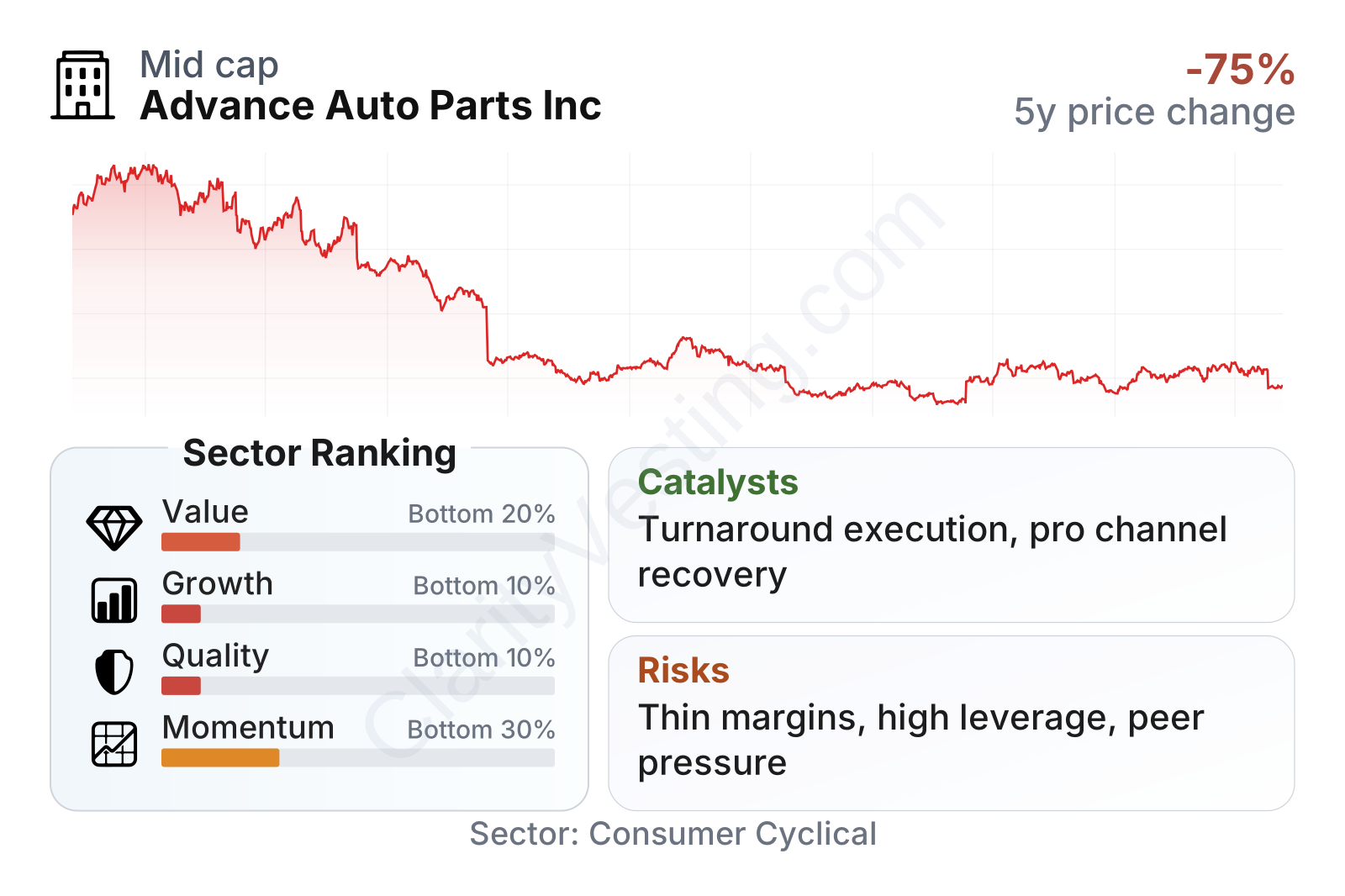
Advance Auto Parts is now a mid-sized public company with share-price performance that has been much weaker than the broader consumer sector over the last several years. The overall profile is currently weak across value, growth, quality, and momentum relative to sector medians. Growth and quality rank near the bottom of the sector, reflecting negative recent sales trends, thin profitability, low returns on invested capital, and a debt load that looks elevated compared with peers. Valuation metrics do not clearly offset those weaknesses, since earnings-based measures remain above sector norms while free-cash-flow yield is low.
Growth
The auto-parts aftermarket is generally a durable sector for long-term analysis. People keep cars longer, and older vehicles usually need more maintenance. Higher prices for new and used cars can also encourage owners to repair existing vehicles instead of replacing them. Those are supportive industry conditions, and they help explain why the sector often holds up better than many other consumer businesses.
That said, a good sector does not automatically create good company growth. Advance Auto Parts has been working through a multi-year operational reset after weak execution, margin compression, and portfolio changes. The company has focused on improving parts availability, simplifying operations, refreshing merchandising, strengthening its professional business, and optimizing the store footprint. It has also been reshaping the business mix, including divestitures and network actions intended to improve focus and cash generation.
Revenue growth has been inconsistent and frequently negative since late 2023. There has been some stabilization more recently, but not a broad return to sustained expansion. This makes the near-term growth case less about opening a large number of new stores and more about recovering lost productivity, improving in-stock levels, and winning back commercial customers.
Cash generation has also been volatile. Free cash flow moved from solidly positive to negative and has not yet shown a stable upward pattern. For long-term analysis, this is important: a turnaround is more credible when profits and cash flow improve together, and that has not fully happened yet.
The most meaningful catalyst is execution improvement rather than a single breakthrough event. If management can lift product availability, sharpen pricing, improve service to repair shops, and reduce unnecessary costs, even modest sales improvement could have an outsized effect on earnings because margins are currently starting from a low base. Another support factor is the underlying demand for maintenance parts in an aging U.S. vehicle fleet, especially in categories where immediate availability matters more than brand preference.
Recent company developments have also pointed toward portfolio simplification and restructuring. These moves can create a clearer operating model and free resources for the core banners, but the benefits need time to show up in comparable sales, margins, and cash flow.
Risks
This article is for informational purposes only and does not constitute financial advice. Some content is AI-generated. See Disclaimer


