Stock Analysis · Applied Opt (AAOI)
Overview
Applied Optoelectronics, usually known as AAOI, designs and makes optical networking products that move large amounts of data through fiber-optic connections. Its components are used inside data centers, cable broadband networks, telecom infrastructure, and other high-bandwidth communication systems. In simple terms, the company helps internet and cloud traffic travel faster between servers, network equipment, and end users.
The business has become increasingly tied to data center demand, especially products used for high-speed optical transceivers. These modules are essential for connecting switches and servers in cloud and artificial intelligence infrastructure. AAOI also sells laser components and broadband access products, but the center of gravity has shifted toward data center optics as hyperscale customers have expanded network spending.
Based on recent company disclosures, revenue is concentrated in a few end markets, with data center products representing the clear majority. The mix can change quarter to quarter, but the broad ranking is as follows:
- Data center optics: approximately 70% to 80% of revenue in the recent period. This includes optical transceivers used in cloud, AI, and high-speed server-to-switch and switch-to-switch links.
- CATV / broadband access: approximately 15% to 25% of revenue. This segment includes products used by cable operators and broadband networks.
- Telecom and other: generally below 10% of revenue. This includes products sold into telecom infrastructure and other communication applications.
Customer concentration is also important. A meaningful share of sales has historically come from a small number of very large customers, particularly major cloud and internet infrastructure companies. That can drive sharp growth when orders ramp, but it also makes revenue less predictable if purchasing patterns change.
The company’s financial profile shows a business that has recently regained strong sales momentum after several difficult years. Revenue rose sharply in 2025, gross profit improved materially, and losses narrowed from the very weak 2024 level. At the same time, the cost structure is still heavy, with large spending on research and development and selling expenses relative to revenue, which helps explain why profitability remains under pressure despite the rebound in sales.
The long-term picture is one of a company that moved from a low-revenue, loss-making period into a much stronger growth phase in 2025. Revenue and gross profit improved significantly, but operating expenses also climbed, showing that AAOI is still investing aggressively to capture demand rather than harvesting mature profits.
Key Figures
| Metric | Value | Sector ⓘ |
|---|---|---|
| Date | Sep 12, 2026 | |
| Context | ||
| Sector | Technology | |
| Industry | Communication Equipment | |
| Market Cap ⓘ | $8.95B | |
| Beta ⓘ | 3.78 | |
Value (Cheapness) | ||
| P/E Ratio ⓘ | N/A | 29.51 |
| FCF Yield ⓘ | -4.62% | 4.25% |
| EBIT / EV ⓘ | -0.68% | 2.85% |
| PEG ⓘ | 0.78 | |
Growth (Business expansion) | ||
| Revenue Growth ⓘ | 86.40% | 15.40% |
| RPS Growth (5Y CAGR) ⓘ | -0.93% | 8.56% |
| EPS Growth (5Y CAGR) ⓘ | -30.91% | -11.88% |
| Margin Growth (5Y Trend) ⓘ | N/A | 0.46% |
| FCF Growth (5Y CAGR) ⓘ | N/A | 9.80% |
Quality (Business durability) | ||
| ROIC (Latest) ⓘ | -4.13% | 9.44% |
| ROIC (5Y Median) ⓘ | -10.96% | 8.30% |
| Net Debt / EBIT (Latest) ⓘ | N/A | 0.54 |
| Net Debt / EBIT (5Y Median) ⓘ | N/A | 0.44 |
| Operating Margin (Latest) ⓘ | -9.43% | 9.58% |
| Operating Margin (5Y Median) ⓘ | -22.94% | 8.25% |
| Debt to Equity (Latest) ⓘ | 15.86% | 33.33% |
| Profit Margin (Latest) ⓘ | -9.57% | 7.14% |
| Free Cash Flow (Latest) ⓘ | -$413.26M | |
Momentum (Price trend) | ||
| 3Y Return ⓘ | +827.46% | +45.48% |
| 12M Return (excl. last month) ⓘ | +505.88% | +23.48% |
| 6M Return ⓘ | -0.78% | +20.93% |
| Price vs. 200-Day MA ⓘ | +2.05% | +7.43% |
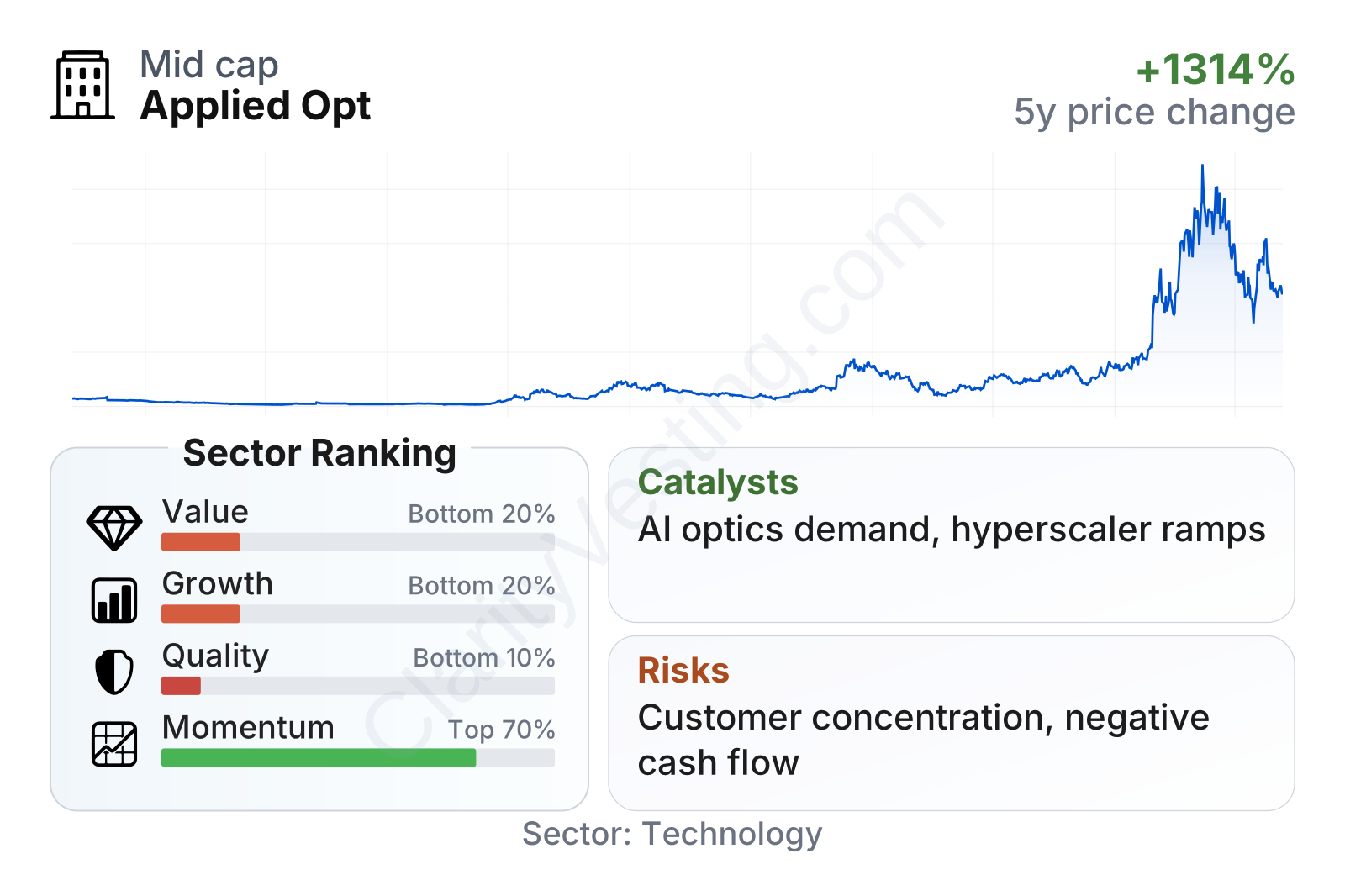
AAOI is now a mid-sized technology company by market value, but its operating profile remains much weaker than most communication equipment peers. Growth and share-price momentum stand out, while value, quality, and profitability rank near the lower end of the sector. The stock has also been extremely volatile, with a beta close to 3.8 and a share-price move from single digits in 2024 to well above $100 in 2026, which shows how strongly the market is reacting to the recovery narrative.
Growth
AAOI operates in a part of the market with real structural growth behind it. Demand for optical connectivity is rising as cloud computing expands, AI workloads require far more bandwidth inside data centers, and network operators continue upgrading speeds. This is not a niche trend: faster optical interconnects are becoming a critical layer of modern computing infrastructure.
The company’s strategy broadly fits that direction. AAOI has focused on higher-speed optical modules, deeper participation in data center applications, and broader engagement with large cloud customers. The logic is straightforward: if data centers need more links, more speed, and more optical content per rack, suppliers that can ship qualified products at scale have a larger revenue opportunity.
The recent revenue trend is powerful. After a long period of uneven performance, year-over-year growth accelerated sharply through 2025 and remained very strong into 2026, with the latest reading around 86%, far above the sector median near 16%. That kind of outperformance suggests AAOI is not simply benefiting from normal market growth; it appears to be gaining from a product-cycle or customer-ramp effect that is much stronger than the industry average.
A major catalyst has been the shift toward AI and high-performance data center networking. Public company communications in 2025 and 2026 have pointed to stronger demand for advanced transceivers and expanding customer programs. Another positive element is that AAOI’s annual revenue in 2025 rose to roughly $456 million from about $249 million in 2024, a very large step-up that indicates the company has moved into a different scale of operations.
The main limitation is that growth has not yet translated into healthy cash generation. Free cash flow remains deeply negative and has worsened over time, which usually means the company is absorbing cash into working capital, capital spending, or both while trying to support the expansion. For long-term analysis, that makes the next stage clear: AAOI still needs to prove that fast sales growth can convert into durable cash returns.
Recent developments appear supportive rather than disruptive. The company has continued to communicate around product ramps and customer demand in optical networking, and the broader industry backdrop remains favorable as cloud and AI infrastructure spending stays elevated. In other words, the opportunity set looks real; the unresolved issue is economic conversion, not market relevance.
Risks
This article is for informational purposes only and does not constitute financial advice. Some content is AI-generated. See Disclaimer


