Stock Analysis · Airtel Africa Plc (AAFRF)
Overview
Airtel Africa Plc is a telecommunications and mobile money company serving millions of customers across sub-Saharan Africa. The group provides traditional mobile services such as voice calls and data access, but an increasingly important part of the business is digital financial services through Airtel Money. In simple terms, Airtel Africa is building two layers of infrastructure at once: communications networks and a payments ecosystem. That combination matters because in many of its markets, mobile connectivity and basic financial access are still expanding from a relatively low base.
The company operates across 14 African countries, with a strong presence in large and fast-growing markets such as Nigeria, East Africa, and Francophone Africa. Its business model benefits from recurring customer spending: people top up airtime, buy data bundles, and use mobile wallets for transfers, payments, and other financial transactions. This creates a broad stream of small, repeat purchases rather than dependence on a handful of large contracts.
Based on recent company reporting, revenue is mainly generated from the following activities:
- Mobile services revenue, around 75% to 80% of total revenue, including:
- Data as the largest component, supported by smartphone adoption and higher internet usage
- Voice, still meaningful but gradually becoming a smaller share over time
- Other mobile services, including messaging and related usage
- Mobile money, around 20% to 25%, generated from wallet transactions, transfers, merchant payments, and related financial services
Geographically, Nigeria is typically the largest single market, with East Africa and Francophone Africa also contributing significant shares. That regional mix gives Airtel Africa scale, but it also means reported results can move sharply when local currencies weaken against the U.S. dollar.
The business flow shows a company that converts a large share of sales into operating profit, although interest and tax expenses still absorb a meaningful portion before earnings reach the bottom line. The latest year also shows a step-up in revenue and operating income after a more uneven period.
Key Figures
| Metric | Value | Sector ⓘ |
|---|---|---|
| Date | Aug 29, 2026 | |
| Context | ||
| Sector | Communication Services | |
| Industry | Telecom Services | |
| Market Cap ⓘ | $16.63B | |
| Beta ⓘ | 0.47 | |
Value (Cheapness) | ||
| P/E Ratio ⓘ | 24.11 | 18.73 |
| FCF Yield ⓘ | 11.07% | 13.16% |
| EBIT / EV ⓘ | 10.64% | 4.55% |
| PEG ⓘ | N/A | |
Growth (Business expansion) | ||
| Revenue Growth ⓘ | 30.50% | 5.50% |
| RPS Growth (5Y CAGR) ⓘ | 8.39% | 4.84% |
| EPS Growth (5Y CAGR) ⓘ | -33.05% | -18.21% |
| Margin Growth (5Y Trend) ⓘ | -0.10% | 0.56% |
| FCF Growth (5Y CAGR) ⓘ | 5.97% | 5.91% |
Quality (Business durability) | ||
| ROIC (Latest) ⓘ | N/A | 8.39% |
| ROIC (5Y Median) ⓘ | 18.57% | 8.11% |
| Net Debt / EBIT (Latest) ⓘ | 1.78 | 1.69 |
| Net Debt / EBIT (5Y Median) ⓘ | 2.02 | 2.94 |
| Operating Margin (Latest) ⓘ | 34.90% | 14.88% |
| Operating Margin (5Y Median) ⓘ | 32.94% | 12.96% |
| Debt to Equity (Latest) ⓘ | 203.38% | 59.59% |
| Profit Margin (Latest) ⓘ | 10.37% | 8.82% |
| Free Cash Flow (Latest) ⓘ | $1.84B | |
Momentum (Price trend) | ||
| 3Y Return ⓘ | +268.88% | +46.35% |
| 12M Return (excl. last month) ⓘ | +72.85% | +3.86% |
| 6M Return ⓘ | -4.74% | +2.46% |
| Price vs. 200-Day MA ⓘ | -0.89% | +3.77% |
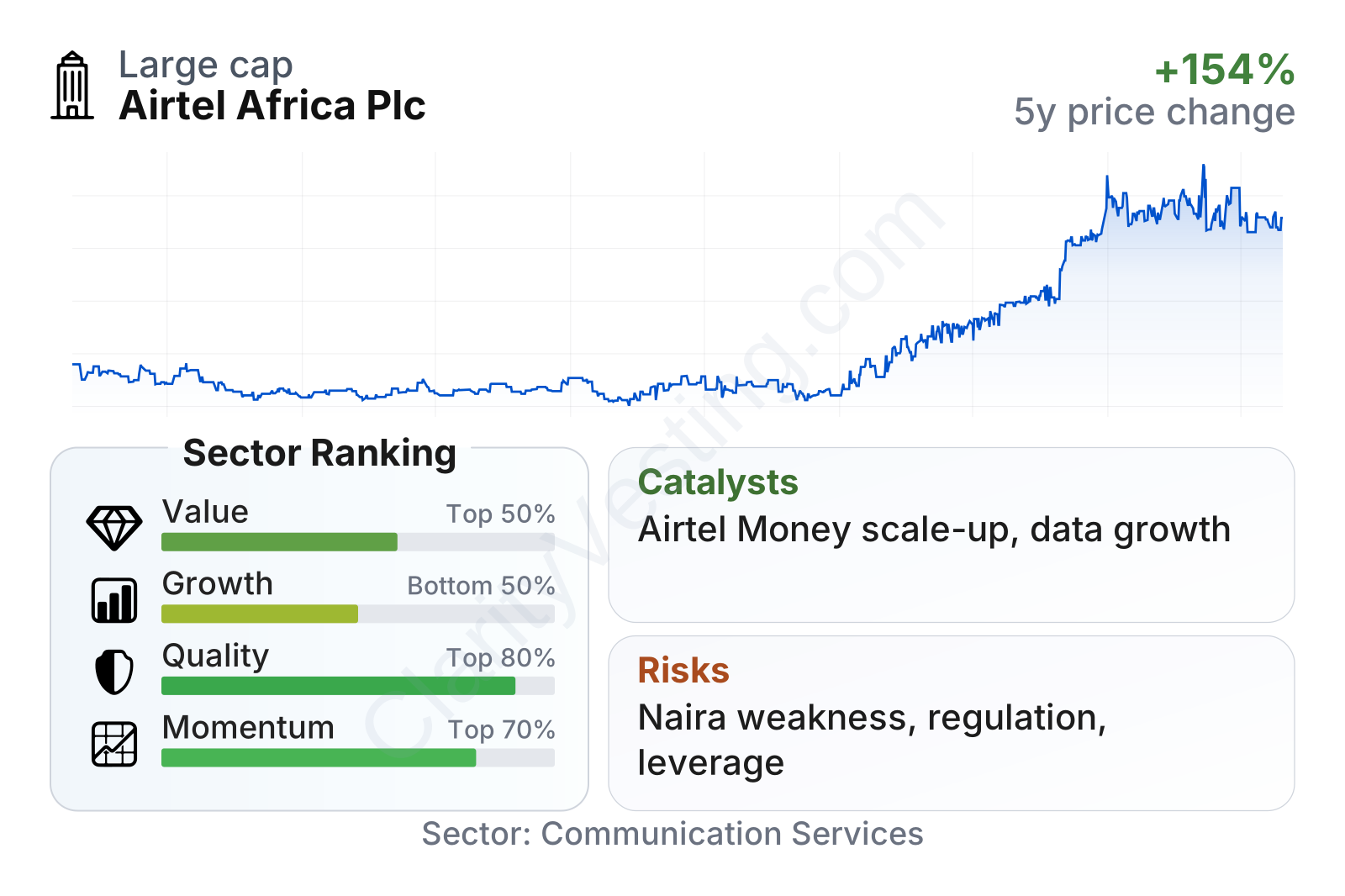
Airtel Africa currently sits in the larger end of the listed telecom universe, with a market value near $19 billion, and its low beta suggests the shares have historically moved less violently than the broader market. The broader scorecard is mixed but generally constructive: growth and profitability stand out, momentum is very strong, while valuation is no longer as undemanding as it once was. Operating margins are well above the sector median, free cash generation has improved materially, and leverage looks manageable on an earnings basis even though balance-sheet debt remains elevated relative to equity.
Growth
Airtel Africa operates in a part of the telecom industry that still has structural room to expand. In many of its markets, mobile internet use, smartphone ownership, digital payments, and formal financial inclusion remain below levels seen in more developed economies. That creates a long runway for higher data consumption and wider use of mobile money services. Unlike mature telecom markets where growth often depends on price increases alone, Airtel Africa can still grow through rising usage, customer additions, and broader service adoption.
The company’s strategy fits that backdrop. Management has emphasized expanding 4G coverage, increasing network capacity, growing smartphone penetration, and deepening Airtel Money adoption. This makes sense because data and mobile money are generally more attractive growth engines than legacy voice services. As more customers move from basic phones to smartphones, they tend to consume more data, and once they enter a mobile wallet ecosystem, transaction activity can become sticky and recurring.
Revenue growth has been volatile in reported currency terms, largely because foreign-exchange swings can distort the underlying picture. Even so, the recent direction is clearly stronger, with year-over-year growth rebounding sharply after the weakness seen in 2023 and 2024. The latest reading is far ahead of the sector median, which suggests the company is not simply drifting with industry conditions but benefiting from specific business momentum.
Cash generation is another encouraging part of the growth profile. Free cash flow has climbed substantially over the last several years and is now above $2 billion on a trailing basis. That matters because telecom operators must continually invest in spectrum, towers, and network equipment. A business that can still expand free cash flow after those investments has greater flexibility to reduce debt, support dividends, fund expansion, or strengthen its balance sheet.
A notable catalyst is the continued scaling of Airtel Money. Mobile money tends to deepen customer relationships beyond connectivity and can raise the overall value of the user base. Another catalyst is tariff and pricing normalization in markets where inflation has been high and telecom pricing has lagged cost pressures. Company updates in 2026 have also pointed to strong customer growth, rising data usage, and continued focus on balancing expansion with deleveraging, which supports the case for durable operating progress if currency conditions remain more stable.
Risks
This article is for informational purposes only and does not constitute financial advice. Some content is AI-generated. See Disclaimer


