Stock Analysis · AAC Technologies Holdings Inc (AACAY)
Overview
AAC Technologies Holdings is a components maker for consumer electronics. In simple terms, it designs and manufactures many of the small but critical parts that make smartphones, tablets, laptops, wearables, and vehicles work better. Its products are used in areas such as camera modules, acoustic parts like speakers and receivers, precision mechanics, metal and glass housings, haptics, sensors, and some optical products. The company is best known for supplying parts that improve sound, imaging, and the overall feel of electronic devices.
The business is closely tied to large electronics brands and their product cycles, especially in smartphones. Over time, AAC has tried to reduce reliance on any single component category by expanding into optics, precision structures, and automotive-related applications. That matters because the market for phone components can be volatile, while automotive and premium-device content can offer longer product cycles and better stability.
Based on recent annual reporting and company segment disclosures, revenue is mainly driven by a handful of product families. Exact mixes move from year to year, but the broad picture is as follows:
- Acoustics: roughly the largest category, often around 30% to 40% of revenue.
- Electromagnetic drives and precision mechanics: about 20% to 30%, including haptics and mechanical parts.
- Optics: approximately 15% to 25%, including camera-related modules and optical components.
- Precision structural parts: around 10% to 20%, such as casings and structural components.
- Other products: a smaller remainder, including sensors and newer business lines.
The financial flow also points to a business that remains manufacturing-intensive: cost of revenue absorbs most sales, while research and development spending is consistently meaningful. That combination is typical for a company competing on engineering, scale, and customer qualification rather than on software-like margins.
One notable trend is that revenue and net income improved strongly after the weaker 2023 period, while research and development spending stayed high. That suggests AAC is still investing to protect product relevance even as profitability rebounds.
Key Figures
| Metric | Value | Sector ⓘ |
|---|---|---|
| Date | Sep 12, 2026 | |
| Context | ||
| Sector | Technology | |
| Industry | Communication Equipment | |
| Market Cap ⓘ | $5.98B | |
| Beta ⓘ | 1.39 | |
Value (Cheapness) | ||
| P/E Ratio ⓘ | 16.19 | 29.51 |
| FCF Yield ⓘ | 98.43% | 4.25% |
| EBIT / EV ⓘ | N/A | 2.85% |
| PEG ⓘ | 0.47 | |
Growth (Business expansion) | ||
| Revenue Growth ⓘ | 8.90% | 15.40% |
| RPS Growth (5Y CAGR) ⓘ | 17.11% | 8.56% |
| EPS Growth (5Y CAGR) ⓘ | 42.40% | -11.88% |
| Margin Growth (5Y Trend) ⓘ | -0.49% | 0.46% |
| FCF Growth (5Y CAGR) ⓘ | N/A | 9.80% |
Quality (Business durability) | ||
| ROIC (Latest) ⓘ | N/A | 9.44% |
| ROIC (5Y Median) ⓘ | 4.44% | 8.30% |
| Net Debt / EBIT (Latest) ⓘ | 0.84 | 0.54 |
| Net Debt / EBIT (5Y Median) ⓘ | 2.27 | 0.44 |
| Operating Margin (Latest) ⓘ | 7.42% | 9.58% |
| Operating Margin (5Y Median) ⓘ | 7.91% | 8.25% |
| Debt to Equity (Latest) ⓘ | 43.00% | 33.33% |
| Profit Margin (Latest) ⓘ | 7.69% | 7.14% |
| Free Cash Flow (Latest) ⓘ | $5.89B | |
Momentum (Price trend) | ||
| 3Y Return ⓘ | +203.42% | +45.48% |
| 12M Return (excl. last month) ⓘ | -3.40% | +23.48% |
| 6M Return ⓘ | +30.81% | +20.93% |
| Price vs. 200-Day MA ⓘ | +9.86% | +7.43% |
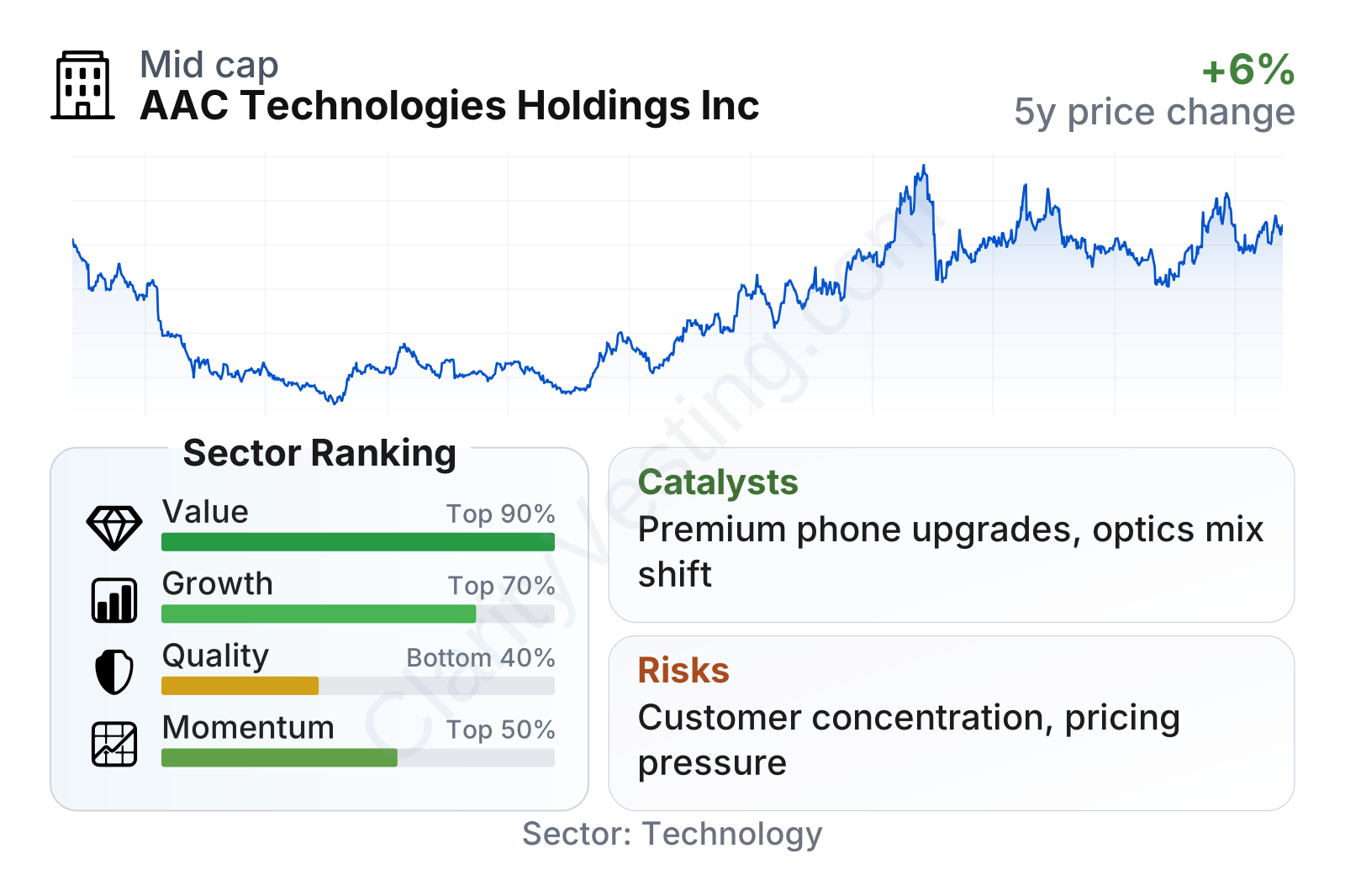
AAC sits in the mid-cap range at about $7 billion in market value, with share-price volatility somewhat above the broader market. The stock’s longer-term performance has recovered sharply from the 2022 trough, although recent trading has been less one-directional.
The overall metric mix is interesting. On valuation, AAC screens favorably versus much of the technology sector, helped by a modest earnings multiple and an unusually strong free cash flow yield. Growth indicators are also better than many sector peers, with revenue and earnings trends improving over multi-year periods. The weaker area is business quality: returns on invested capital and operating margins remain below stronger technology names, and leverage is somewhat higher than the sector median.
Growth
AAC operates in a sector that still has long-term relevance, even if it is no longer a straight-line growth market. Smartphones are mature, but the amount of high-value content inside each premium device keeps increasing. Better camera systems, richer sound, improved haptics, thinner mechanical designs, and more advanced materials all create room for suppliers that can deliver technically demanding parts at scale. Beyond phones, wearables, AI-enabled devices, tablets, and automotive electronics broaden the addressable market.
AAC’s strategy broadly fits that reality. Rather than depending only on basic acoustic components, the company has been moving toward a wider portfolio with optics, precision structures, and higher-end solutions. That is important because it can increase revenue per device and make customer relationships harder to replace. The company’s continued willingness to spend heavily on research and development also supports the idea that management is trying to compete on product complexity, not only price.
The revenue trend shows a business that can swing with industry cycles, but the latest phase has been much stronger. After a deep contraction in 2023, growth rebounded sharply in 2024 and remained positive into 2025. That pattern is consistent with a component supplier benefiting from customer restocking, product upgrades, and a better mix.
Cash generation deserves attention as well. Free cash flow remains positive and sizable, which gives AAC more flexibility to fund capital spending, support research, and manage debt. For a hardware supplier, that matters because growth often requires both engineering investment and production capacity.
As for catalysts, several stand out. First, premium smartphone upgrades can lift content demand in acoustics, haptics, and camera-related parts. Second, automotive applications could become a larger contributor over time, especially where precision components and sensing-related technologies are needed. Third, if optics execution continues to improve, AAC could gain a more meaningful position in higher-value imaging modules rather than relying mainly on mature product lines.
Recent company reporting also points to stronger profitability and improved operating leverage after the prior downturn. That is not a guarantee of a sustained upcycle, but it does suggest the company entered 2026 from a healthier base than it had a couple of years earlier.
Risks
This article is for informational purposes only and does not constitute financial advice. Some content is AI-generated. See Disclaimer


