Stock Analysis · Arcos Dorados Holdings Inc (ARCO)
Overview
Arcos Dorados Holdings Inc. is the largest independent McDonald’s franchisee in the world by number of restaurants. The company operates and franchises McDonald’s restaurants across Latin America and the Caribbean, running day-to-day restaurant activities such as food preparation, staffing, local marketing, and store operations under the McDonald’s brand. This business is typically driven by customer traffic, average ticket size, menu pricing, and the balance between in-restaurant dining, drive-thru, delivery, and digital ordering.
From a revenue standpoint, Arcos Dorados mainly generates sales directly from company-operated restaurants (food and beverage sales to customers). A smaller portion generally comes from franchised restaurants (fees and royalties from franchisees) and other restaurant-related income (which can include things like rent and service income, depending on the structure disclosed in filings). Specific percentage splits can vary by year and are best confirmed in the company’s annual report segment disclosures.
The overall profit structure is shaped by high “cost of revenue” (food ingredients, packaging, and restaurant labor tied to sales) and significant operating costs such as rent, utilities, and administrative expenses. Over recent years, total revenue expanded meaningfully, while net income fluctuated as costs, taxes, and interest expenses changed alongside inflation and currency dynamics across the region.
Across the years shown, total revenue increased from about $2.66B (2021) to about $4.68B (2025). Operating income also rose over that span (about $127M to about $375M), while interest expense remained a recurring cost (roughly $32M–$50M range in the years displayed). Net income increased overall from about $45M (2021) to about $212M (2025), with a dip in 2024 (about $149M) that highlights how profitability can move year to year even when sales are higher.
Key Figures
| Metric | Value | Industry ⓘ |
|---|---|---|
| Date | Mar 23, 2026 | |
| Context | ||
| Sector | Consumer Cyclical | |
| Industry | Restaurants | |
| Market Cap ⓘ | $1.62B | |
| Beta ⓘ | 0.47 | |
| Fundamental | ||
| P/E Ratio ⓘ | 6.56 | 28.03 |
| Profit Margin ⓘ | 4.53% | 7.24% |
| Revenue Growth ⓘ | 10.70% | 7.60% |
| Debt to Equity ⓘ | 291.43% | 93.31% |
| PEG ⓘ | 0.54 | |
| Free Cash Flow ⓘ | $11.22M | |
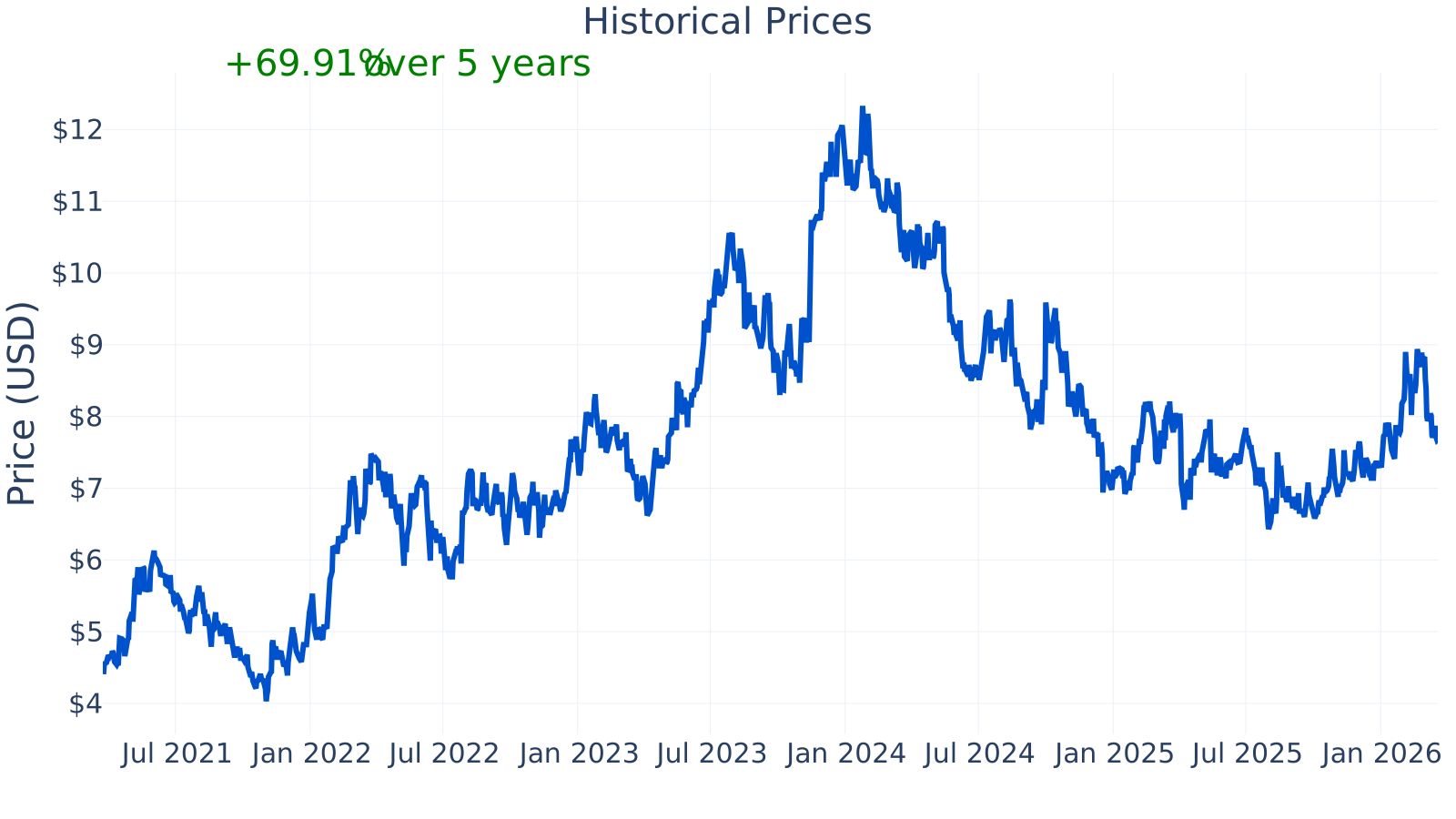
Arcos Dorados’ market capitalization is about $1.62B, placing it among smaller publicly traded restaurant companies. The stock’s beta of ~0.47 indicates it has historically moved less than the broader U.S. stock market on average, though company-specific and country-specific events can still cause sharp swings. The P/E ratio is ~6.6 versus an industry median near ~28.0, meaning the market is valuing each dollar of current earnings at a much lower multiple than the typical company in its restaurant peer group. Profit margin is ~4.5% compared with an industry median near ~7.2%, showing thinner profitability than many peers. Year-over-year revenue growth is ~10.7% versus an industry median near ~7.6%, indicating faster recent sales growth than the typical peer. Debt-to-equity is ~291% versus an industry median near ~93%, reflecting meaningfully higher leverage than most peers. Free cash flow over the trailing twelve months is positive at roughly $11.2M, but it is low relative to the company’s size and has been volatile over time.
Growth (Medium)
Quick-service restaurants are a mature category globally, but Arcos Dorados’ footprint in Latin America adds a different growth profile than many U.S.-focused peers. The region has a large addressable customer base, ongoing restaurant development potential in some markets, and long-term tailwinds tied to urbanization and the continued normalization of delivery and digital ordering. At the same time, the industry is highly competitive and sensitive to consumer purchasing power, which can swing with inflation, employment, and currency movements.
Strategically, the company’s long-run growth logic is straightforward: expand the restaurant base selectively, raise average check through pricing and menu mix, grow digital and delivery channels, and improve restaurant-level efficiency. Because Arcos Dorados operates under the McDonald’s brand system, it can benefit from global menu innovation and brand marketing while adapting pricing and promotions locally.
Revenue growth was extremely strong in 2021–2023 (often well into double digits, and in some quarters far higher), then slowed materially in 2024 (including a slightly negative quarter), before re-accelerating to about 10.7% by the end of 2025. This pattern can reflect a mix of tougher comparisons after a rebound period, macroeconomic variability across operating countries, and currency translation effects that can meaningfully impact reported U.S. dollar results.
Free cash flow has been uneven. It was positive in 2021–2023 (peaking around $164M in 2022), then turned negative in 2024 and 2025 (around -$37M and -$52M respectively, based on the points shown), and more recently is modestly positive on a trailing basis (about $11M in the latest metrics). For a restaurant operator, this line can move with capital spending cycles (new restaurant openings and remodels), working capital swings, and short-term profitability changes. For long-term context, investors typically track whether free cash flow becomes consistently positive across cycles while the store base and sales expand.
Risks (High)
Arcos Dorados’ biggest risks are closely tied to its geography and capital structure. Operating across multiple Latin American countries means results can be affected by inflation, currency devaluations versus the U.S. dollar, changes in wage and labor regulation, and shifts in consumer demand during economic slowdowns. Because food and labor are major cost items, periods of cost inflation can pressure restaurant margins if pricing actions lag behind costs or if consumers trade down.
A second central risk is leverage. Restaurant businesses can use debt to fund expansion and remodels, but higher leverage increases sensitivity to interest rates and reduces flexibility during downturns.
Debt-to-equity is about 291% in the latest metrics, well above the restaurant industry median near 93%. The longer-term series shows leverage declining substantially from very elevated levels earlier in the period, but it remains high relative to peers. This can amplify outcomes: it may help returns in strong periods, but it can also make profitability and equity value more sensitive when conditions deteriorate.
Profitability is another risk area. While the company is profitable, margins have been below typical industry levels, leaving less cushion if costs rise or sales weaken.
Net profit margin is about 4.5% versus an industry median around 6.9% in the latest reading. The trend line shows a recovery from losses in 2021 to consistently positive margins afterward, but still generally below peer medians. For a long-term view, a key question is whether scale, digital mix, and operating discipline can lift margins closer to peers without sacrificing demand.
On competitive positioning, Arcos Dorados has meaningful advantages: it runs a very large McDonald’s platform in the region (scale in purchasing, marketing execution, operational know-how) and benefits from one of the most recognized consumer brands globally. However, it does not operate in a monopoly. Competition comes from other global quick-service chains (for example Burger King and KFC), strong local players, and fast-growing delivery-first and convenience offerings. The company’s relative position depends on execution in value pricing, speed of service, digital experience, and consistent restaurant standards across diverse markets.
Valuation
Valuation is often discussed using multiples such as the price-to-earnings (P/E) ratio, which compares the stock price to the company’s earnings. A lower P/E than peers can point to lower market expectations, higher perceived risk, or more cyclical/volatile earnings. It can also reflect differences in leverage, country risk, and currency exposure compared with restaurant companies that earn most of their profits in the U.S. or other more stable currencies.
The company’s P/E ratio is around 6.6 in the latest metrics, versus an industry median near 28.0. Historically (based on the plotted period), Arcos Dorados’ P/E has often been below the peer median, and it declined to the lowest point shown by late 2025. Interpreting this gap requires context: the company shows positive earnings and decent recent revenue growth, but it also carries higher leverage than peers and operates in markets with higher macro and currency volatility. Those factors commonly lead to lower valuation multiples versus restaurant businesses with steadier cash flows and lower financial risk.
Conclusion
Arcos Dorados is a large-scale operator of a globally recognized restaurant brand across Latin America and the Caribbean, with revenue growth that has re-accelerated recently and a multi-year record of positive net income after earlier losses. The business model is relatively straightforward—selling food and beverages at high volume—while long-term outcomes depend on execution, cost control, and the economic backdrop in the countries where it operates.
From a fundamentals perspective, the main balancing factors are clear. On the supportive side: scale, brand strength through McDonald’s, and revenue growth that can benefit from ongoing modernization and digital adoption. On the cautionary side: higher leverage than typical restaurant peers, thinner net margins than the industry median, and free cash flow that has been volatile and at times negative during recent periods. The valuation picture (notably the low P/E versus peers) aligns with this mixed profile: it suggests the market is applying a significant discount that may be linked to these risks and the company’s operating environment.
Sources:
- SEC EDGAR — Arcos Dorados Holdings Inc. annual reports (Form 20-F) and other filed reports
- Arcos Dorados Holdings Inc. Investor Relations — Annual reports and shareholder materials (company-hosted)
- Wikipedia — “Arcos Dorados Holdings” (basic company background)
This article is for informational purposes only and does not constitute financial advice. Some content is AI-generated. See Disclaimer


