Stock Analysis · MakeMyTrip Limited (MMYT)
Overview
MakeMyTrip Limited (NASDAQ: MMYT) is an online travel company focused primarily on the Indian travel market. Through its websites and mobile apps, it helps customers search, compare, and book travel products such as flights, hotels, holiday packages, and ground transportation. The company generally operates as an intermediary: it brings travelers and travel suppliers together and earns fees/commissions and other booking-related revenue rather than owning airlines or hotels.
In practice, the business is built around high-frequency transactions (for example, air tickets) and higher-value trips (for example, hotels and packages). Over time, improving the booking experience, building brand recognition, and encouraging repeat use (especially through mobile) are central to how online travel platforms try to grow.
Public filings commonly describe revenue in a few broad buckets rather than a simple “product price × units” model. For MakeMyTrip, the main revenue streams are typically organized around:
- Air ticketing (fees/commissions and related income from flight bookings)
- Hotels and packages (commissions and service fees from hotel bookings and packaged travel)
- Bus and other services (ground transport, ancillary travel services, and other booking-related income)
The exact split can shift year to year with travel demand patterns and the company’s mix between flights and lodging.
Across the last several fiscal years shown, total revenue increased materially (from about $163.4M in FY2021 to about $978.3M in FY2025). Over the same period, operating income moved from negative (about -$56.6M in FY2021) to positive (about $132.8M in FY2025), illustrating the operating leverage that can appear when a scaled platform grows revenue faster than overhead.
Key Figures
| Metric | Value | Industry ⓘ |
|---|---|---|
| Date | Feb 08, 2026 | |
| Context | ||
| Sector | Consumer Cyclical | |
| Industry | Travel Services | |
| Market Cap ⓘ | $5.43B | |
| Beta ⓘ | 0.62 | |
| Fundamental | ||
| P/E Ratio ⓘ | 109.81 | 21.78 |
| Profit Margin ⓘ | 5.46% | 10.37% |
| Revenue Growth ⓘ | 10.60% | 10.60% |
| Debt to Equity ⓘ | -593.42% | 96.47% |
| PEG ⓘ | -0.21 | |
| Free Cash Flow ⓘ | $223.94M | |
At the latest snapshot, MakeMyTrip’s market capitalization is about $5.43B and the stock’s beta is 0.62 (a measure often used to describe how much the stock has moved relative to the broader market). Profit margin is about 5.46%, below the displayed industry median of 10.37%. Year-over-year revenue growth is about 10.6%, in line with the displayed industry median (10.6%). Trailing free cash flow is about $223.9M. The trailing P/E ratio is about 109.8, well above the displayed industry median of 21.8. The debt-to-equity figure is shown as negative at the latest point, which often happens when accounting equity is negative (or near zero), making the ratio less intuitive to interpret on its own.
Growth (Medium)
Online travel is structurally supported by long-term shifts such as increasing internet penetration, mobile-first purchasing, and consumers becoming more comfortable buying services digitally. In that setting, large platforms typically aim to grow by adding inventory (more hotels/rooms, routes, and partners), improving conversion (turning searches into bookings), and increasing repeat usage through loyalty features and better customer experience.
MakeMyTrip’s recent financial trajectory indicates that growth has come alongside a move toward stronger profitability and cash generation. Revenue growth has moderated over time from very high post-pandemic recovery rates to more “normalized” levels, which is typical after a demand rebound.
Year-over-year revenue growth declined from unusually high levels in earlier periods to around the low double-digits most recently (about 10.6% at the latest point). This pattern is consistent with travel demand moving from recovery-driven growth toward steadier expansion.
Cash generation is often an important cross-check for online platforms because it reflects both profitability and working-capital dynamics. Positive and rising free cash flow can give a company more flexibility to invest in marketing, product, and partnerships while still strengthening its balance sheet.
Trailing twelve-month free cash flow rose from near break-even in FY2022 (about -$0.6M) to about $185.3M in FY2025, and the latest metric snapshot shows about $223.9M. That direction suggests improved operating performance and higher cash conversion over time.
Potential catalysts (in the neutral, factual sense) for companies in this space typically include continued travel demand growth, share gains from offline-to-online booking, improved hotel supply depth, and better monetization of repeat customers. The strength of these factors depends on competitive intensity and overall consumer travel spending.
Risks (High)
Travel is cyclical. Demand can fall quickly in recessions, during spikes in fuel prices that raise ticket costs, or due to geopolitical events and public-health disruptions. Because online travel agencies often have meaningful fixed costs (technology, headcount, brand/marketing), sharp volume declines can pressure earnings.
Competition is a central risk. Online travel platforms compete on price transparency, user experience, customer service, app performance, and supplier relationships. Suppliers (airlines, hotels) can also push direct bookings through their own websites and apps, which may reduce intermediary volumes or increase marketing costs for platforms.
Balance sheet and leverage are worth monitoring, but some standard ratios can be misleading if equity becomes very small or negative due to accounting effects. That appears relevant here given the latest debt-to-equity reading.
From FY2021 through FY2025 (most quarters shown), debt-to-equity was relatively low (roughly in the 20%–27% range), generally below the displayed industry median in those periods. In FY2025, the ratio shows large swings (including very high and then negative values), which can occur when equity changes sharply and makes the ratio harder to interpret mechanically. In such cases, other balance-sheet measures in filings (cash, total debt, and equity level) typically provide clearer context than the ratio alone.
Profitability is another key risk area because online travel companies can see margins change with marketing intensity, product mix (air vs. hotels), and supplier commissions.
Profit margin improved substantially from large losses in FY2021 (about -71.0%) to positive profitability in more recent periods. However, margins also became more volatile: they peaked around 27.7% in FY2024 and then declined to about 5.46% most recently, which is below the displayed industry median (about 10.01%). This suggests that while the company has achieved profitability, maintaining higher margins may depend on pricing discipline, marketing efficiency, and competitive dynamics.
Competitive positioning in online travel is often tied to brand trust, scale, supply breadth, and technology. MakeMyTrip is widely associated with the Indian online travel market, but it operates in a field that also includes global travel platforms and regional players, as well as direct supplier channels. A practical way to track competitive strength over time is to monitor trends in revenue growth, marketing expense efficiency (as disclosed in filings), repeat behavior/loyalty metrics (if disclosed), and margin stability.
Valuation
Valuation is often discussed using multiples such as price-to-earnings (P/E). A higher P/E can be consistent with expectations of faster growth or higher future profitability, but it also means the market is placing a larger value on each dollar of current earnings.
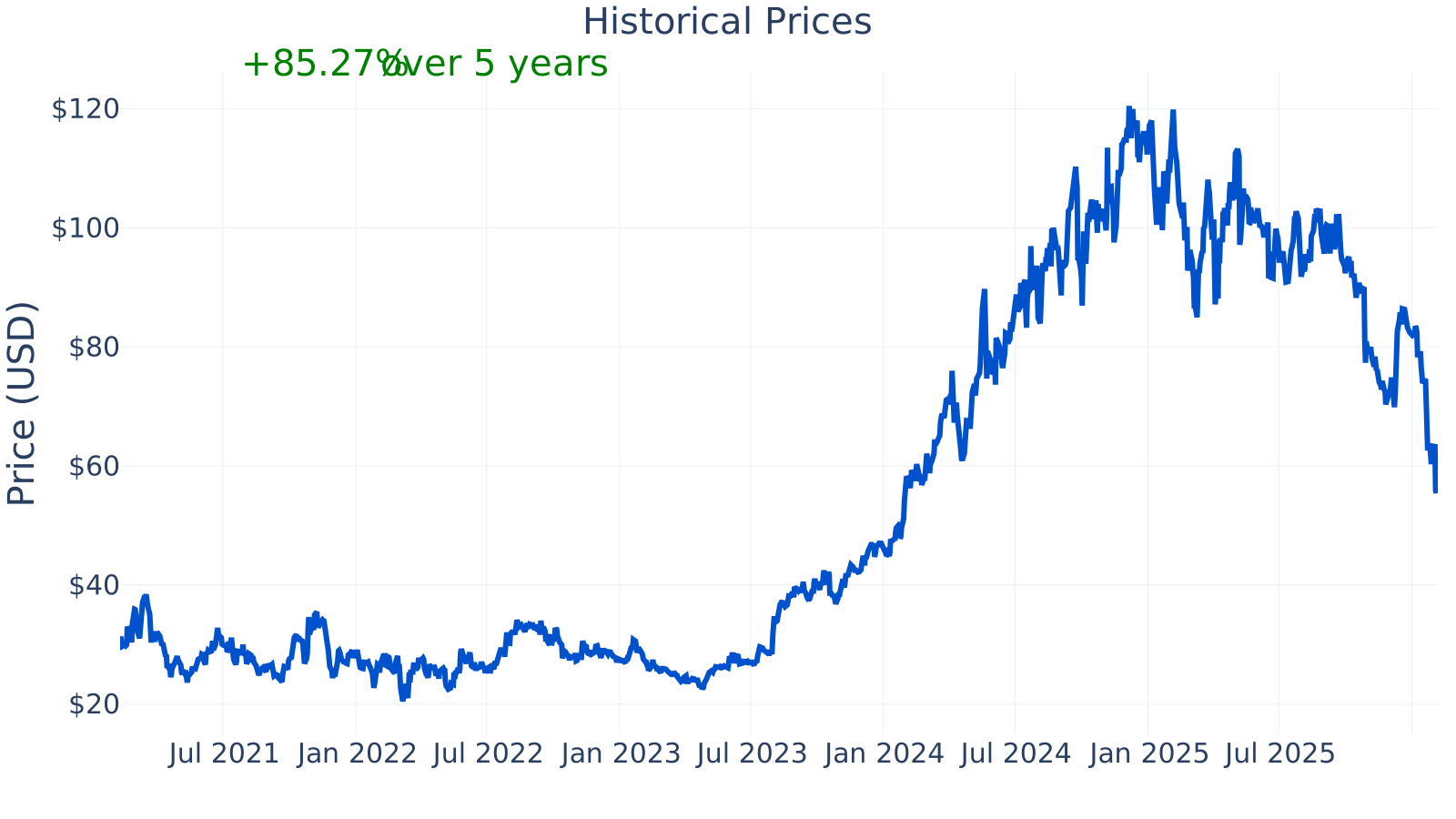
MakeMyTrip’s latest trailing P/E is about 109.8, compared with a displayed industry median around 21.8. The historical series also shows the company trading at elevated P/E levels in many recent periods (for example, above 100 in parts of 2023–2025), indicating that the stock price has often implied optimistic expectations relative to typical industry valuations. This matters because if growth slows, margins compress, or competition intensifies, high-multiple stocks can be more sensitive to changes in expectations.
In context, the company shows meaningful progress in revenue scale, a shift into sustained profitability, and growing free cash flow. At the same time, the combination of moderate recent revenue growth (around low double-digits) and a high P/E multiple implies that valuation depends heavily on continued execution and the market’s confidence that profitability and cash generation can expand further over time.
Conclusion
MakeMyTrip operates a scaled online travel platform focused on India, earning primarily from booking-related fees and commissions across air, hotels/packages, and other travel services. Over several years, it expanded revenue significantly and improved operating results, moving from operating losses to operating profits and generating substantial positive free cash flow.
The key long-term questions are less about whether people will keep traveling (they likely will, though cyclically) and more about how efficiently the company can grow in a competitive marketplace where suppliers and rival platforms constantly push for customer attention. Current valuation indicators (notably a high P/E relative to industry medians) suggest that the market is embedding sizable expectations, which increases the importance of monitoring margin durability, marketing efficiency, and the stability of cash generation through different travel cycles.
Sources:
- U.S. SEC EDGAR — MakeMyTrip Limited filings (Form 20-F, Form 6-K)
- MakeMyTrip Limited Investor Relations — SEC filings and shareholder materials (company website)
- Wikipedia — “MakeMyTrip” (basic company background)
This article is for informational purposes only and does not constitute financial advice. Some content is AI-generated. See Disclaimer


