Stock Analysis · Globant SA (GLOB)
Overview
Globant S.A. is a global information technology services company that helps organizations design, build, and modernize digital products and customer experiences. In practical terms, it provides teams and expertise for software engineering, cloud work, data and AI-related implementations, and digital transformation programs. The company operates with delivery talent distributed across multiple geographies, which is common in IT services and consulting-style business models.
Globant’s revenue is primarily service-based (fees for professional services delivered to clients). In its public reporting, revenue is commonly discussed by geography and/or industry verticals rather than by “product” lines, and the exact mix can shift over time as client demand changes. A simple way to think about the revenue engine is:
- Digital engineering and software development services (building and maintaining applications and platforms)
- Digital transformation programs (modernizing systems, processes, and customer experiences)
- Data, AI, and cloud-related work (implementing and operating modern data stacks and cloud infrastructure)
- Ongoing managed work (longer-running engagements and support tied to the above)
The business model depends on winning client engagements, staffing them efficiently, and maintaining strong utilization (keeping teams billable) while controlling labor costs and overhead.
From 2021 to 2025, total revenue increased from about $1.30B to about $2.45B. Over the same span, operating income and net income rose through 2024 but fell in 2025 (operating income about $179M in 2025 vs. about $254M in 2024; net income about $103M in 2025 vs. about $166M in 2024). This points to margin pressure in the most recent year, even as revenue remained higher than earlier years.
Key Figures
| Metric | Value | Industry ⓘ |
|---|---|---|
| Date | Mar 02, 2026 | |
| Context | ||
| Sector | Technology | |
| Industry | Information Technology Services | |
| Market Cap ⓘ | $2.19B | |
| Beta ⓘ | 1.17 | |
| Fundamental | ||
| P/E Ratio ⓘ | 22.72 | 20.58 |
| Profit Margin ⓘ | 4.19% | 4.91% |
| Revenue Growth ⓘ | -4.70% | 5.85% |
| Debt to Equity ⓘ | 22.62% | 60.43% |
| PEG ⓘ | 1.67 | |
| Free Cash Flow ⓘ | $211.69M | |
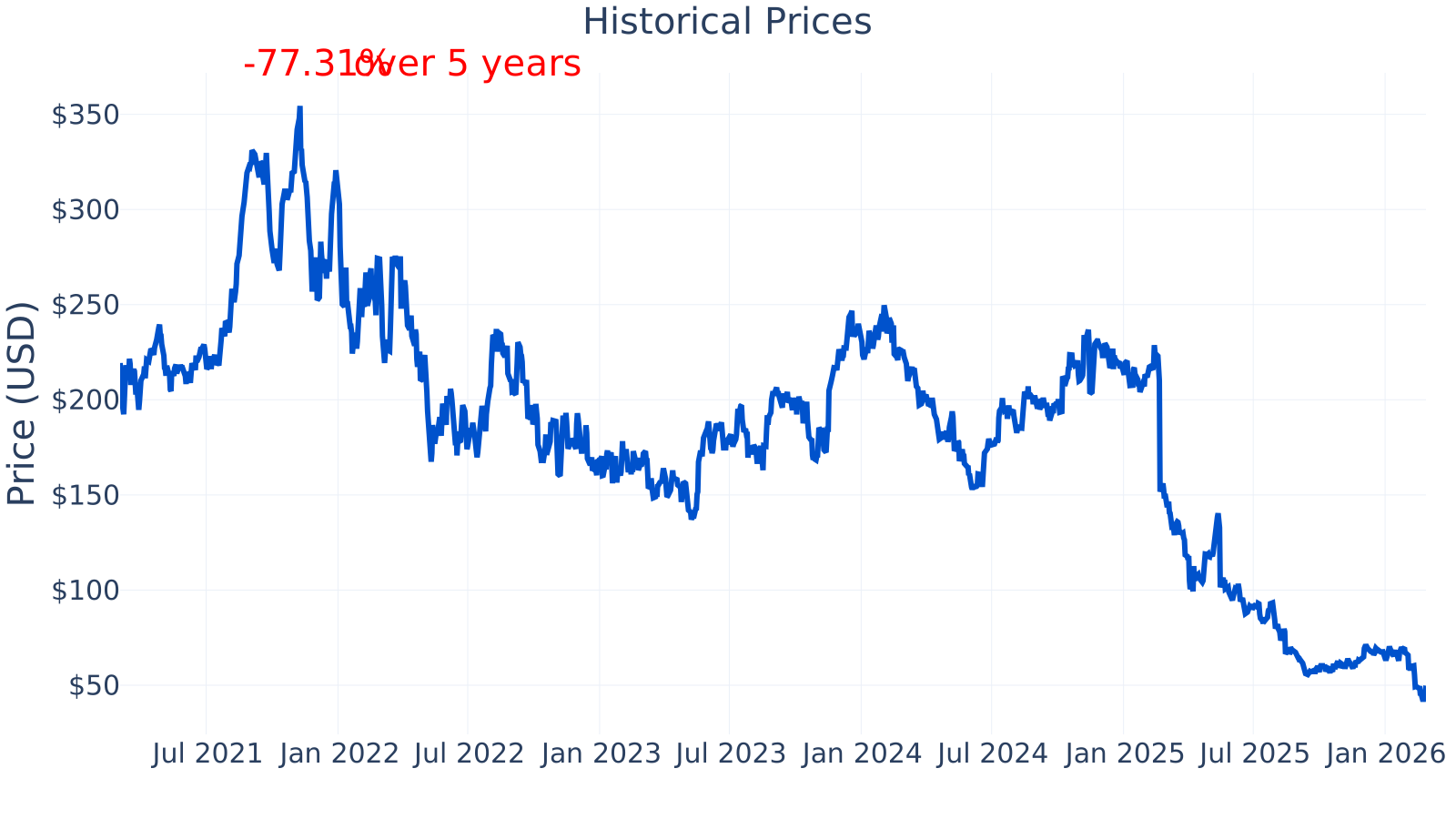
Globant’s market capitalization is about $2.19B and its beta is about 1.17, which indicates the stock has historically moved somewhat more than the broader market. The current P/E ratio is about 22.7 versus an industry median near 20.6, while the net profit margin is about 4.19% versus an industry median near 4.91%. Year-over-year revenue growth is currently negative (about -4.7%) compared with an industry median around +5.85%. Debt-to-equity is about 22.6% versus an industry median around 60.4%, suggesting a comparatively lighter balance-sheet leverage profile. Free cash flow over the trailing twelve months is about $211.7M.
Growth (medium)
The company operates in IT services, a broad industry tied to enterprises continually investing in software, cybersecurity, cloud migration, data platforms, and customer-facing digital experiences. Demand tends to be durable over long periods because technology modernization is recurring rather than “one-and-done.” However, this industry is also cyclical in the short run: client spending can slow when budgets tighten, projects get delayed, or companies reduce discretionary initiatives.
Globant’s strategy—positioning around digital transformation and specialized engineering talent—generally aligns with where enterprises spend money over time (modern apps, cloud, and data/AI-related projects). The main growth “catalysts” in an IT services model typically come from expanding work with existing clients (more projects, larger scopes), adding new large clients, and improving utilization and pricing as demand conditions strengthen.
Revenue growth has decelerated meaningfully over the last several years, moving from very high growth rates in 2021–2022 to low single digits in 2025, ending the latest period at approximately -4.7% year-over-year. That shift is important for long-term owners because IT services valuations and profitability often look very different when growth slows.
Free cash flow (a cash-based measure after operating needs and capital spending) has remained positive across the periods shown, ranging from about $131M to $266M, most recently about $212M. Consistent positive free cash flow can provide flexibility for hiring, acquisitions, and balance sheet resilience, although the trend also shows variability rather than a steady upward line.
Risks (high)
A key risk for Globant is that the business is fundamentally people-driven: costs are heavily tied to compensation, and profitability depends on keeping teams utilized and billing at healthy rates. When demand slows, utilization can fall and margins can compress quickly. The latest margin profile (net margin near 4.2%) indicates relatively limited cushion compared with periods when profitability was higher.
Competition is intense. Globant competes with large global IT services firms and consultancies (such as Accenture, Tata Consultancy Services, Infosys, Wipro, Cognizant, EPAM, Capgemini) as well as many smaller regional specialists. Larger competitors may have deeper client relationships, broader service catalogs, and more scale to absorb pricing pressure. In this landscape, competitive advantages tend to be “softer” and execution-based—reputation, delivery quality, specialized expertise in certain domains, and the ability to attract and retain talent—rather than a single protected technology.
Another risk is client concentration and project-based variability (common in IT services): results can be affected by the timing of large project starts/stops, scope reductions, or procurement-driven price negotiations. In addition, because delivery work is performed across countries and currencies, foreign exchange movements and local labor market dynamics can influence results.
Debt-to-equity has risen from roughly 8%–12% in 2021–2022 to about 22.6% most recently, but it remains well below the industry median (around 60%). This suggests leverage is not the dominant balance-sheet risk compared with many peers, even though the upward trend is worth monitoring.
Net profit margin has declined from roughly 7%–8% in 2021–2023 to about 4.2% most recently, now slightly below the industry median. This reinforces that the current challenge is more about operating performance and pricing/utilization dynamics than about financial leverage.
Valuation
A common quick-check valuation metric for service companies is the price-to-earnings (P/E) ratio, interpreted alongside growth and profitability. Globant’s latest P/E is about 22.7, somewhat above the industry median near 20.6. Whether that is “high” or “low” in context depends heavily on whether revenue growth and margins stabilize and re-accelerate, because slower growth and thinner margins typically justify lower multiples than high-growth, high-margin periods.
Historically, Globant traded at much higher P/E levels earlier in the period shown (well above 100 at times in 2021), then compressed substantially over subsequent years. More recently, the P/E values shown are far closer to the industry median than they were earlier, implying the market has repriced expectations downward compared with the earlier high-growth phase.
Another reference point is the PEG ratio (P/E relative to expected growth), shown at about 1.67. Without relying on forecasts here, a higher PEG generally indicates the valuation multiple is less supported by growth compared with lower-PEG situations, which is consistent with the recent slowdown in reported revenue growth.
Conclusion
Globant is a technology services company focused on digital transformation and software engineering, operating in a long-lived industry supported by ongoing enterprise modernization needs. The company has produced multi-year revenue expansion and sustained positive free cash flow, and it currently shows relatively modest leverage compared with the industry median.
At the same time, the most recent fundamentals highlight meaningful near-term pressures: year-over-year revenue growth turned negative and net profit margins have compressed to the low single digits. In a competitive services market, future outcomes depend heavily on execution—client demand, pricing discipline, utilization, and the ability to deliver differentiated expertise at scale.
The current valuation (P/E around the low 20s) appears much closer to industry norms than in earlier years, suggesting the market is embedding more conservative expectations than during the prior high-multiple period. Understanding whether the business returns to steadier growth and recovers profitability is central to evaluating long-term compounding potential versus ongoing margin and demand risks.
Sources:
- SEC EDGAR — Globant S.A. Form 20-F (Annual Report)
- SEC EDGAR — Globant S.A. Form 6-K (Reports of Foreign Private Issuer)
- Globant Investor Relations — Annual Reports / SEC Filings archive
- Wikipedia — “Globant” (company overview and history)
This article is for informational purposes only and does not constitute financial advice. Some content is AI-generated. See Disclaimer


