Stock Analysis · Amdocs Ltd (DOX)
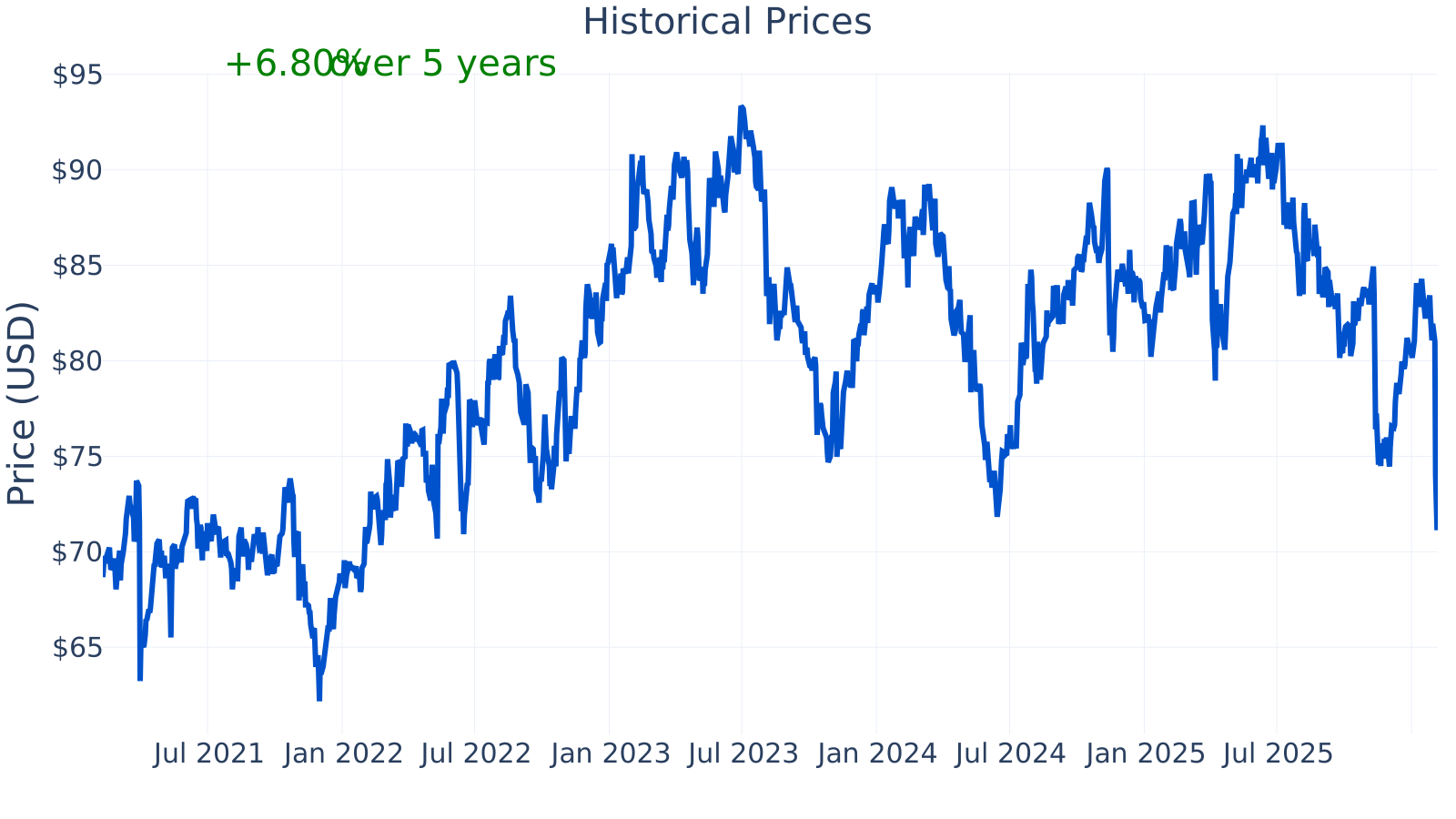
Overview
Amdocs Ltd (DOX) is a software and services company that primarily supports communications and media providers (such as wireless and broadband operators). Its products and teams help these companies run key “behind-the-scenes” functions like billing, customer management, ordering, and ongoing support operations. In practice, Amdocs is often involved in large, long-term projects where a telecom operator modernizes core systems, moves workloads to the cloud, and improves digital customer experiences.
The company generally earns money through a mix of software licenses or subscriptions, ongoing maintenance/support, and professional services (implementation, integration, and managed services). Amdocs also provides offerings tied to cloud migration and network-related software, which are commonly bundled into multi-year customer engagements.
In its SEC reporting, Amdocs presents revenue by business lines such as services and software-related revenue. Exact percentages can vary by fiscal year and depend on how the company groups and reports categories. In simplified terms, the revenue mix typically includes:
- Services (implementation, integration, and managed services tied to running and improving customer systems)
- Software licenses / subscriptions (access to Amdocs platforms and applications)
- Maintenance and support (ongoing support for installed software and solutions)
From the company’s income statement pattern over multiple fiscal years, a large share of revenue is associated with delivering services (reflected in a sizeable cost of revenue), while Amdocs also spends meaningfully on research and development to maintain and extend its product suite.
Across the years shown, total revenue rose from about $4.29B (FY2021) to $5.00B (FY2024), then declined to about $4.53B (FY2025). Operating income and net income moved within a relatively narrow band compared with revenue, which suggests profitability has been influenced not only by sales levels but also by cost control, project mix, and spending levels (including R&D and overhead).
Key Figures
| Metric | Value | Industry ⓘ |
|---|---|---|
| Date | Feb 07, 2026 | |
| Context | ||
| Sector | Technology | |
| Industry | Software - Infrastructure | |
| Market Cap ⓘ | $8.07B | |
| Beta ⓘ | 0.40 | |
| Fundamental | ||
| P/E Ratio ⓘ | 13.76 | 25.66 |
| Profit Margin ⓘ | 12.47% | 6.68% |
| Revenue Growth ⓘ | 4.10% | 15.20% |
| Debt to Equity ⓘ | 27.82% | 19.82% |
| PEG ⓘ | 1.05 | |
| Free Cash Flow ⓘ | $754.89M | |
Amdocs’ market capitalization is about $8.1B, and its beta (~0.40) indicates the stock has historically moved less than the broader U.S. market on average (lower volatility, though this can change). The company’s latest P/E ratio (~13.8) is below the industry median (~25.7) for its peer group, while its profit margin (~12.5%) is above the industry median (~6.7%). Recent year-over-year revenue growth (~4.1%) is below the industry median (~15.2%). The debt-to-equity (~27.8%) is somewhat higher than the industry median (~19.8%), and trailing twelve-month free cash flow is about $755M. The reported PEG ratio (~1.05) indicates the valuation multiple relative to growth assumptions is roughly near “1,” though PEG depends heavily on the growth estimate used and can shift as expectations change.
Growth (medium)
Amdocs operates in markets shaped by long-running telecom priorities: expanding and upgrading networks, reducing operating costs, improving digital self-service, and modernizing legacy IT stacks. These needs tend to persist through economic cycles because telecom operators must keep service quality high while controlling costs. That said, spending can be “lumpy,” since many initiatives are large programs that can be delayed, resized, or re-scoped.
Strategically, Amdocs positions itself around helping customers modernize core business systems and move to cloud-based approaches, while also supporting automation and improved customer experience. This direction aligns with where many large operators have been heading: replacing older systems, consolidating vendors, and using more standardized platforms to speed up product launches and reduce complexity.
The year-over-year revenue growth pattern shows that growth was stronger in 2022–2023, slowed during 2024, turned negative for several quarters, and then returned to positive territory (about 4.1% most recently). This type of swing is consistent with a project- and contract-driven model, where timing of large engagements and renewals can meaningfully affect reported growth rates.
Free cash flow has been consistently positive over the period shown, ranging from roughly $547M to $727M, and most recently around $755M on a trailing twelve-month basis. For long-term business quality, steady cash generation can matter because it helps fund research and development, acquisitions, and shareholder returns without relying solely on external financing.
Risks (medium)
Amdocs’ business is closely tied to spending decisions by a concentrated group of large telecom and media customers. Large contracts can be material, and the timing of project starts, completions, renewals, or scope changes can affect quarterly and annual results. This customer concentration dynamic is a common structural risk in enterprise software and services providers serving telecom operators.
Competition is another ongoing factor. Telecom software and services is a crowded space that includes large IT services firms and specialized telecom software vendors. Depending on the specific deal, Amdocs may compete with companies such as Infosys, Tata Consultancy Services (TCS), Accenture, IBM, and telecom-focused software providers like Netcracker (a business of NEC). Competitive pressure can show up in pricing, contract terms, and required investment levels to win and deliver programs.
In terms of competitive advantages, Amdocs’ positioning is typically associated with deep telecom domain expertise, long operating history in complex billing and customer systems, and the ability to deliver large-scale, multi-year transformations. Those qualities can support customer stickiness, but they do not eliminate the risk of displacement when customers modernize systems or consolidate vendors.
The debt-to-equity ratio has generally been in the low-to-mid 20% range for several years and most recently increased to about 27.8%. This is still moderate in absolute terms, but it is above the industry median shown (about 13.9% at the latest point). Higher leverage can reduce flexibility if operating conditions weaken, though the company’s ongoing cash generation can partially offset that risk.
Profit margin has fluctuated over time, declining from mid-teens levels earlier in the series to around 10–12% in more recent periods, and ending near 12.5%. Even with that variability, the company’s margin remains above the peer median shown for the same periods. Margin resilience can be a sign of pricing power and delivery discipline, but changes in project mix, wage inflation, or competitive pricing can push margins up or down.
Valuation
Amdocs’ current P/E ratio (~13.8) is below the industry median shown on the same chart (recently in the high-20s to low-30s range). Over the historical period displayed, Amdocs’ P/E has generally stayed in the mid-teens to low-20s, and it has typically remained below the peer median. A lower P/E can reflect market expectations of slower growth, higher uncertainty about future demand, or simply a preference for other names in the sector with faster expansion.
How “expensive” the stock looks depends heavily on what is assumed about future growth and stability. The company shows above-median profitability (relative to the peer median provided) and solid free cash flow generation, which can support valuation. On the other hand, the revenue growth rate shown is below the peer median, and the recent period included negative year-over-year quarters, which can weigh on how the market values the business.
Conclusion
Amdocs is an established provider of software and services that are central to how telecom operators bill customers, manage accounts, and run customer-facing operations. The business model tends to be built on large, complex, multi-year engagements, which can provide durability but can also create uneven growth patterns as contracts and project timing shift.
Based on the figures shown, Amdocs combines steady cash generation and profitability above the peer median, alongside slower recent growth than the peer median and a business profile exposed to customer concentration and competitive bidding. Its valuation multiple (P/E) appears lower than the peer median, which is consistent with a market view that the company’s growth outlook is more modest or less predictable than faster-growing software peers.
Sources:
- SEC EDGAR — Amdocs Ltd filings (Form 10-K, Form 10-Q)
- Amdocs — Investor Relations materials and press releases (company-hosted)
- Wikipedia — “Amdocs” (company overview and background)
This article is for informational purposes only and does not constitute financial advice. Some content is AI-generated. See Disclaimer


