Stock Analysis · Amdocs Ltd (DOX)
Overview
Amdocs Ltd (DOX) is a software and services company that primarily supports communications and media providers (such as wireless and broadband operators). Its products and teams help these companies run key “behind-the-scenes” functions like billing, customer management, ordering, and ongoing support operations. In practice, Amdocs is often involved in large, long-term projects where a telecom operator modernizes core systems, moves workloads to the cloud, and improves digital customer experiences.
The company generally earns money through a mix of software licenses or subscriptions, ongoing maintenance/support, and professional services (implementation, integration, and managed services). Amdocs also provides offerings tied to cloud migration and network-related software, which are commonly bundled into multi-year customer engagements.
In its SEC reporting, Amdocs presents revenue by business lines such as services and software-related revenue. Exact percentages can vary by fiscal year and depend on how the company groups and reports categories. In simplified terms, the revenue mix typically includes:
- Services (implementation, integration, and managed services tied to running and improving customer systems)
- Software licenses / subscriptions (access to Amdocs platforms and applications)
- Maintenance and support (ongoing support for installed software and solutions)
From the company’s income statement pattern over multiple fiscal years, a large share of revenue is associated with delivering services (reflected in a sizeable cost of revenue), while Amdocs also spends meaningfully on research and development to maintain and extend its product suite.
Across the years shown, total revenue rose from about $4.29B (FY2021) to $5.00B (FY2024), then declined to about $4.53B (FY2025). Operating income and net income moved within a relatively narrow band compared with revenue, which suggests profitability has been influenced not only by sales levels but also by cost control, project mix, and spending levels (including R&D and overhead).
Key Figures
| Metric | Value | Industry ⓘ |
|---|---|---|
| Date | Feb 07, 2026 | |
| Context | ||
| Sector | Technology | |
| Industry | Software - Infrastructure | |
| Market Cap ⓘ | $8.07B | |
| Beta ⓘ | 0.40 | |
| Fundamental | ||
| P/E Ratio ⓘ | 13.76 | 25.66 |
| Profit Margin ⓘ | 12.47% | 6.68% |
| Revenue Growth ⓘ | 4.10% | 15.20% |
| Debt to Equity ⓘ | 27.82% | 19.82% |
| PEG ⓘ | 1.05 | |
| Free Cash Flow ⓘ | $754.89M | |
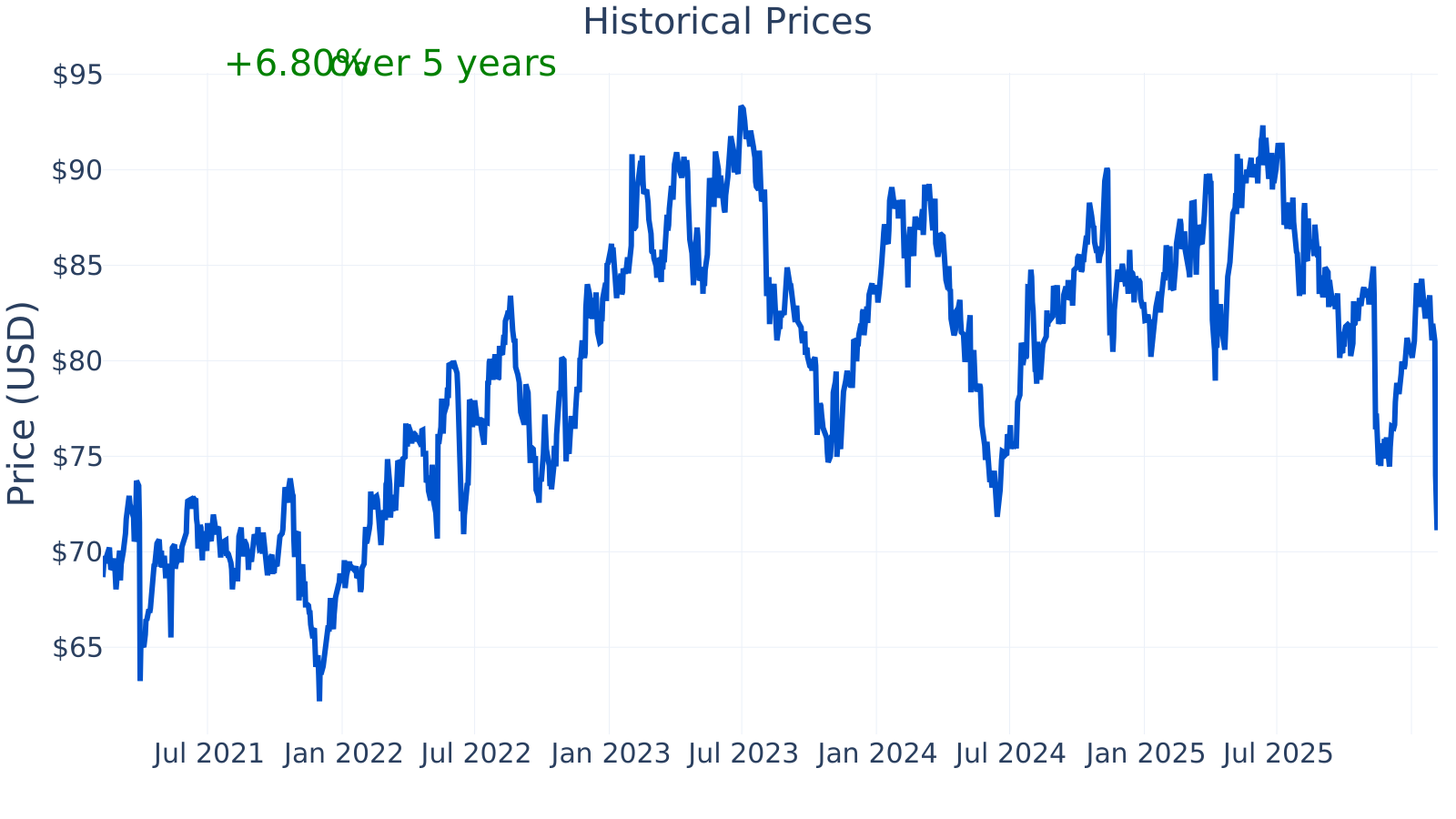
Amdocs’ market capitalization is about $8.1B, and its beta (~0.40) indicates the stock has historically moved less than the broader U.S. market on average (lower volatility, though this can change). The company’s latest P/E ratio (~13.8) is below the industry median (~25.7) for its peer group, while its profit margin (~12.5%) is above the industry median (~6.7%). Recent year-over-year revenue growth (~4.1%) is below the industry median (~15.2%). The debt-to-equity (~27.8%) is somewhat higher than the industry median (~19.8%), and trailing twelve-month free cash flow is about $755M. The reported PEG ratio (~1.05) indicates the valuation multiple relative to growth assumptions is roughly near “1,” though PEG depends heavily on the growth estimate used and can shift as expectations change.
Growth (medium)
Amdocs operates in markets shaped by long-running telecom priorities: expanding and upgrading networks, reducing operating costs, improving digital self-service, and modernizing legacy IT stacks. These needs tend to persist through economic cycles because telecom operators must keep service quality high while controlling costs. That said, spending can be “lumpy,” since many initiatives are large programs that can be delayed, resized, or re-scoped.
Strategically, Amdocs positions itself around helping customers modernize core business systems and move to cloud-based approaches, while also supporting automation and improved customer experience. This direction aligns with where many large operators have been heading: replacing older systems, consolidating vendors, and using more standardized platforms to speed up product launches and reduce complexity.
The year-over-year revenue growth pattern shows that growth was stronger in 2022–2023, slowed during 2024, turned negative for several quarters, and then returned to positive territory (about 4.1% most recently). This type of swing is consistent with a project- and contract-driven model, where timing of large engagements and renewals can meaningfully affect reported growth rates.
Free cash flow has been consistently positive over the period shown, ranging from roughly $547M to $727M, and most recently around $755M on a trailing twelve-month basis. For long-term business quality, steady cash generation can matter because it helps fund research and development, acquisitions, and shareholder returns without relying solely on external financing.
Risks (medium)
This article is for informational purposes only and does not constitute financial advice. Some content is AI-generated. See Disclaimer