Stock Analysis · Kodiak AI Inc (KDK)
Overview
Kodiak AI Inc (KDK) is a small-cap technology company classified in the Software - Infrastructure industry. In practical terms, companies in this category typically earn money by building and operating software platforms and tools that other organizations use as part of their core computing infrastructure (for example, software that supports data processing, connectivity, monitoring, cybersecurity, developer tooling, or other “behind-the-scenes” systems).
From the financial profile visible in the company’s results, Kodiak AI appears to be in a phase where it is still working to reach stable scale: annual revenue is relatively small compared with operating expenses, and profitability has been negative in recent periods. That combination is common for early-stage or transition-stage software companies, but it also means the long-term story depends heavily on execution (growing revenue while controlling costs) and on whether the company’s product offering proves durable in its target market.
Detailed revenue breakdown by product line or customer category (with percentages) is not provided in the information shown here. In many cases, that level of detail is disclosed in the company’s SEC filings (such as the annual report), often within segment reporting or revenue recognition notes. Without those disclosures included here, it is not possible to reliably rank revenue sources by size.
Across the periods shown, revenue is modest (about $16.9M in 2023 and $14.9M in 2024, then much lower at about $3.8M in 2025), while operating costs remain high. Research and development spending increased (about $39.5M in 2023 to $50.2M in 2025), and selling/general/administrative costs rose sharply in 2025 (to about $66.3M), which helps explain the widening losses.
Key Figures
| Metric | Value | Industry ⓘ |
|---|---|---|
| Date | Mar 28, 2026 | |
| Context | ||
| Sector | Technology | |
| Industry | Software - Infrastructure | |
| Market Cap ⓘ | $1.25B | |
| Beta ⓘ | -0.34 | |
| Fundamental | ||
| P/E Ratio ⓘ | N/A | 25.89 |
| Profit Margin ⓘ | N/A | 7.12% |
| Revenue Growth ⓘ | -92.30% | 15.80% |
| Debt to Equity ⓘ | -60.87% | 24.92% |
| PEG ⓘ | N/A | |
| Free Cash Flow ⓘ | -$156.50M | |
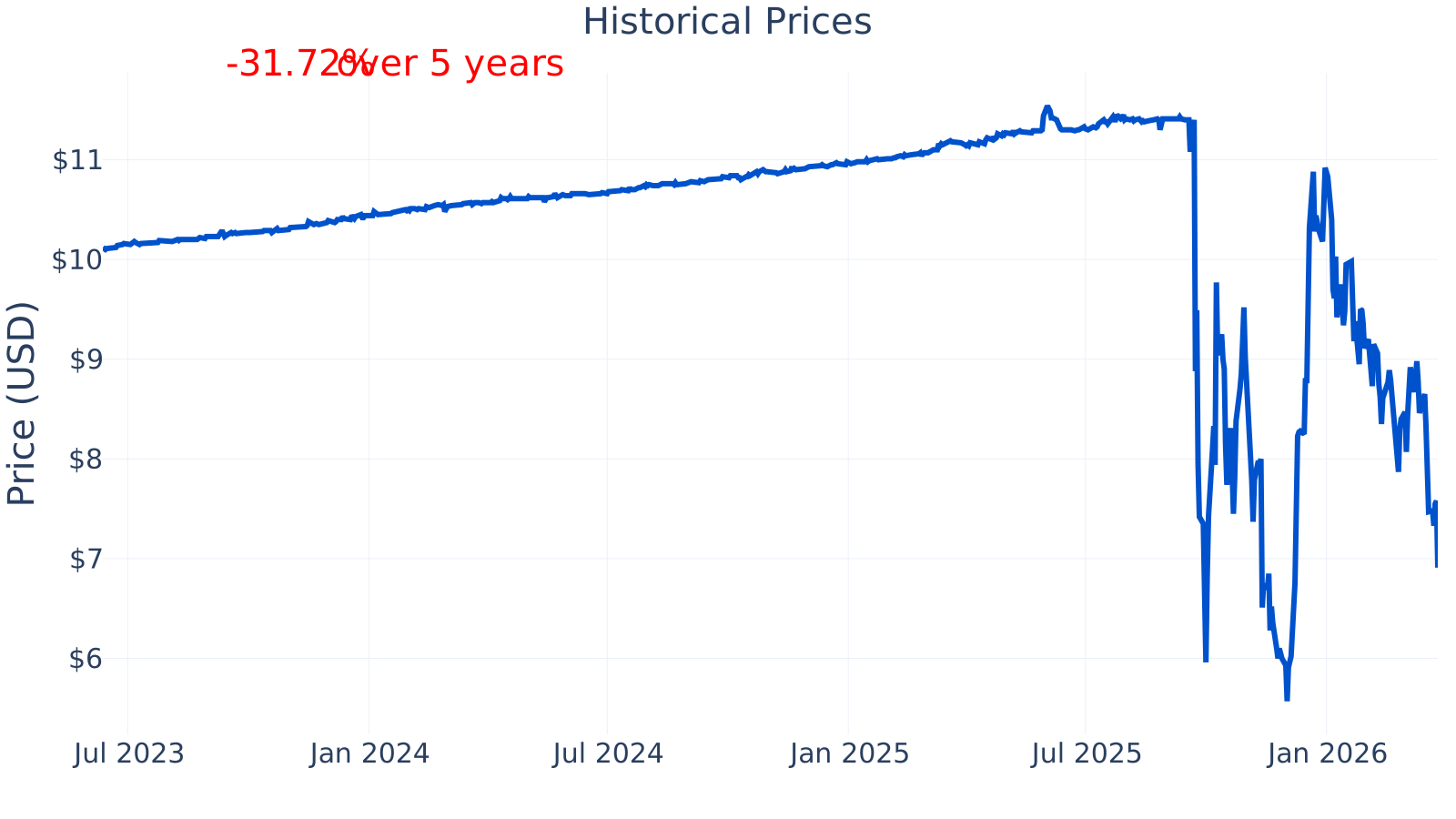
Kodiak AI’s market capitalization is about $1.25B. The company shows negative profitability versus a positive industry median (industry profit margin around 7.1%), and the latest year-over-year revenue growth shown is negative versus a positive industry median (industry median about 15.8%). Free cash flow over the trailing twelve months is also negative (about -$156.5M), which indicates the business has been using cash rather than generating it. The P/E ratio is not meaningful in the periods shown (displayed as 0), which is common when earnings are negative.
Growth (Medium)
Kodiak AI operates within software infrastructure, a part of the technology sector that has historically benefited from long-term demand for cloud computing, automation, and ongoing digitization across industries. As a category, infrastructure software can scale well if products become embedded in customers’ operations (often through subscriptions or usage-based contracts), but the category is also competitive and can require sustained investment in product development and customer acquisition.
For Kodiak AI specifically, the recent revenue pattern is mixed and then deteriorates: after a period of strong year-over-year growth in early 2025, growth slows and then turns sharply negative later in 2025. That kind of swing can occur when a company has a small revenue base, relies on a limited number of customers, experiences contract timing effects, or changes how it recognizes revenue. Regardless of the cause, it raises an important growth question: whether the company can establish a more consistent revenue engine.
Cash generation is another key part of sustainable growth. Negative free cash flow does not automatically mean a company cannot grow—many companies invest heavily before reaching scale—but it does mean growth may depend on continued access to financing and on management’s ability to convert investment into durable revenue.
Potential catalysts (in general terms for software infrastructure companies) typically include: signing larger multi-year customer contracts, expanding into adjacent product areas, improving retention and usage, or achieving a clear shift toward profitability and positive cash flow. Whether Kodiak AI has near-term catalysts of that type should be verified through its company filings and investor relations materials (for example, management discussion of pipeline, backlog, product milestones, and guidance).
Risks (High)
The most visible risk is financial performance. Profitability has been deeply negative in the periods shown, and the net loss in 2025 is substantially larger than prior years. When losses widen while revenue falls, it often signals either temporary disruption (such as customer concentration issues or pricing/contract changes) or structural challenges (product-market fit, competitive pressure, or execution problems). Either way, the path to stable margins becomes harder to assess without additional detail from filings.
The profit margin trend shown is significantly below the industry median, and it worsens materially over time. This gap implies Kodiak AI is not currently operating like a typical mature infrastructure software business, where recurring revenue and gross margins often support positive operating leverage. The company’s cost structure (R&D plus selling/administrative expenses) appears large relative to revenue, and the deterioration in 2025 suggests the company faced major headwinds or one-time impacts that should be explained in official reports.
Balance sheet risk is harder to interpret from the debt-to-equity ratio alone because the company’s ratio is negative in several periods. A negative debt-to-equity can happen when shareholder equity is negative (often due to accumulated losses), which can make the ratio less intuitive than for stable, profitable companies. In such cases, liquidity (cash balance), debt terms, and upcoming maturities become especially important items to review in filings.
Competition is another key risk. The “Software - Infrastructure” space contains many well-capitalized competitors, ranging from large platform companies to specialized providers. If Kodiak AI’s products compete against incumbents with broader distribution and deeper resources, sustaining pricing power and customer retention may be difficult unless the company has clear differentiation (for example, superior performance, unique features, regulatory moat, switching costs, or a strong ecosystem). Based on the financial profile shown—small revenue base, high spending, and weak margins—there is not enough evidence here to describe Kodiak AI as a category leader.
Valuation
Because the P/E ratio is not meaningful in the periods shown (displayed as 0), earnings-based valuation is not currently a useful tool for Kodiak AI. In these situations, market participants often look at other approaches such as revenue multiples, gross profit, customer metrics, or a clearly defined path to future profitability. Those metrics are not provided here, so the valuation discussion has to stay high-level and tied to what is observable: the company has a market capitalization around $1.25B while reporting negative free cash flow and negative profit margins.
The industry median P/E shown (around the high-20s to low-30s in the periods displayed) reflects that many peers are profitable. Kodiak AI’s lack of a meaningful P/E alongside widening losses suggests the company’s valuation is more dependent on expectations of future improvement than on current earnings power. Whether the current price level is justified therefore hinges on factors that must be confirmed in filings: the durability of its revenue model, the reasons for revenue decline in 2025, customer concentration, and credible milestones toward stabilizing margins and cash flow.
Conclusion
Kodiak AI operates in a technology category that can support long-term expansion, but the company’s recent financial trajectory shows elevated uncertainty. Revenue declines in 2025, sharply negative profit margins, and negative free cash flow indicate the business has not yet demonstrated the operating stability typically associated with mature infrastructure software companies.
From a long-term perspective, the key factual checkpoints are whether revenue can return to consistent growth, whether gross profit improves and operating expenses become better aligned with revenue, and whether cash usage moderates over time. Until those elements become clearer in the company’s official disclosures, Kodiak AI’s profile remains more dependent on execution and financing conditions than on established, repeatable profitability.
Sources:
- U.S. SEC EDGAR — Company filings for Kodiak AI Inc (KDK) (annual and quarterly reports, current reports)
This article is for informational purposes only and does not constitute financial advice. Some content is AI-generated. See Disclaimer