Stock Analysis · Zscaler Inc (ZS)
Overview
Zscaler Inc. (ZS) is a cybersecurity company focused on protecting users, devices, and data when they access applications and the internet. Instead of relying mainly on traditional on‑premises security hardware, Zscaler delivers its security services through a cloud platform. In practical terms, it acts as a secure “checkpoint” between employees (often working from anywhere) and the apps or websites they use, helping companies reduce exposure to cyber threats while supporting remote work and cloud adoption.
The business model is primarily subscription-based: customers pay recurring fees to use Zscaler’s platform and related services. This is common among software companies because it can create more predictable revenue over time, though results still depend on renewal rates, new customer wins, and expansion within existing accounts.
Public filings typically describe revenue as coming mainly from subscriptions (the core platform and modules) and a smaller portion from professional services (implementation and support). A precise percentage split is not included here because it can vary by period and would need to be taken from the most recent filed financial statements’ revenue note.
Main revenue streams (largest to smallest, as generally described in filings):
- Subscription revenue (recurring platform and security services)
- Professional services revenue (implementation, training, and support services)
Over the periods shown, total revenue increases substantially (from about $673M to about $2.67B), while operating income remains slightly negative in the latest year displayed. This combination is typical for a company emphasizing growth and product development, with sizeable operating expenses—especially research and development—while moving gradually toward break-even.
Key Figures
| Metric | Value | Industry ⓘ |
|---|---|---|
| Date | Mar 02, 2026 | |
| Context | ||
| Sector | Technology | |
| Industry | Software - Infrastructure | |
| Market Cap ⓘ | $23.44B | |
| Beta ⓘ | 1.02 | |
| Fundamental | ||
| P/E Ratio ⓘ | N/A | 24.58 |
| Profit Margin ⓘ | -2.25% | 6.79% |
| Revenue Growth ⓘ | 25.90% | 16.35% |
| Debt to Equity ⓘ | 84.90% | 26.59% |
| PEG ⓘ | 1.93 | |
| Free Cash Flow ⓘ | $943.74M | |
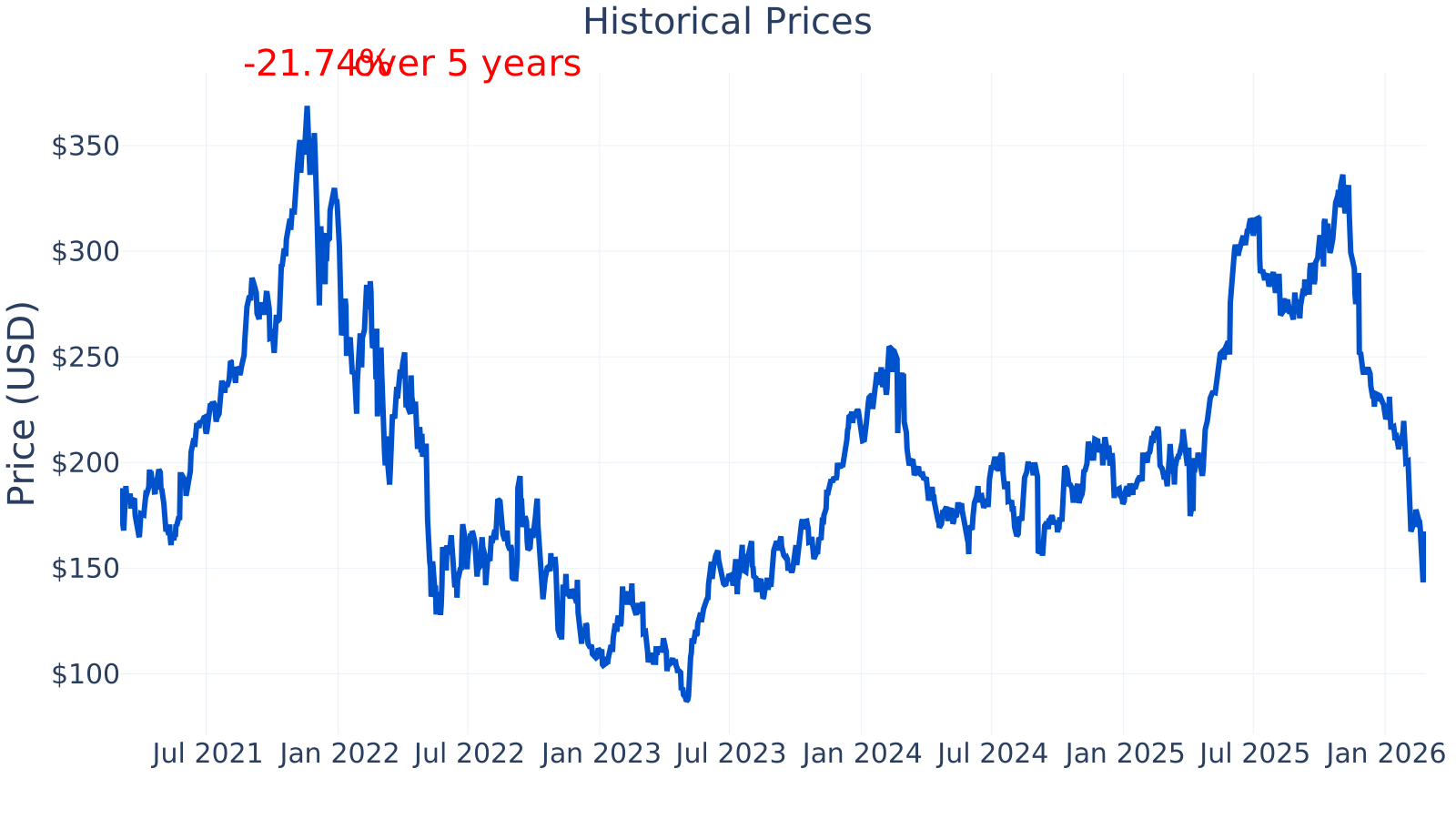
Zscaler’s market capitalization is about $23.44B, and its beta is ~1.02, indicating price movements that have been roughly in line with the broader market over time (though individual periods can differ). The company’s profit margin is about -2.3%, below the industry median of about 6.8%, meaning it is still slightly unprofitable on a net basis. At the same time, its year-over-year revenue growth is ~25.9%, higher than the industry median of about 16.4%. The company shows meaningful cash generation with ~$944M in trailing twelve-month free cash flow. Its debt-to-equity is ~84.9%, higher than the industry median of about 26.6%, which can matter when evaluating financial flexibility.
Growth (High)
Zscaler operates in cybersecurity, an area supported by long-term trends such as cloud migration, remote/hybrid work, and the steady increase in the frequency and impact of cyber incidents. As organizations rely more on cloud applications and distributed workforces, security tools that sit “in the cloud” and can be applied consistently across users and locations are often positioned as a practical fit for modern IT environments.
Strategically, Zscaler’s approach centers on delivering security as a cloud service, with customers adopting the platform and potentially expanding usage over time by adding more users, devices, or product modules. In general, recurring subscription models can amplify growth if renewal rates are strong and customers expand their deployments.
The chart shows revenue growth decelerating from very high rates earlier in the period (above 50–60%) toward the mid‑20% range more recently (about 25.9% in the latest point shown). Even with slowing growth, the most recent level remains above the industry median shown in the table, suggesting the company is still growing faster than many peers, though at a more mature pace than in its earlier years.
Free cash flow trends upward over time (from about $196M to about $944M). This can be a meaningful indicator for a subscription software business because it suggests the company is generating cash that can be used for reinvestment, acquisitions, debt management, or other corporate needs—despite net income still being slightly negative.
Risks (Medium-High)
A central risk is competitive pressure in cybersecurity. Large, well-resourced vendors and cloud-native specialists compete for enterprise security budgets. Pricing pressure, feature competition, and customer consolidation of security tools can affect growth rates, renewal economics, and sales efficiency over time.
Another key risk is profitability. While margins have improved significantly over the multi-year period shown, Zscaler remains slightly unprofitable on a net basis in the latest point displayed. Achieving and sustaining higher profitability can depend on controlling operating expenses (such as sales & marketing and R&D) while continuing to grow.
The profit margin improves markedly from deep losses earlier in the series (around -38%) to roughly -2.3% most recently. However, it is still below the industry median (about 6.7%), highlighting that Zscaler has not yet reached the typical net profitability level seen across the broader software infrastructure peer set.
Balance sheet structure is also relevant. Higher leverage can reduce flexibility during downturns or periods of slower growth, depending on how obligations are structured and how cash flow holds up.
Debt-to-equity declines substantially from very elevated levels earlier in the period (well above 100%) to about 84.9% most recently, but it remains higher than the industry median (about 24.5%). The direction of travel looks favorable, yet the relative level suggests leverage remains a factor to monitor.
Operational and external risks also matter in cybersecurity. A major product vulnerability, service outage, or security incident could harm reputation and customer trust. In addition, enterprise purchasing cycles can be sensitive to macroeconomic conditions, which may slow new deals or expansions even if long-term demand remains intact.
In terms of competitive positioning, Zscaler is widely associated with cloud-delivered security (often discussed in categories like secure access service edge / “SASE” and zero trust). Whether it is “the leader” depends on the exact segment definition and measurement method. Its competitive advantages often described in filings and company materials include a cloud-native architecture, a large installed base, and continued investment in product development.
Main competitors often include large platform and networking/security vendors as well as cloud-focused security providers, such as:
- Palo Alto Networks
- Cisco
- Fortinet
- Check Point Software
- Cloudflare
- Microsoft (security offerings within its broader platform)
Compared with these firms, Zscaler is more narrowly focused on cloud security services and is smaller in scale than the largest diversified vendors, which can be a strength (focus) but also a challenge (competition with broader bundles and large sales channels).
Valuation
For many companies, the price-to-earnings (P/E) ratio is a quick way to compare valuation. In Zscaler’s case, the P/E chart is not meaningful in the period shown because earnings are not consistently positive (and the displayed P/E values are effectively absent).
Because the company has had negative net income in the period shown, valuation discussions often shift toward other lenses such as revenue multiples, free cash flow generation, and the expected path to sustained profitability. A useful context point from the table is that the industry median P/E is in the high‑20s range, but Zscaler’s P/E is not directly comparable if earnings are negative or very small.
In practical terms, Zscaler’s valuation tends to rely on whether it can maintain above-average growth (relative to peers) while continuing progress toward durable profitability and strong cash generation. The combination visible here—~26% revenue growth, ~$944M free cash flow, and a slightly negative net margin—creates a mixed picture: strong operating momentum and cash generation, but not yet the profitability profile that makes earnings-based valuation straightforward.
Conclusion
Zscaler is a cloud-focused cybersecurity company built around recurring subscriptions, operating in an industry supported by long-term demand drivers. The company has shown substantial revenue expansion over multiple years and a strong upward trend in free cash flow, while net profitability has improved dramatically but remains slightly negative in the latest period shown.
The main areas to weigh when assessing the company over a long time horizon are (1) how effectively it can sustain growth as it becomes larger, (2) whether it can translate scale into consistent net profitability, and (3) how it performs amid intense competition from both specialized security firms and large diversified technology vendors. Balance sheet leverage has improved versus earlier periods but remains higher than the industry median, which may be relevant depending on future operating conditions.
Sources:
- SEC EDGAR — Zscaler, Inc. filings (Form 10-K, Form 10-Q)
- Zscaler Investor Relations — Shareholder letters, quarterly results materials, and press releases
- Wikipedia — “Zscaler” (basic company background)
This article is for informational purposes only and does not constitute financial advice. Some content is AI-generated. See Disclaimer